Review
doi: 10.1084/jem.20110367.
Epub 2011 Feb 28.
Mitochondrial reactive oxygen species drive proinflammatory cytokine production
Affiliations
- PMID: 21357740
- PMCID: PMC3058577
- DOI: 10.1084/jem.20110367
Item in Clipboard
Review
Mitochondrial reactive oxygen species drive proinflammatory cytokine production
J Exp Med.
.
Abstract
High levels of reactive oxygen species (ROS) are observed in chronic human diseases such as neurodegeneration, Crohn's disease, and cancer. In addition to the presence of oxidative stress, these diseases are also characterized by deregulated inflammatory responses, including but not limited to proinflammatory cytokine production. New work exploring the mechanisms linking ROS and inflammation find that ROS derived from mitochondria act as signal-transducing molecules that provoke the up-regulation of inflammatory cytokine subsets via distinct molecular pathways.
Figures
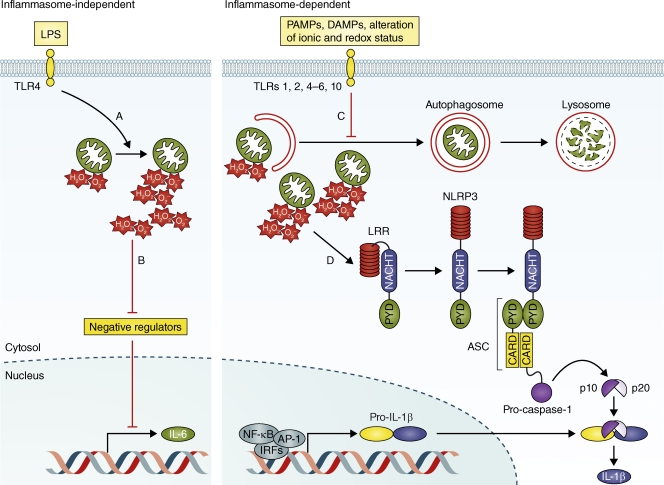
Putative mechanisms of ROS-dependent proinflammatory cytokine production in normal, healthy cells. During inflammasome-independent proinflammatory cytokine production (left), mtROS modulates the equilibrium between positive and negative regulators, which results in an increase in the rate of transcription of cytokines such as IL-6. Several steps in this pathway require further investigation. Specifically, how does activation of TLR4 by LPS result in an increase in ROS production from an individual mitochondrion (A), and how does mtROS inhibit negative regulators (e.g., MAPK phosphatases) of cytokine gene transcription (B)? Inflammasome-dependent proinflammatory cytokine production (right) requires inhibition of autophagy and mitophagy to increase the net amount of mtROS within the cell. The mechanism of this inhibition is unknown (C). Once mtROS accumulates, it activates the NLRP3 inflammasome, but the mechanism of this activation remains undefined (D). Once activated, the NLRP3 inflammasome undergoes a conformational change and assembles into a homooligomeric complex (one subunit is depicted) that catalyzes the activation of pro–caspase-1. In the case of IL-β, the active p10-p20 caspase-1 heterodimer cleaves pro–IL-1β to produce a mature form that is subsequently exported from the cell. AP-1, activator protein 1; ASC, apoptosis-associated speck-like protein; CARD, caspase recruitment domain; DAMP, damage-associated molecular patterns; IRF, interferon response factor; LRR, leucine-rich repeat; PAMP, pathogen-associated molecular patterns; PYD, pyrin domain.
References
-
- Bulua A.C., Simon A., Maddipati R., Pelletier M., Park H., Kim K.-Y., Sack M.N., Kastner D.L., Siegel R.M. 2011. Mitochondrial reactive oxygen species promote production of proinflammatory cytokines and are elevated in TNFR1-associated periodic syndrome (TRAPS). J. Exp. Med. 208:519–533 - PMC - PubMed
Publication types
MeSH terms
Substances
LinkOut - more resources
Full Text Sources
Other Literature Sources