


Prognostic significance and tumor biology of regional lymph node disease in patients with rhabdomyosarcoma: a report from the Children's Oncology Group
- PMID: 21357792
- PMCID: PMC3083998
- DOI: 10.1200/JCO.2010.29.4611
Prognostic significance and tumor biology of regional lymph node disease in patients with rhabdomyosarcoma: a report from the Children's Oncology Group
Abstract
Purpose: Regional lymph node disease (RLND) is a component of the risk-based treatment stratification in rhabdomyosarcoma (RMS). The purpose of this study was to determine the contribution of RLND to prognosis for patients with RMS.
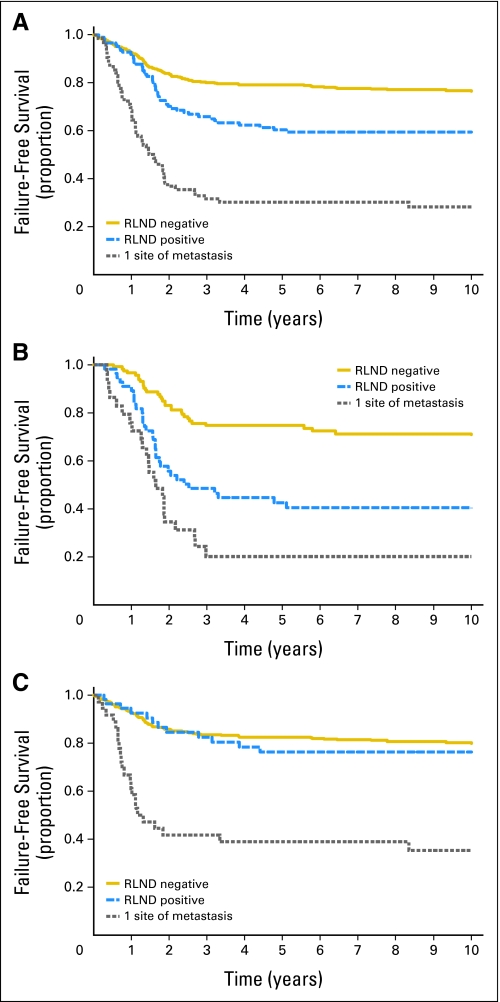
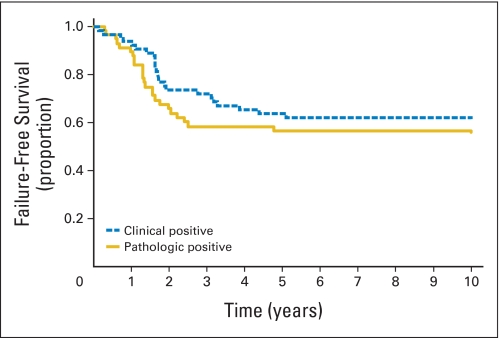
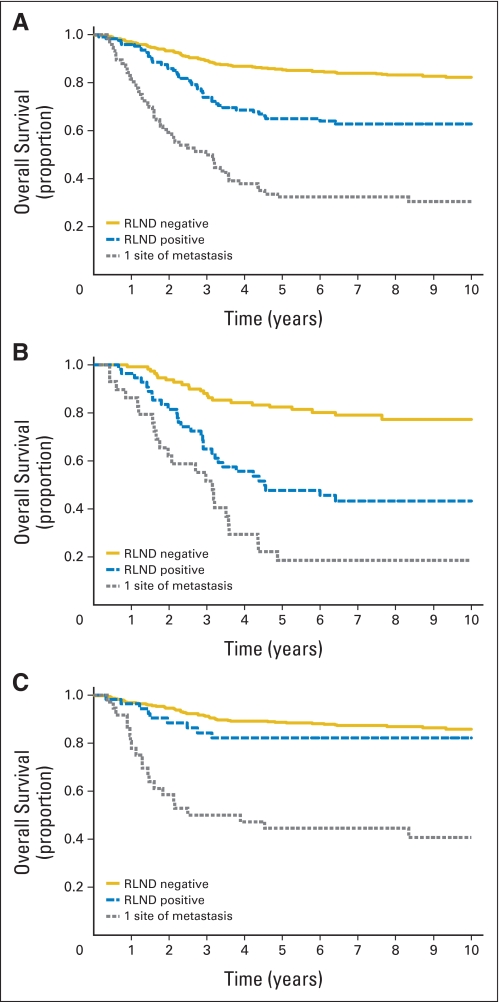
Patients and methods: Patient characteristics and survival outcomes for patients enrolled onto Intergroup Rhabdomyosarcoma Study IV (N = 898, 1991 to 1997) were evaluated among the following three patient groups: nonmetastatic patients with clinical or pathologic negative nodes (N0, 696 patients); patients with clinical or pathologic positive nodes (N1, 125 patients); and patients with a single site of metastatic disease (77 patients).
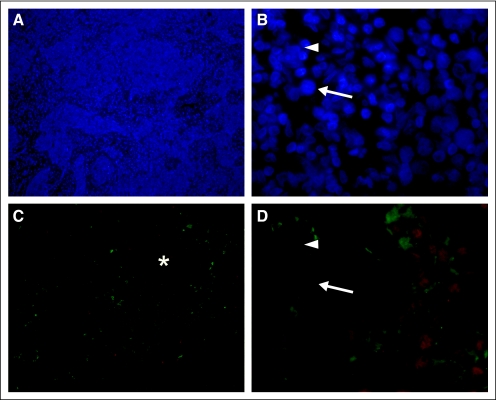
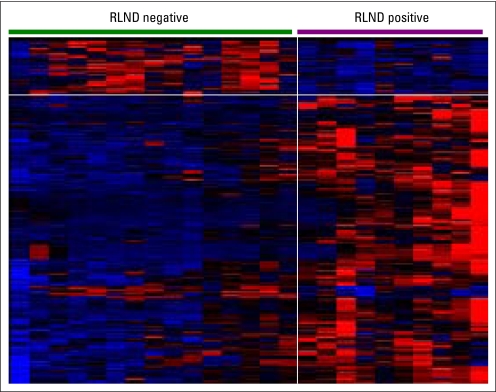
Results: Outcomes for patients with nonmetastatic alveolar N0 RMS were significantly better than for patients with N1 RMS (5-year failure-free survival [FFS], 73% v 43%, respectively; 5-year overall survival [OS], 80% v 46%, respectively; P < .001). Patients with a single site of alveolar metastasis had even worse FFS and OS (23% FFS and OS, P = .01) when compared with patients with N1 RMS; however, the differences was not as large as the differences between patients with N0 RMS and N1 RMS. For embryonal RMS, there was no statistically significant difference in FFS or OS (P = .41 and P = .77, respectively) for patients with N1 versus N0 RMS. Gene array analysis of primary tumor specimens identified that genes associated with the immune system and antigen presentation were significantly increased in N1 versus N0 alveolar RMS.
Conclusion: RLND alters prognosis for alveolar but not embryonal RMS. For patients with N1 disease and alveolar histology, outcomes were more similar to distant metastatic disease rather than local disease. Current data suggest that more aggressive therapy for patients with alveolar N1 RMS may be warranted.
Conflict of interest statement
Authors' disclosures of potential conflicts of interest and author contributions are found at the end of this article.
Figures
References
-
- Gurney JG, Young JL, Roffers SD, et al. Bethesda, MD: National Cancer Institute; 1999. Soft tissue sarcomas, in: SEER Pediatric Monograph.
-
- Raney RB, Anderson JR, Barr FG, et al. Rhabdomyosarcoma and undifferentiated sarcoma in the first two decades of life: A selective review of Intergroup Rhabdomyosarcoma Study Group experience and rationale for Intergroup Rhabdomyosarcoma Study V. J Pediatr Hematol Oncol. 2001;23:215–220. - PubMed
-
- Pappo AS, Shapiro DN, Crist WM, et al. Biology and therapy of pediatric rhabdomyosarcoma. J Clin Oncol. 1995;13:2123–2139. - PubMed
-
- Breneman JC, Lyden E, Pappo AS, et al. Prognostic factors and clinical outcomes in children and adolescents with metastatic rhabdomyosarcoma: A report from the Intergroup Rhabdomyosarcoma Study IV. J Clin Oncol. 2003;21:78–84. - PubMed
Publication types
MeSH terms
Grants and funding
LinkOut - more resources
Full Text Sources
