


Fasting indicators of insulin sensitivity: effects of ethnicity and pubertal status
- PMID: 21357795
- PMCID: PMC3064063
- DOI: 10.2337/dc10-1593
Fasting indicators of insulin sensitivity: effects of ethnicity and pubertal status
Abstract
Objective: To examine the relationship of fasting indicators of insulin sensitivity with a more invasive measure of insulin sensitivity (frequently sampled intravenous glucose tolerance test [FSIVGTT]) and the effect of Tanner stage and ethnicity on that relationship.
Research design and methods: Data were analyzed from 149 overweight girls (97 Hispanic and 52 African American) who were either in the early stages of maturation defined by Tanner stages 1 or 2 (52 Hispanic and 18 African American) or in the later stages of maturation defined by Tanner stages 4 and 5 (45 Hispanic and 34 African American). Fasting indicators of insulin sensitivity (IS) included fasting insulin and glucose and the homeostasis model assessment of insulin resistance (HOMA-IR). IS was derived from an FSIVGTT with minimal modeling.
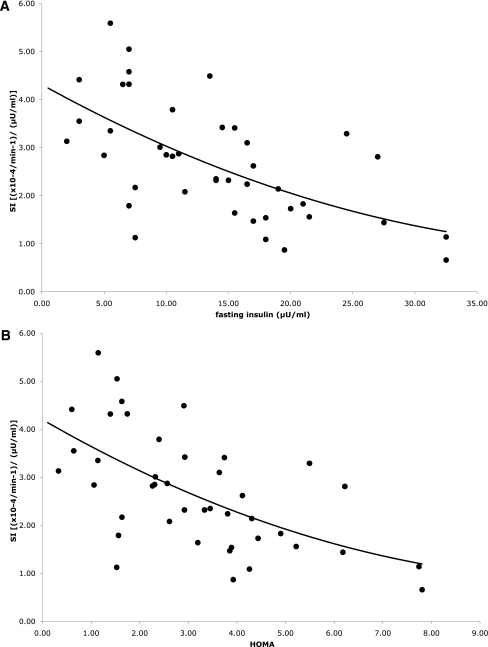
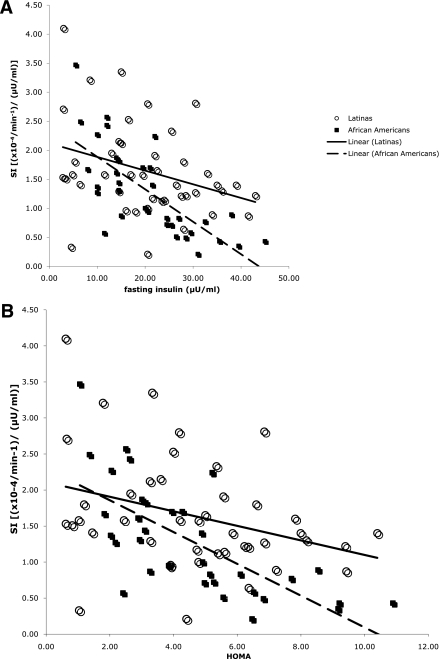
Results: In Tanner stages 1 and 2, all fasting indicators were significantly associated with IS: (fasting insulin: r = -0.67, P < 0.01; HOMA: r = -0.66, P < 0.01) with no significant influence of ethnicity on these relationships. In Tanner stages 4 and 5, however, all fasting indicators were associated with IS in African American girls (fasting insulin: r = -0.55, P < 0.01; HOMA: r = -0.47, P < 0.01), but none of the indicators were significantly associated with IS in Hispanic girls.
Conclusions: Fasting indicators were reflective of IS for girls in Tanner stages 1 and 2, regardless of ethnicity and may provide a clinical measure of future risk for type 2 diabetes. In the latter stages of maturation, however, more invasive measures are warranted to adequately determine IS in clinical practice.
Figures
References
-
- Dabelea D, Bell RA, D’Agostino RB, Jr, et al. Writing Group for the SEARCH for Diabetes in Youth Study Group Incidence of diabetes in youth in the United States. JAMA 2007;297:2716–2724 - PubMed
-
- Haffner SM, Stern MP, Hazuda HP, Pugh JA, Patterson JK. Hyperinsulinemia in a population at high risk for non-insulin-dependent diabetes mellitus. N Engl J Med 1986;315:220–224 - PubMed
-
- Freedman DS, Khan LK, Dietz WH, Srinivasan SR, Berenson GS. Relationship of childhood obesity to coronary heart disease risk factors in adulthood: the Bogalusa Heart Study. Pediatrics 2001;108:712–718 - PubMed
-
- Goran MI, Bergman RN, Cruz ML, Watanabe R. Insulin resistance and associated compensatory responses in African-American and Hispanic children. Diabetes Care 2002;25:2184–2190 - PubMed
Publication types
MeSH terms
Substances
Grants and funding
LinkOut - more resources
Full Text Sources
Medical
