


Underutilization of BRCA1/2 testing to guide breast cancer treatment: black and Hispanic women particularly at risk
- PMID: 21358336
- PMCID: PMC3604880
- DOI: 10.1097/GIM.0b013e3182091ba4
Underutilization of BRCA1/2 testing to guide breast cancer treatment: black and Hispanic women particularly at risk
Abstract
Purpose: Women with early-onset (age ≤40 years) breast cancer are at high risk of carrying deleterious mutations in the BRCA1/2 genes; genetic assessment is thus recommended. Knowledge of BRCA1/2 mutation status is useful in guiding treatment decisions. To date, there has been no national study of BRCA1/2 testing among newly diagnosed women.
Methods: We used administrative data (2004-2007) from a national sample of 14.4 million commercially insured patients to identify newly diagnosed, early-onset breast cancer cases among women aged 20-40 years (n = 1474). Cox models assessed BRCA1/2 testing, adjusting for covariates and differential lengths of follow-up.
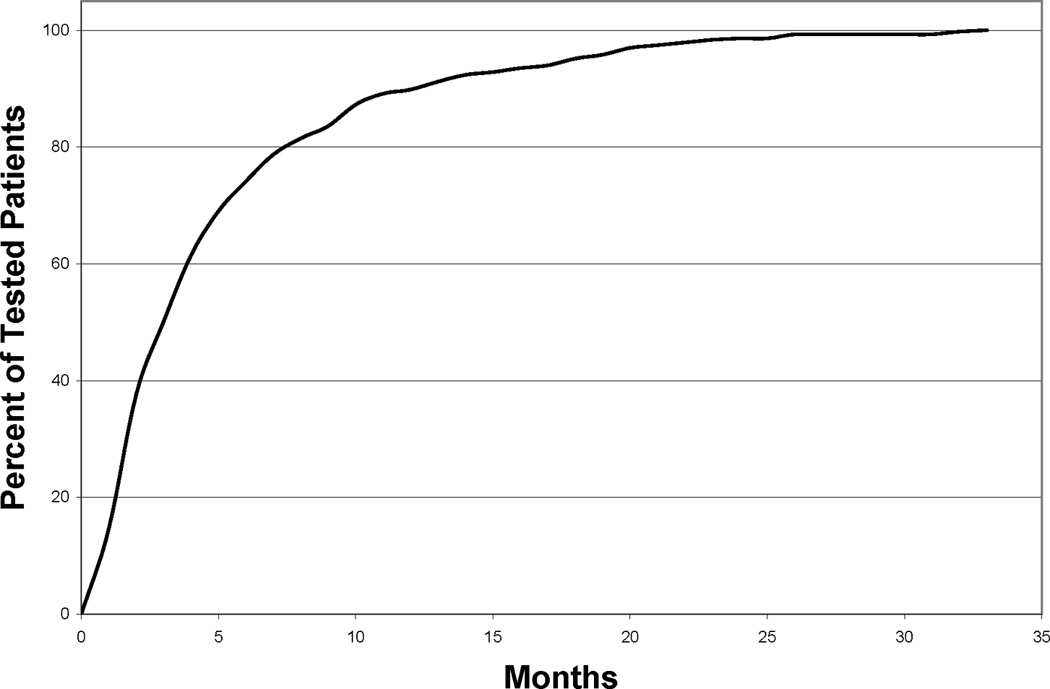
Results: Overall, 30% of women aged 40 years or younger received BRCA1/2 testing. In adjusted analyses, women of Jewish ethnicity were significantly more likely to be tested (hazard ratio = 2.83, 95% confidence interval: 1.52-5.28), whereas black women (hazard ratio = 0.34, 95% 0.18-0.64) and Hispanic women (hazard ratio = 0.52, 95% confidence interval: 0.33-0.81) were significantly less likely to be tested than non-Jewish white women. Those enrolled in a health maintenance organization (hazard ratio = 0.73, 95% confidence interval: 0.54-0.99) were significantly less likely to receive BRCA1/2 testing than those point of service insurance plans. Testing rates increased sharply for women diagnosed in 2007 compared with 2004.
Conclusions: In this national sample of patients with newly diagnosed breast cancer at high risk for BRCA1/2 mutations, genetic assessment was low, with marked racial differences in testing.
Figures
References
-
- American Society of Clinical Oncology. American Society of Clinical Oncology policy statement update: genetic testing for cancer susceptibility. J Clin Oncol. 2003 Jun 15;21(12):2397–2406. - PubMed
-
- U.S. Preventive Services Taskforce. Genetic risk assessment and BRCA mutation testing for breast and ovarian cancer susceptibility: recommendation statement. Ann Intern Med. 2005 Sep 6;143(5):355–361. - PubMed
-
- National Comprehensive Cancer Network. [Accessed September 28, 2009];Genetic/Familial High-Risk Asessment: Breast and Ovarian V.1.2009. 2009 http://www.nccn.org/professionals/physician_gls/PDF/genetics_screening.pdf.
-
- American Society of Clinical Oncology. Statement of the American Society of Clinical Oncology: genetic testing for cancer susceptibility, Adopted on February 20, 1996. J Clin Oncol. 1996 May;14(5):1730–1736. discussion 1737–1740. - PubMed
-
- Myriad Genetics. [Accessed May 14, 2008];Myriad Genetics Awarded Three U. S. Patents And Eight International Patents. 2001 News release. Available at: http://www.myriad.com/news/release/210288.
Publication types
MeSH terms
Substances
Grants and funding
LinkOut - more resources
Full Text Sources
Medical
Miscellaneous
