


Fluctuation of knee pain and changes in bone marrow lesions, effusions, and synovitis on magnetic resonance imaging
- PMID: 21360498
- PMCID: PMC3056156
- DOI: 10.1002/art.30148
Fluctuation of knee pain and changes in bone marrow lesions, effusions, and synovitis on magnetic resonance imaging
Abstract
Objective: Fluctuations in pain in patients with knee osteoarthritis (OA) are common, but risk factors for pain fluctuation are poorly understood. To best identify the structural causes of fluctuations, multiple assessments of pain status and structural lesions are needed. This study was undertaken to determine whether pain resolution is accompanied by diminution of lesions in patients with knee OA.
Methods: Subjects in the Multicenter Osteoarthritis Study were queried about their knee pain by interview, and knees were assessed by magnetic resonance imaging at the baseline and 15-month and 30-month clinic visits. For those knees in which pain fluctuation was identified over 3 clinic visits, the relationship of bone marrow lesions (BMLs), synovitis, and effusion to frequent knee pain and severity of knee pain was examined using conditional logistic regression analyses.
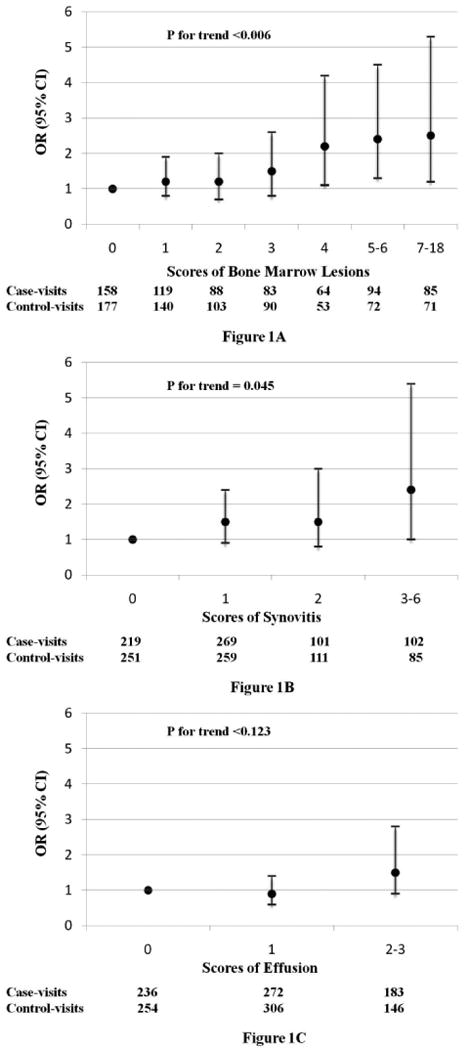
Results: Included in the analysis were 570 subjects with knee OA (651 knees). When the BML score changed from 0 to 1, 2, 3, 4, 5-6, and 7-18 over 2 consecutive clinic visits, the odds ratios (ORs) for frequent knee pain were 1.2, 1.2, 1.5, 2.2, 2.4, and 2.5, respectively (P for trend = 0.006). The corresponding ORs were 1.5, 1.5, and 2.4 when the synovitis score changed from 0 to 1, 2, and 3-6, respectively (P for trend = 0.045). No significant association was found between the effusion score and frequent knee pain. Diminishing size of BMLs was associated with resolution of knee pain (P for trend = 0.007). Similar associations were also observed between these structural lesions and the severity of knee pain.
Conclusion: Changes in BMLs and synovitis are associated with fluctuations in knee pain in patients with knee OA. Pain resolution occurs more frequently when BMLs become smaller.
Copyright © 2011 by the American College of Rheumatology.
Figures
References
-
- Hadler NM. Knee pain is the malady--not osteoarthritis. Ann Intern Med. 1992;116:598–9. - PubMed
-
- Gooberman-Hill R, Woolhead G, Mackichan F, Ayis S, Williams S, Dieppe P. Assessing chronic joint pain: lessons from a focus group study. Arthritis Rheum. 2007;57:666–71. - PubMed
-
- Hill CL, Gale DG, Chaisson CE, et al. Knee effusions, popliteal cysts, and synovial thickening: association with knee pain in osteoarthritis. J Rheumatol. 2001;28:1330–7. - PubMed
-
- Felson DT, Chaisson CE, Hill CL, et al. The association of bone marrow lesions with pain in knee osteoarthritis. Ann Intern Med. 2001;134:541–9. - PubMed
Publication types
MeSH terms
Grants and funding
LinkOut - more resources
Full Text Sources
Other Literature Sources
Medical
