Continued cannabis use and risk of incidence and persistence of psychotic symptoms: 10 year follow-up cohort study
- PMID: 21363868
- PMCID: PMC3047001
- DOI: 10.1136/bmj.d738
Continued cannabis use and risk of incidence and persistence of psychotic symptoms: 10 year follow-up cohort study
Abstract
Objective: To determine whether use of cannabis in adolescence increases the risk for psychotic outcomes by affecting the incidence and persistence of subclinical expression of psychosis in the general population (that is, expression of psychosis below the level required for a clinical diagnosis).
Design: Analysis of data from a prospective population based cohort study in Germany (early developmental stages of psychopathology study).
Setting: Population based cohort study in Germany.
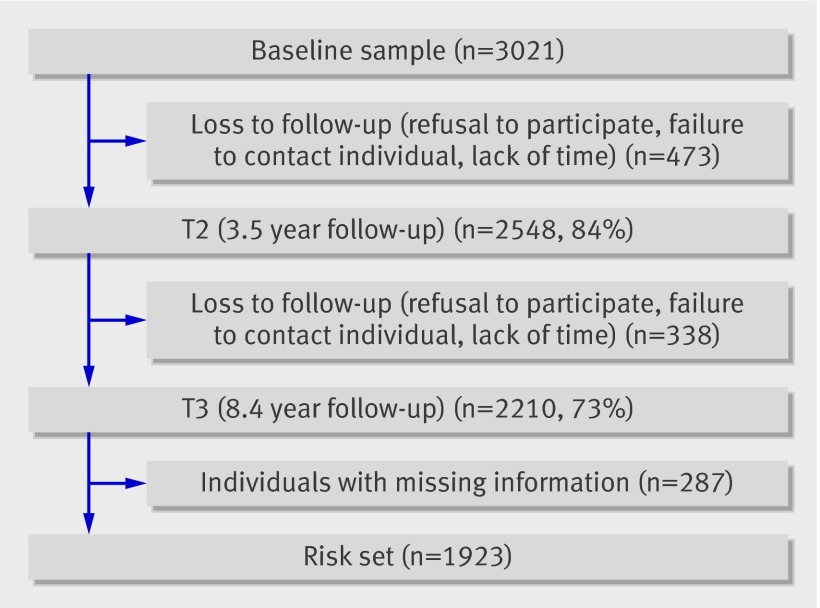
Participants: 1923 individuals from the general population, aged 14-24 at baseline.
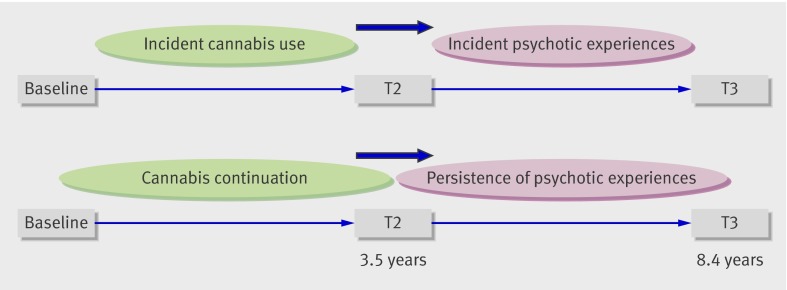
Main outcome measure: Incidence and persistence of subthreshold psychotic symptoms after use of cannabis in adolescence. Cannabis use and psychotic symptoms were assessed at three time points (baseline, T2 (3.5 years), T3 (8.4 years)) over a 10 year follow-up period with the Munich version of the composite international diagnostic interview (M-CIDI).
Results: In individuals who had no reported lifetime psychotic symptoms and no reported lifetime cannabis use at baseline, incident cannabis use over the period from baseline to T2 increased the risk of later incident psychotic symptoms over the period from T2 to T3 (adjusted odds ratio 1.9, 95% confidence interval 1.1 to 3.1; P=0.021). Furthermore, continued use of cannabis increased the risk of persistent psychotic symptoms over the period from T2 to T3 (2.2, 1.2 to 4.2; P=0.016). The incidence rate of psychotic symptoms over the period from baseline to T2 was 31% (152) in exposed individuals versus 20% (284) in non-exposed individuals; over the period from T2 to T3 these rates were 14% (108) and 8% (49), respectively.
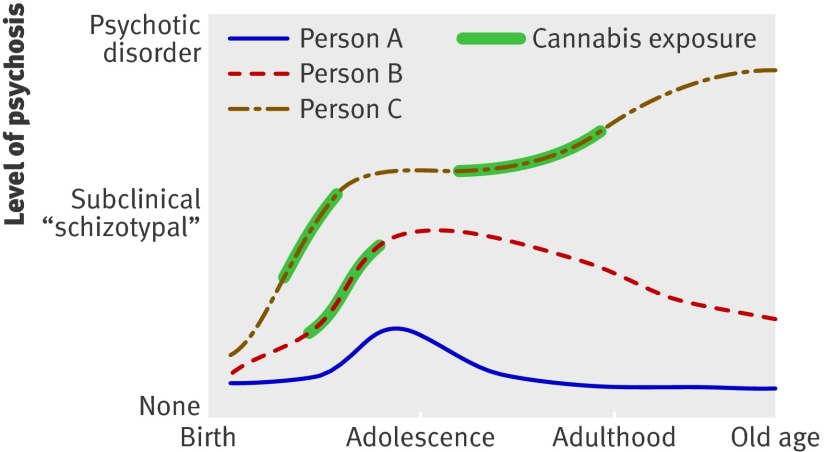
Conclusion: Cannabis use is a risk factor for the development of incident psychotic symptoms. Continued cannabis use might increase the risk for psychotic disorder by impacting on the persistence of symptoms.
Conflict of interest statement
Competing interests: All authors have completed the Unified Competing Interest form at
Figures
Comment in
-
Cannabis and the increased incidence and persistence of psychosis.BMJ. 2011 Mar 1;342:d719. doi: 10.1136/bmj.d719. BMJ. 2011. PMID: 21363867 No abstract available.
-
Cannabis use and psychosis. Are these results clinically relevant?BMJ. 2011 Apr 18;342:d1952; author reply d1973. doi: 10.1136/bmj.d1952. BMJ. 2011. PMID: 21502264 No abstract available.
-
Incident cannabis use in adolescents and young adults is associated with an increased risk of developing psychotic symptoms.Evid Based Ment Health. 2011 Aug;14(3):70. doi: 10.1136/ebmh.14.3.70. Evid Based Ment Health. 2011. PMID: 21764869 No abstract available.
References
-
- Wittchen HU, Behrendt S, Hofler M, Perkonigg A, Rehm J, Lieb R, et al. A typology of cannabis-related problems among individuals with repeated illegal drug use in the first three decades of life: evidence for heterogeneity and different treatment needs. Drug Alcohol Depend 2009;102:151-7. - PubMed
-
- Perkonigg A, Goodwin RD, Fiedler A, Behrendt S, Beesdo K, Lieb R, et al. The natural course of cannabis use, abuse and dependence during the first decades of life. Addiction 2008;103:439-51. - PubMed
-
- Wittchen HU, Frohlich C, Behrendt S, Gunther A, Rehm J, Zimmermann P, et al. Cannabis use and cannabis use disorders and their relationship to mental disorders: a 10-year prospective-longitudinal community study in adolescents. Drug Alcohol Depend 2007;88(suppl 1):60-70S. - PubMed
-
- Moore TH, Zammit S, Lingford-Hughes A, Barnes TR, Jones PB, Burke M, et al. Cannabis use and risk of psychotic or affective mental health outcomes: a systematic review. Lancet 2007;370:319-28. - PubMed
-
- Van Os J, Bak M, Hanssen M, Bijl RV, de Graaf R, Verdoux H. Cannabis use and psychosis: a longitudinal population-based study. Am J Epidemiol 2002;156:319-27. - PubMed
Publication types
MeSH terms
Grants and funding
LinkOut - more resources
Full Text Sources
Medical