. 2011 Mar 1;71(5):1883-92.
doi: 10.1158/0008-5472.CAN-10-2252.

Distinct TRAIL resistance mechanisms can be overcome by proteasome inhibition but not generally by synergizing agents

Affiliations

Distinct TRAIL resistance mechanisms can be overcome by proteasome inhibition but not generally by synergizing agents

Christina Menke et al. Cancer Res. .

Abstract

One impediment to the use of tumor necrosis factor-related apoptosis-inducing ligand (TRAIL) receptor-targeted agents as antitumor drugs is the evolution of resistance, a common problem in cancer. On the contrary, many different kinds of drugs synergize with TRAIL in TRAIL-sensitive tumor cells, raising the question whether one can overcome resistance with the same drugs producing synergy. This is an important question, because recent clinical trials suggest that combination treatments with cytotoxic drugs and TRAIL receptor-targeted agents do not provide additional benefit compared with cytotoxic agents on their own. Such results might be expected if drug combinations that synergize in sensitive tumor cells but cannot overcome TRAIL resistance are used in patients whose tumors were not selected for retention of TRAIL sensitivity. We tested this idea by creating isogenic tumor cells with acquired TRAIL resistance or defined mechanisms of resistance that occur in human tumors and then comparing them to the TRAIL-sensitive parental cell line. Although diverse classes of anticancer drugs were all able to synergize with TRAIL in sensitive cells, most agents were unable to overcome resistance and there was no relationship between the amount of synergy seen with a particular agent and its ability to overcome acquired resistance. An important exception was proteasome inhibitors, which were, however, able to overcome diverse resistance mechanisms. Our findings suggest that one should select drugs for TRAIL receptor agonist combination therapy based not just on their ability to synergize, but rather on their ability to overcome resistance as well as synergize.


Figures

Figure 1
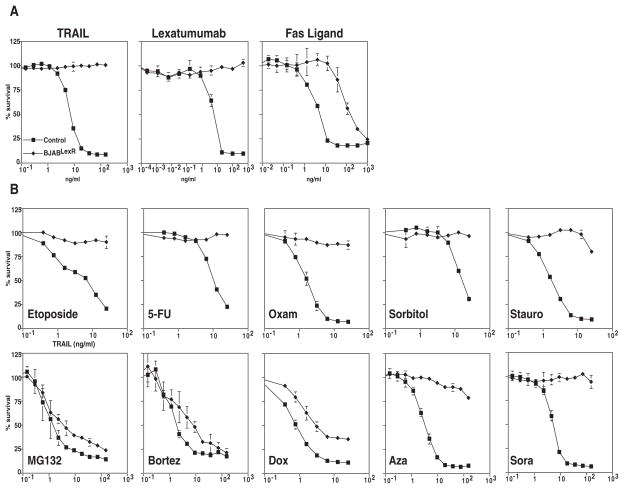
Figure 1. Only some synergizing agents can overcome acquired TRAIL resistance
Panel a, MTS Assay quantifying cell viability of BJABLexR cells in response to TRAIL, Lexatumumab, and Fas Ligand indicating that LexR cells display complete resistance to TRAIL and Lexatumumab and partial resistance to Fas ligand. 1b MTS Assay quantifying cell viability of BJABLexR cells after treatment with sensitizing drugs. Cells were pretreated with drugs Etoposide (1.5 μM), 5-FU (100 nM), Oxamflatin (1μg/ml), Sorbitol (5 mM), Staurosporine (0.1 μM), MG132 (0.5 μM), Bortezomib (10 pM), Doxorubicin (2.5 ng/ml), Azacitadine (5 nM), or Sorafenib (7 nM) for 24 hrs prior to TRAIL treatment. Cell viability was determined using MTS assays 24 hours later indicating that although all the agents caused synergy with TRAIL in parental cells, most do not overcome TRAIL resistance in LexR cells.
Figure 2
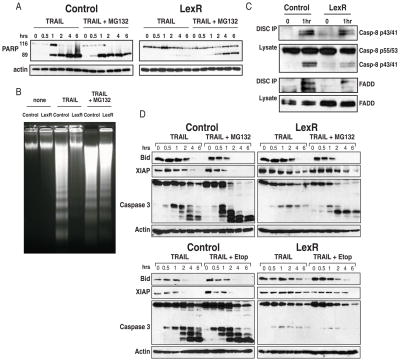
Figure 2. LexR cells have functional DISC formation and proximal signaling events
PARP Western blot analysis of parental BJAB cells and BJABLexR cells treated with TRAIL after pre-treatment with MG132 (0.35μM) (panel A). Panel B, DNA Fragmentation Assay of parental BJAB cells and BJABLexR cells. TRAIL was added at a concentration of 150 ng/ml after pre-treatment with MG132 (0.35μM) and treated for 4 hrs to assess apoptosis. Panel C, DISC IP using Lexatumumab in BJAB and BJABLexR cells; the western blot was probed with anti-FADD and anti-caspase-8 indicating no apparent difference in FADD and caspase-8 recruitment. Panel D, TRAIL R signaling events in parental BJAB cells and BJABLexR cells treated with TRAIL after pre-treatment with MG132 (0.35μM) or etoposide (0.75μM). TRAIL was added at 150 ng/ml for the indicated times before harvesting in RIPA buffer. These data show that proximal TRAIL R signaling events are functional in the LexR cells with acquired TRAIL resistance and that the block in signaling lies between caspase-8 and caspase-3.
Figure 3
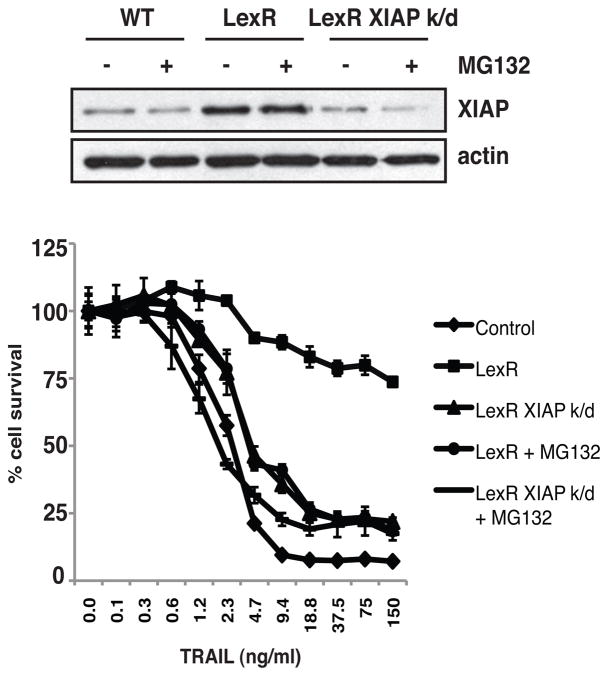
Figure 3. XIAP contributes but does not fully explain TRAIL resistance
Western blot analysis of parental BJAB cells and BJABLexR cells treated with TRAIL after pre-treatment with MG132 (0.35μM). XIAP was knocked down in BJABLexR cells using pGIPZ Lentiviral shRNA. MTS Assay quantifying cell viability of BJAB parental and BJABLexR cells after treatment with TRAIL.
Figure 4
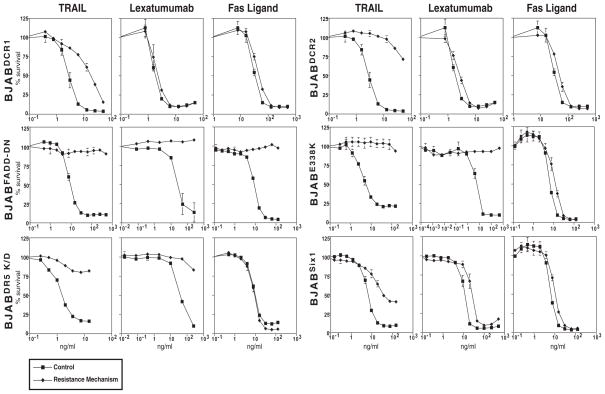
Figure 4. Different mechanisms can confer TRAIL resistance
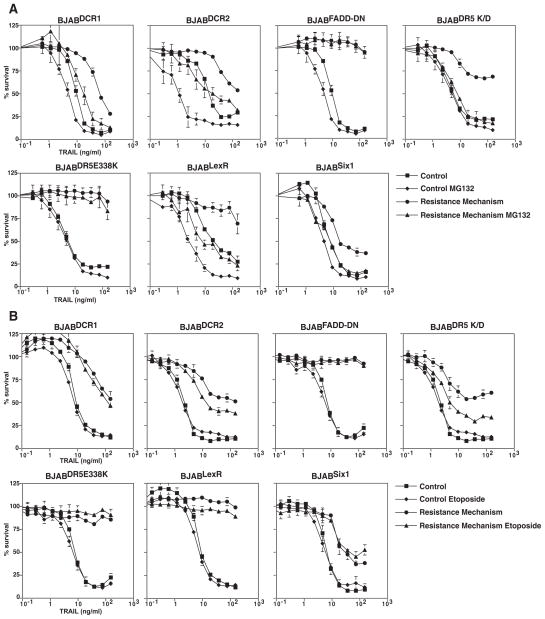
Matched cell lines BJABDCR1, BJABDCR2, BJABFADD-DN, BJABDR5E338K, BJABDR5 K/D, BJABSix1 were treated with TRAIL, Lexatumumab, or Fas Ligand for 24 hrs and viability determined by MTS assay. All the resistance mechanisms conferred TRAIL resistance to various degrees.
Figure 5
Figure 5. Sensitization experiments with TRAIL resistant cell lines
Parental BJAB cells and matched cell lines with different mechanisms of TRAIL resistance were pretreated with MG132 or etoposide 24 hrs prior to TRAIL treatment, then treated with increasing doses of TRAIL and viability determined by MTS assay after a further 24 hours. MG132 caused TRAIL sensitivity equivalent to the parental BJAB cells for all resistant cells except the BJABFADD-DN, BJABDR5E338K lines. Etoposide treatment failed to overcome TRAIL resistance for any of the resistant cell lines.

References

    1. Ashkenazi A, Herbst RS. To kill a tumor cell: the potential of proapoptotic receptor agonists. J Clin Invest. 2008;118:1979–90. - PMC - PubMed
    1. Johnstone RW, Frew AJ, Smyth MJ. The TRAIL apoptotic pathway in cancer onset, progression and therapy. Nat Rev Cancer. 2008;8:782–98. - PubMed
    1. Thorburn A. Tumor necrosis factor-related apoptosis-inducing ligand (TRAIL) pathway signaling. J Thorac Oncol. 2007;2:461–5. - PubMed
    1. Walczak H, Miller RE, Ariail K, et al. Tumoricidal activity of tumor necrosis factor-related apoptosis-inducing ligand in vivo. Nat Med. 1999;5:157–63. - PubMed
    1. Koschny R, Holland H, Sykora J, et al. Bortezomib sensitizes primary human astrocytoma cells of WHO grades I to IV for tumor necrosis factor-related apoptosis-inducing ligand-induced apoptosis. Clin Cancer Res. 2007;13:3403–12. - PubMed

Publication types

MeSH terms

Substances