. 2011 May 15;17(10):3112-22.
doi: 10.1158/1078-0432.CCR-10-1264. Epub 2011 Mar 1.

Fyn is downstream of the HGF/MET signaling axis and affects cellular shape and tropism in PC3 cells

Affiliations

Fyn is downstream of the HGF/MET signaling axis and affects cellular shape and tropism in PC3 cells

Ana R Jensen et al. Clin Cancer Res. .

Abstract

Purpose: Fyn is a member of the Src family of kinases that we have previously shown to be overexpressed in prostate cancer. This study defines the biological impact of Fyn inhibition in cancer using a PC3 prostate cancer model.

Experimental design: Fyn expression was suppressed in PC3 cells using an shRNA against Fyn (PC3/FYN-). Knockdown cells were characterized using standard growth curves and time-lapse video microscopy of wound assays and Dunn Chamber assays. Tissue microarray analysis was used to verify the physiologic relevance of the HGF/MET axis in human samples. Flank injections of nude mice were performed to assess in vivo growth characteristics.

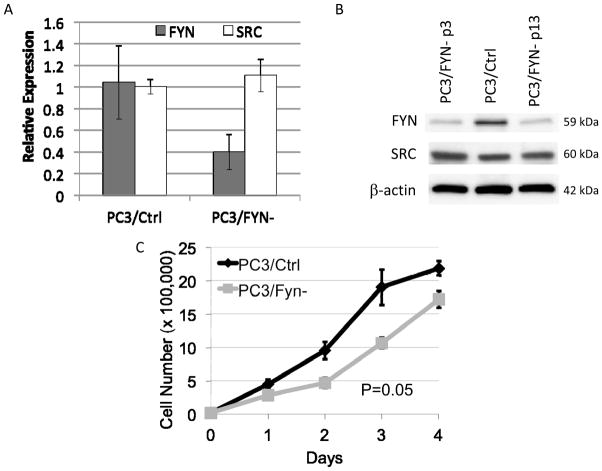
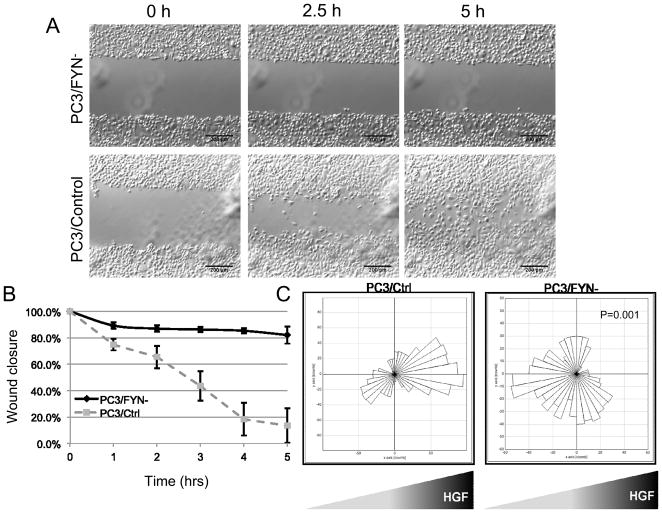
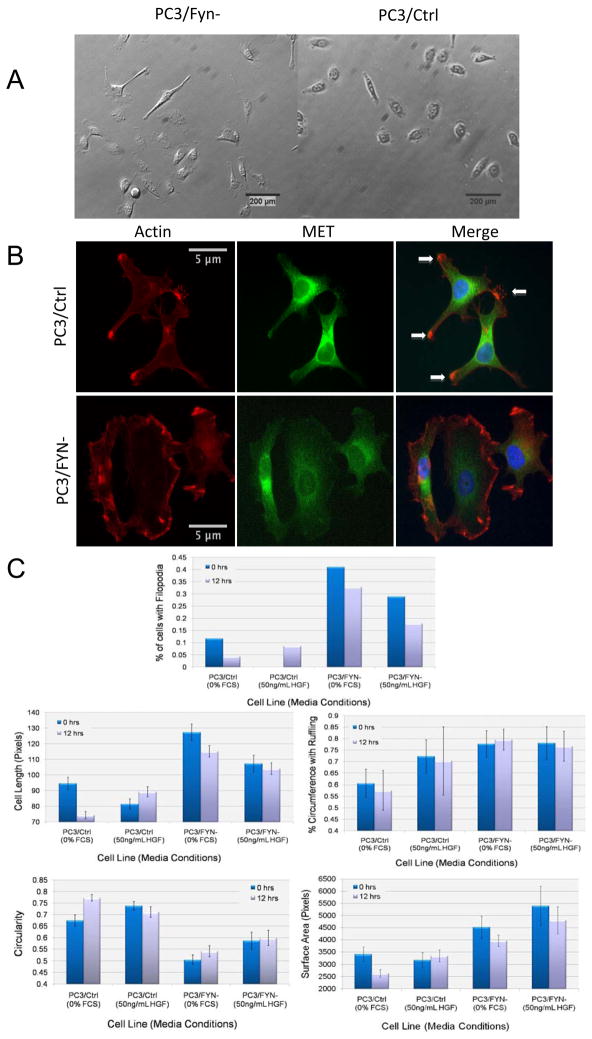
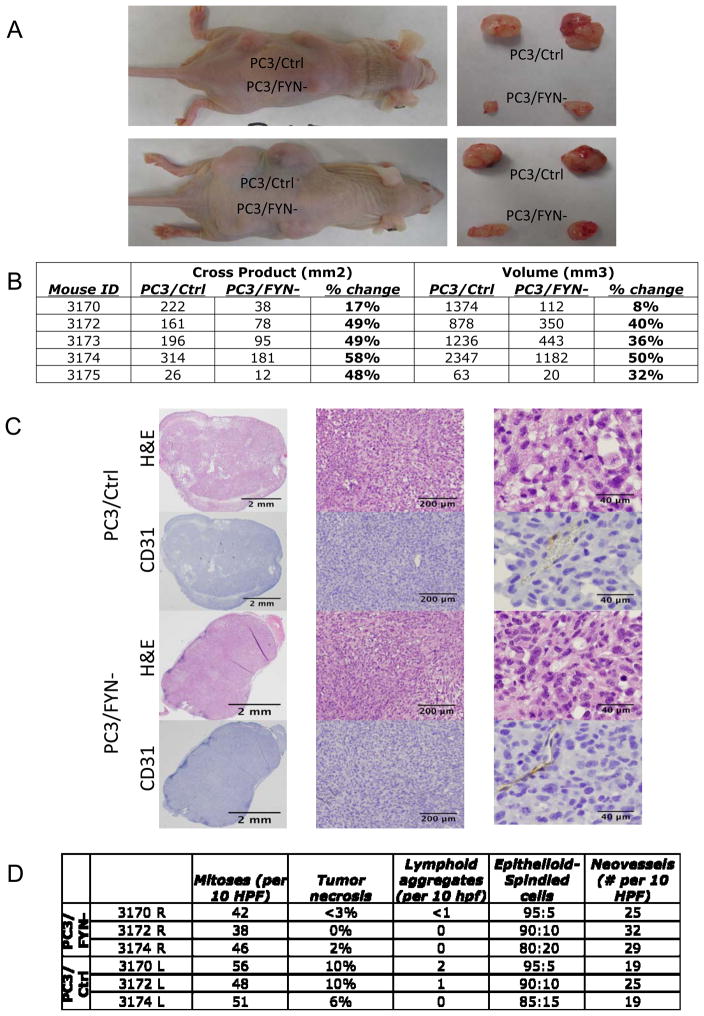
Results: HGF was found to be sufficient to drive Fyn-mediated events. Compared to control transductants (PC3/Ctrl), PC3/FYN- showed a 21% decrease in growth at 4 days (P = 0.05). PC3/FYN- cells were 34% longer than control cells (P = 0.018) with 50% increase in overall surface area (P < 0.001). Furthermore, when placed in a gradient of HGF, PC3/FYN- cells showed impaired directed chemotaxis down an HGF gradient in comparison to PC3/Ctrl (P = 0.001) despite a 41% increase in cellular movement speed. In vivo studies showed 66% difference of PC3/FYN- cell growth at 8 weeks using bidimensional measurements (P = 0.002).

Conclusions: Fyn plays an important role in prostate cancer biology by facilitating cellular growth and by regulating directed chemotaxis-a key component of metastasis. This finding bears particular translational importance when studying the effect of Fyn inhibition in human subjects.


Figures

Figure 1
Figure 1
Generation of Fyn knockdown cell lines (PC3/FYN-). A) Comparative RT-PCR showing mRNA expression of Fyn and Src in PC3/Ctrl and PC3/FYN- lines. Fyn expression is decreased approximately 60% without significant impact on Src expression B) Immunoblots for Fyn and Src expression showing decreased Fyn expression without significant alteration of Src expression. No significant variation in Fyn expression is seen in the PC3/FYN- line over serial passage. C) Four day growth curves comparing PC3/FYN- to PC3/Ctrl. Error bars represent standard error of the mean with 3 replicates for each day.
Figure 2
Figure 2
Wound healing assays of PC3/FYN- and PC3/Ctrl cells in serum replete media. Full videos are available in the supplemental data. A) Representative images from time lapse video. B) Graphical representation of wound closure over time. Error bars represent standard deviation of wound closure as a percentage of the original wound distance taken at 5 serial points. C) Rose plots (circular histogram) showing collective number of steps in any given direction (in 10-degree increments) in the presence of an HGF gradient.
Figure 3
Figure 3
A) Representative images of PC3/FYN- and PC3/Ctrl cells on polystyrene plates stimulated by HGF. PC3/FYN- cells were found to have greater cell length, area, and ruffling than PC3/Ctrl cells. B) Immunofluoresence of actin and MET in PC3 sublines. Overlap of actin and MET is shown in yellow and demarcated by arrows in the rightmost panels. These areas are most consistent with focal adhesion plaques. As seen in the lower right panel, there is no focal accumulation of both MET and actin to suggest plaque formation. B) Rose plots showing direction of movement of PC3 sublines relative to an HGF gradient (source on right). A rose plot is a circular histogram in 10 degree increments showing cumulative motion in any given direction in 360 degrees without regard to the magnitude of movement. C) Graphical representation of quantified morphologic variations between PC3/FYN- and PC3/Ctrl cells.
Figure 4
Figure 4
A) (left panels)Nude mouse with subcutaneous injection of PC3/Ctrl and PC3/FYN- cells at day 57. (right panels) Tumor recovered at necropsy. B) Table of mouse tumor measurements showing both cross products (length x width) and volumetric approximations based on maximal and minimal tumor dimensions. C) Immuohistochemical analysis of tumors from in vivo growth study. PC3/Ctrl (top) and PC3/FYN- cells (bottom) were injected into the flanks of nu/nu mice and collected at necropsy. H&E and CD31 staining is shown at 1× (left panels), 4.2× (middle panels), and 20× (right panels). No significant change in cellular morphology or neovessel formation was seen between the two conditions. D) table of quantification of mitoses, tumor necrosis, lymphoid aggregate formation, ratio of epithliod to spindled cells, and neovessel density. No significant differences were seen.

References

    1. Posadas EM, Al-Ahmadie H, Robinson VL, et al. FYN is overexpressed in human prostate cancer. BJU Int. 2009;103:171–7. - PMC - PubMed
    1. Alland L, Peseckis SM, Atherton RE, Berthiaume L, Resh MD. Dual myristylation and palmitylation of Src family member p59fyn affects subcellular localization. J Biol Chem. 1994;269:16701–5. - PubMed
    1. Liang X, Lu Y, Wilkes M, Neubert TA, Resh MD. The N-terminal SH4 region of the Src family kinase Fyn is modified by methylation and heterogeneous fatty acylation: role in membrane targeting, cell adhesion, and spreading. J Biol Chem. 2004;279:8133–9. - PubMed
    1. Calautti E, Grossi M, Mammucari C, et al. Fyn tyrosine kinase is a downstream mediator of Rho/PRK2 function in keratinocyte cell-cell adhesion. J Cell Biol. 2002;156:137–48. - PMC - PubMed
    1. Cary LA, Chang JF, Guan JL. Stimulation of cell migration by overexpression of focal adhesion kinase and its association with Src and Fyn. J Cell Sci. 1996;109 (Pt 7):1787–94. - PubMed

Publication types

MeSH terms