


Screening for celiac disease in a North American population: sequential serology and gastrointestinal symptoms
- PMID: 21364545
- PMCID: PMC3130886
- DOI: 10.1038/ajg.2011.21
Screening for celiac disease in a North American population: sequential serology and gastrointestinal symptoms
Abstract
Objectives: The prevalence of diagnosed celiac disease is <1 in 2,000 in the United States, but screening studies undertaken in European and other populations have revealed a much higher prevalence. The objective of this study was to determine the prevalence of celiac disease and the utility of screening in the general adult population of a geographically isolated area.
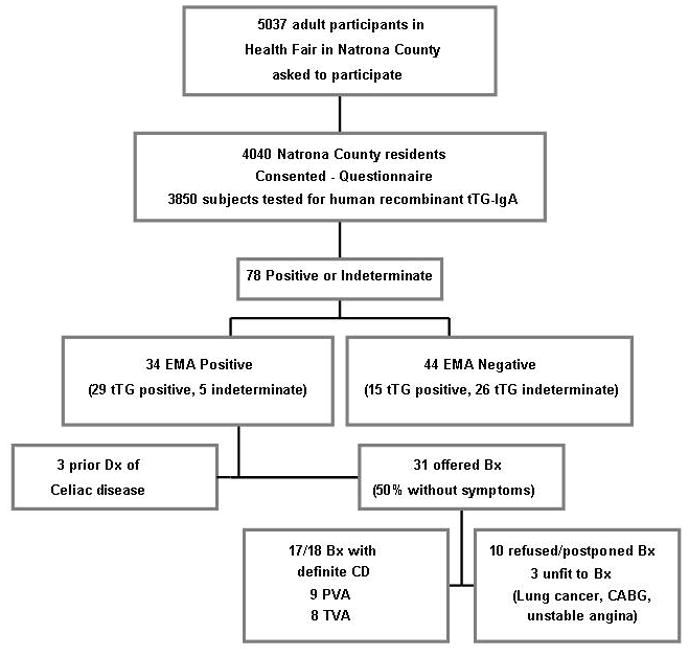
Methods: Serum tissue transglutaminase antibodies (tTG-IgA) were measured in volunteer health-care participants aged ≥ 18 years at the annual Casper, Wyoming, Blue Envelope Health Fair blood draw. Subjects with positive tTG-IgA tests had their endomysial IgA antibodies checked. Double positives were offered endoscopy with small bowel biopsy. All subjects completed a short gastrointestinal (GI) symptom questionnaire.
Results: A total of 3,850 residents of the Natrona County had serologic evaluation for celiac disease, 34 of whom tested positive for both tTG and endomysial antibody (EMA) IgA. Excluding three individuals with previous diagnosis of celiac disease, the overall prevalence of positive celiac serology in this community sample was 0.8%. All 31 subjects were offered a small bowel biopsy. Of the 18 biopsied subjects, 17 (94%) had at least partial villous atrophy. Symptoms that were reported by the fair attendees did not predict positivity.
Conclusions: Screening for celiac disease was widely accepted in this preventative health-care setting. Undiagnosed celiac disease affects 1 in 126 individuals in this Wyoming community. Most were asymptomatic or had atypical presentations. Serologic testing can readily detect this disease in a general population.
Conflict of interest statement
Figures
References
-
- Carlsson AK, Axelsson IE, Borulf SK, Bredberg AC, Ivarsson SA. Serological screening for celiac disease in healthy 2.5-year-old children in Sweden. Pediatrics. 2001;107:42–5. - PubMed
-
- Dube C, Rostom A, Sy R, Cranney A, Saloojee N, Garritty C, Sampson M, Zhang L, Yazdi F, Mamaladze V, Pan I, Macneil J, Mack D, Patel D, Moher D. The prevalence of celiac disease in average-risk and at-risk Western European populations: a systematic review. Gastroenterology. 2005;128:S57–67. - PubMed
-
- Catassi C, Ratsch IM, Fabiani E, Rossini M, Bordicchia F, Candela F, Coppa GV, Giorgi PL. Coeliac disease in the year 2000: exploring the iceberg. Lancet. 1994;343:200–3. - PubMed
-
- Cook HB, Burt MJ, Collett JA, Whitehead MR, Frampton CM, Chapman BA. Adult coeliac disease: prevalence and clinical significance. J Gastroenterol Hepatol. 2000;15:1032–6. - PubMed
-
- Corazza GR, Andreani ML, Biagi F, Corrao G, Pretolani S, Giulianelli G, Ghironzi G, Gasbarrini G. The smaller size of the ‘coeliac iceberg’ in adults. Scand J Gastroenterol. 1997;32:917–9. - PubMed
Publication types
MeSH terms
Substances
Grants and funding
LinkOut - more resources
Full Text Sources
Other Literature Sources
Medical
Research Materials
Miscellaneous
