


Cancer care inequity for women in resource-poor countries
Affiliations
- PMID: 21364864
- PMCID: PMC3046761
Item in Clipboard
Cancer care inequity for women in resource-poor countries
Rev Obstet Gynecol.
2010 Summer.
Abstract
Cervical, endometrial, and breast cancers are paradigms for global health disparity. The paucity of well-designed and -used cancer registries obstructs accurate assessment and planning for international agency resource allocation. Increasing rates of both smoking and obesity in resource-poor nations will lead to increases in the incidence of cancers in developing nations. Women residing in the developing world continue to present in later stages of disease and have fewer options for treatment than those in developed countries.
Keywords: Breast cancer; Cervical cancer; Endometrial cancer; Treatment inequity.
Figures
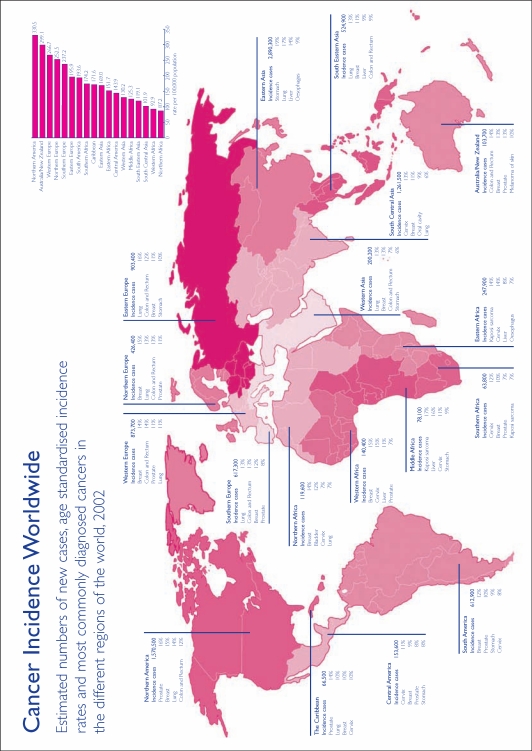
Many areas of the world have national or regional associations of cancer registries. These associations collaborate in setting methodological standards and publishing data on cancer incidence. They are a useful source of information on cancer and cancer registration. Reproduced with permission from Cancer Research UK.
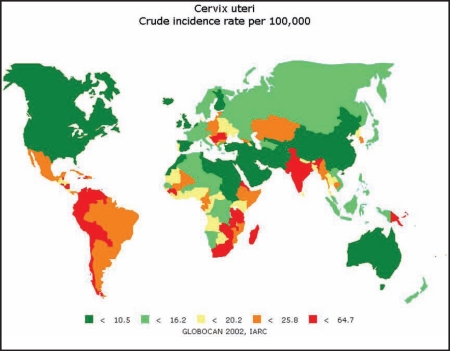
Global distribution of cancer of the uterine cervix (crude incidence rates). Reproduced with permission from the International Agency for Research on Cancer.
References
-
- Marmot M, Friel S, Bell R, et al. Commission on Social Determinants of Health. Closing the gap in a generation: health equity through action on the social determinants of health. Lancet. 2008;372:1661–1669. - PubMed
-
- Breast cancer in developing countries. Lancet. 2009;374:1567. - PubMed
-
- Lodge M. The evidence base for cancer control in developing countries: what is to be done? The Newsletter of the International Network for Cancer Treatment and Research. 2005;6(3) http://www.inctr.org/publications/2005_v06_n03_w02.shtml.
-
- Sankaranarayanan R, Ferlay J. Worldwide burden of gynaecological cancer: the size of the problem. Best Pract Res Clin Obstet Gynaecol. 2006;20:207–225. - PubMed
-
- Wakabi W. Research collaboration boosts women’s health in Ethiopia. Lancet. 2008;372:1534. - PubMed
LinkOut - more resources
Full Text Sources