. 2011 Apr 18;24(4):505-14.
doi: 10.1021/tx100344e. Epub 2011 Mar 18.

Unique cyanide adduct in human serum albumin: potential as a surrogate exposure marker

Affiliations

Unique cyanide adduct in human serum albumin: potential as a surrogate exposure marker

Michael J Fasco et al. Chem Res Toxicol. .

Abstract

Cyanide (CN = HCN + CN(-)) is a renowned poison and neurotoxicant that is prevalent throughout the environment. Despite a plethora of studies conducted over the last half century, relatively little is known of its potential to cause adverse health outcomes at sublethal exposures. CN exposure is normally determined from blood, but because CN is rapidly metabolized and cleared from this compartment (t(1/2) < 1 h), it is common for several half-lives to have passed before blood samples are drawn for analysis. This variable, coupled with a very narrow toxic index and metabolic diversity within the human population, has rendered accurate assessment of CN exposure, and consequently any predictions of possible adverse health outcomes, highly problematic. Prior studies by us showed the potential of Cys-SCN adducts within human serum albumin (HSA) to act as retrospective surrogates of CN exposure. Here, we report the discovery of a stable, SCN adduct at Cys(567) formed by the reaction of CN with the C-terminal Cys(558)Cys(567) disulfide bond of HSA. Treatment of HSA purified from human serum with base in guanidine hydrochloride releases a readily detectable, uniquely modified, C-terminal-19-mer peptide from Cys(567)-SCN moieties in all the samples examined thus far. Inclusion of a HSA-Cys(567)-S(13)C(15)N labeled internal standard permits quantitation of the Cys(567)-SCN adduct by LC-MS/MS in selective reaction monitoring (SRM) of the surrogate peptide with high sensitivity and good precision. Reaction of CN in vitro with the Cys(558)Cys(567) disulfide bond in HSA is specific, rapid, and concentration dependent within a putative, physiologically relevant range. Data from various human sera demonstrate the potential usefulness of this adduct as a biomarker of CN exposure.


Figures
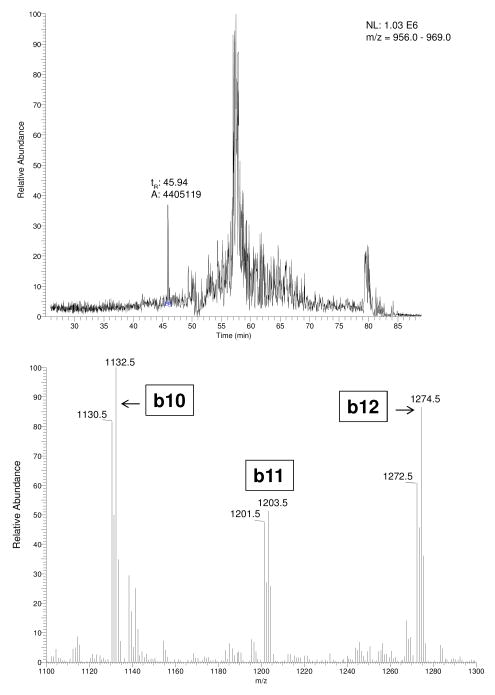
Figure 1
Figure 1
LC-MS/MS analysis of peptides released from HSA exposed to 1:1 mixture of KCN/K13C15N, following treatment with base. Upper panel is an extracted ion chromatogram from m/z 956 to 969. The peptide eluting at tR 45.94 min is the doubly charged peptide (m/z 967.4) released by incubation of purified HSA in 6 M GuHCl/0.1 M NaOH at 50°C for 3 hr and separated by LC using the gradient and MS/MS conditions cited under Experimental procedures. The lower panel shows the partial MS/MS product ion spectrum of the doubly charged peptide (m/z 967.4) from m/z 1100–1300. The major product ions observed at m/z 1130.50/1132.46, 1201.45/1203.50, and 1272.49/1274.51 are consistent with the anticipated isotope distribution of any itcCys peptides released from HSA, and the partial HSA sequence of itcCys-Phe-Ala-Glu-Glu-Gly-Lys-Lys-Leu-Valb10-Alab11-Alab12.
Figure 2
Figure 2
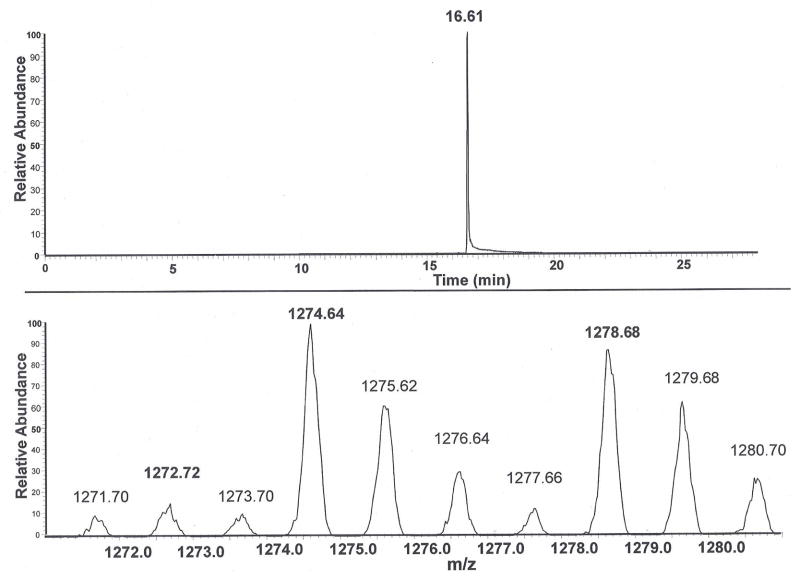
LC-MS/MS trace of a mixture of itcCys peptides prepared from the Cys567SCN and, Cys567S13C15N adducts in HSA and the full length-deuterium labeled (D6) cyanylated peptide. The deuterium (D6) labeled peptide was added to the HSA solubilized in 6 M GuHCl/0.1M NaOH just prior to heating at 50°C for 3 h. Upper panel is the ion current (m/z 963 to m/z 973) scan obtained by isocratic elution of the mixture and MS/MS analysis. Lower panel is a MS/MS product ion spectrum within in a restricted window of m/z 1271 to m/z 1281, showing the product b12 ion of interest in the peak eluting at 16.61 min. The uniquely high relative abundance of the 1272.72 isotope peaks at m/z 1274.64 and m/z 1278.68 confirm the presence of the peptides produced, respectively, from the itcCys567S13C15N HSA adduct and the deuterium labeled (D6) cyanylated peptide.
Figure 3
Figure 3
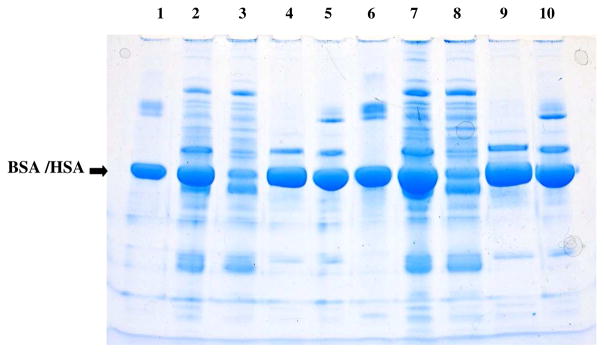
SDS-Page electrophoresis of proteins present in fractions produced during processing of HSA. Lane 1: 4.4 μg BSA from BCA protein quantitation kit; Lane 2: starting serum; Lane 3: ammonium sulfate precipitate; Lane 4: ammonium sulfate supernatant; Lane 5: octanoic acid precipitated HSA used in the peptide assay. Lanes 6–10 contain double the concentrations of lanes 1–5. Conditions were as described under Experimental Procedures.
Figure 4
Figure 4
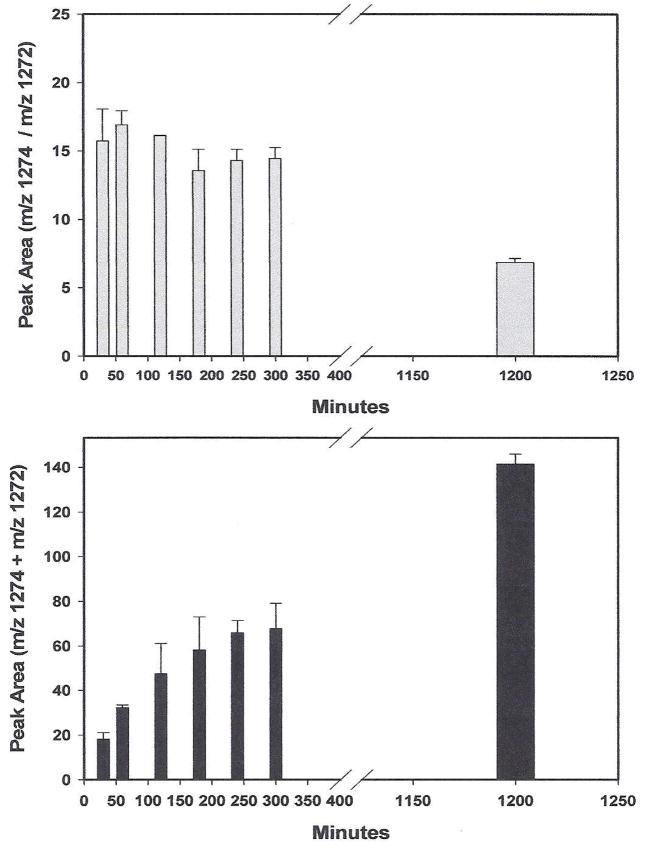
Release of 13C15N and CN itcCys567-C-terminal peptides from HSA by incubation at 50°C in GuHCl/NaOH as a function of time. Human serum was treated with an excess of K13C15N at room temperature overnight.. Triplicate HSA precipitates from it were isolated, dissolved in 0.3 ml of 6 M GuHCl/0.1 NaOH and placed in a Eppendorf Thermomixer at 50°C with gentle shaking. At the times indicated, triplicate samples were removed and the integrated peak areas of the labeled and unlabeled itcCys peptides determined. Data points are the average ± SD of the triplicate samples. Upper panel: m/z 1274/1272 peak area ratios obtained at various times from the itcCys567 13C15N and CN peptides, respectively. Lower panel: data from the same experiment except that the peak areas of the m/z 1274 and 1272 product ions of the itcCys13C15N and itcCysCN peptides, respectively, were summed.
Figure 5
Figure 5
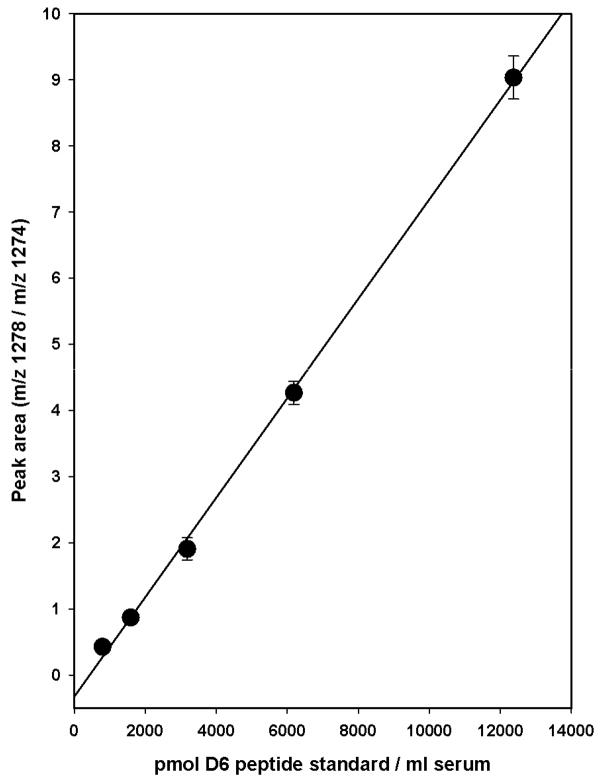
Quantitation of the 13C15N Cys567 adduct in HSA using the synthetic, deuterated (D6) peptide as the standard. Several HSA precipitates prepared from human serum treated with an excess of of K13C15N were solubilized 0.3 ml of 6M GuHCl/0.1 M NaOH. The deuterated (D6)-cyanylated peptide was added to triplicate samples to mimic a serum concentration range of 800 to 12,500 pmol/mL. The mixtures were incubated at 50°C for 3 h, and the peptides purified and analyzed by LC-MS/MS in SRM. Data are the average ± SD from triplicate samples. The line is a simple regression of the data points and not forced through zero.
Figure 6
Figure 6
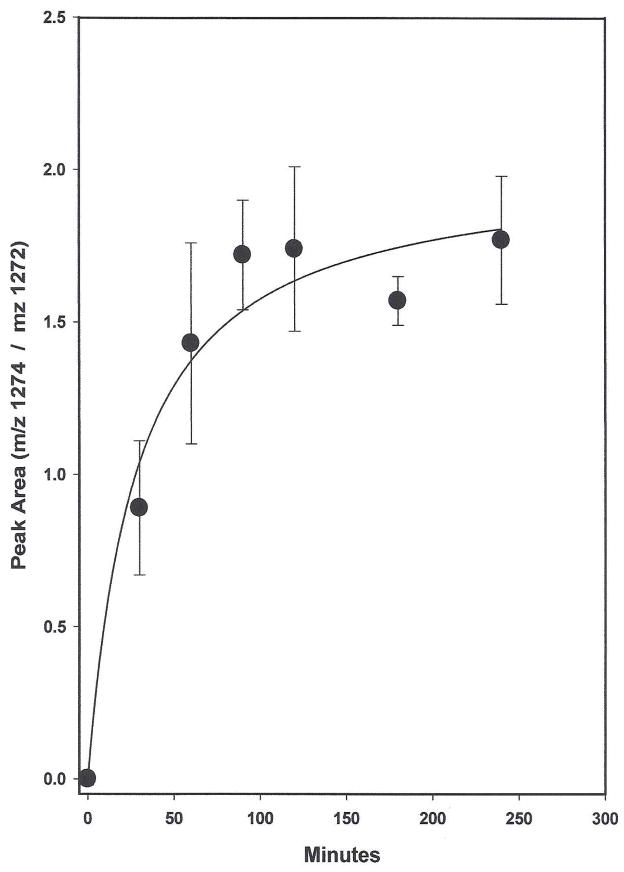
Time course of 13C15N adduction to Cys567 in HSA. K13C15N in water (20 mg/mL) was added to 10 ml of untreated serum to a final concentration of 6000 pmol/mL. Aliquots (18 × 0.3 mL) were immediately added to Eppendorf tubes equilibrated at 37°C in an Eppendorf Thermomixer. At 30, 60, 90, 120, 180 and 240 min, 0.3 mL of saturated ammonium sulfate was added to each of 3 tubes and the peptides released from HSA were assayed in the usual manner. Zero time samples were processed immediately after addition of the K13C15N. The ratio of the itcCys13C15N and itcCysCN peptides released was determined from the integrated peak areas of the 1274 and 1272 m/z product ions. Values are the average ± SD of the triplicate samples. The line is hyperbola, single rectangular, 2 parameter using all the data points.
Figure 7
Figure 7
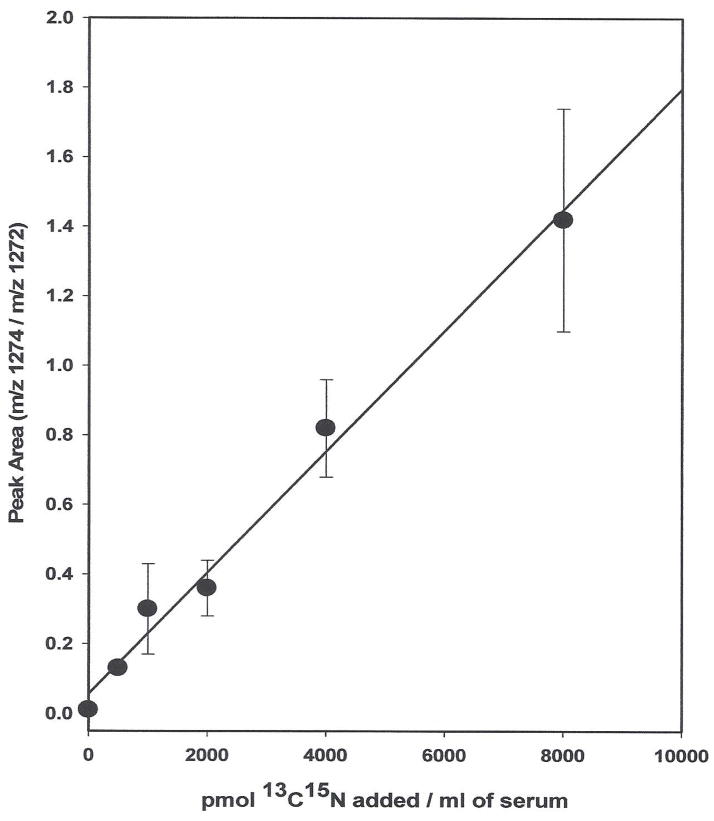
Concentration-dependent adduction of KCN to HSA Cys567. K13C15N in water was added to 6 × 1 mL aliquots of human serum spanning a concentration range 0 to 8000 pmol/mL. After incubation at 37°C for 1.5 h, the ratio of the itcCys 13C15N and itcCysCN peptides released from HSA was determined from their integrated peak areas. Values are the average ± SD of the triplicate samples. The line is simple regression using all the data points and not forced through zero.
Figure 8
Figure 8
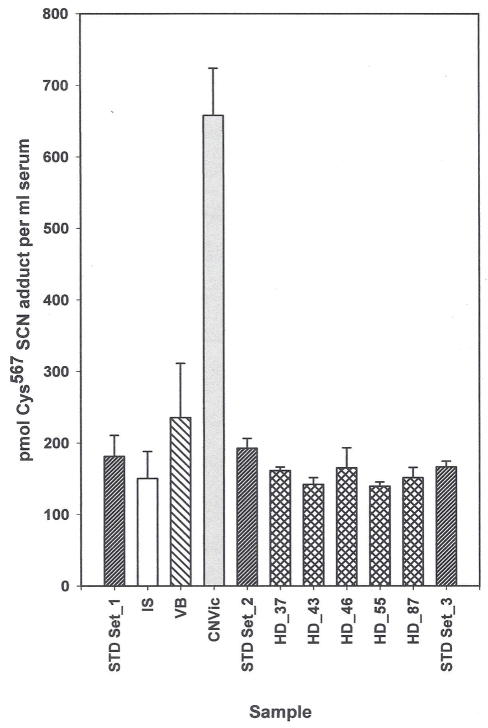
HSA Cys567-SCN adduct concentration in human serum samples. The internal standard concentration was 125 pmol of itcCys567S13C15N adduct/mL of serum.. STD set 1, 2, 3: “everyday” external 13C15N itcCys567 peptide standards containing 248, 124 and 62 pmol of 13C15N adduct per ml of serum. Sets 1 to 3 are the same samples assayed at different times during the run to ensure the integrity of the assay. Values are the average ± SD from each concentration. Values for the remaining samples are the average ± SD of triplicate samples containing 125 pmol of the labeled adduct per ml of serum added as an internal standard. IS: the untreated serum used to prepare the “everyday” external standards and treated as a test sample. VB: a commercial serum sample from Valley Biomedical that consistently shows an elevated level of adduct relative to other commercial samples. CNVic: a CN overdose- suicide victim whose serum was obtained approximately 3 h after death. HD-37, 43, 46, 55 and 87: male and female sera from nonsmoking healthy NYS Health Department volunteers that were randomly chosen from an 89 member cohort.

References

    1. Agency for Toxic Substances and Disease Registry (ATSDR) Toxicological Profile for cyanide. U.S. Department of Health and Human Services, Centers for Disease Control; 2006. http://www.atsdr.cdc.gov/toxprofiles/TP.asp?id=72&tid=19. - PubMed
    1. Baskin SI, Brewer TG. Cyanide Poisoning. In: Zajtchuk R, Bellamy RF, Sidell FR, Takefugi ET, Franz DR, editors. Medical Aspects of Chemical and Biological Warfare. Office of the Surgeon General, Department of the Army; United States: 1997. pp. 271–286.
    1. Boivin MJ. An ecological paradigm for a health behavior analysis of “konzo”, a paralytic disease of Zaire from toxic cassava. Soc Sci Med. 1997;45:1853–1862. - PubMed
    1. Tylleskar T, Banea M, Bikangi N, Cooke RD, Poulter NH, Rosling H. Cassava cyanogens and konzo, an upper motoneuron disease found in Africa. Lancet. 1992;339:208–211. - PubMed
    1. Tylleskar T, Banea M, Bikangi N, Fresco L, Persson LA, Rosling H. Epidemiological evidence from Zaire for a dietary etiology of konzo, an upper motor neuron disease. Bull World Health Organ. 1991;69:581–589. - PMC - PubMed

Publication types