


Common or redundant neural circuits for duration processing across audition and touch
- PMID: 21368051
- PMCID: PMC3204366
- DOI: 10.1523/JNEUROSCI.3296-10.2011
Common or redundant neural circuits for duration processing across audition and touch
Abstract
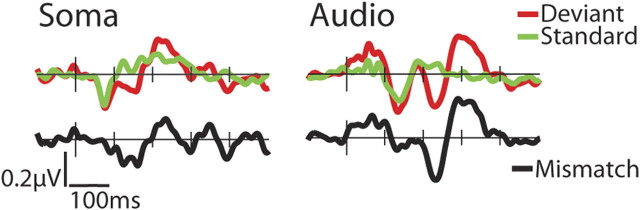
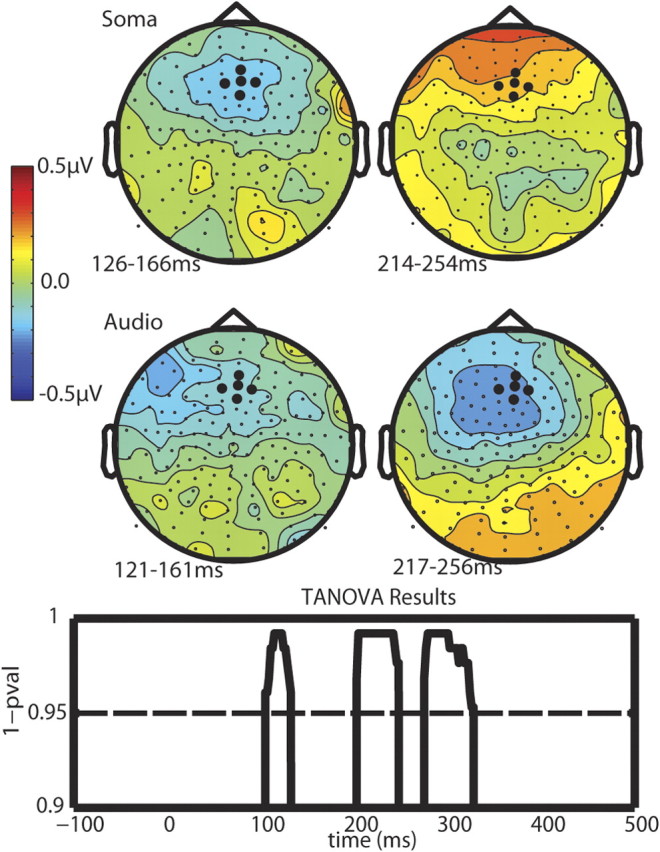
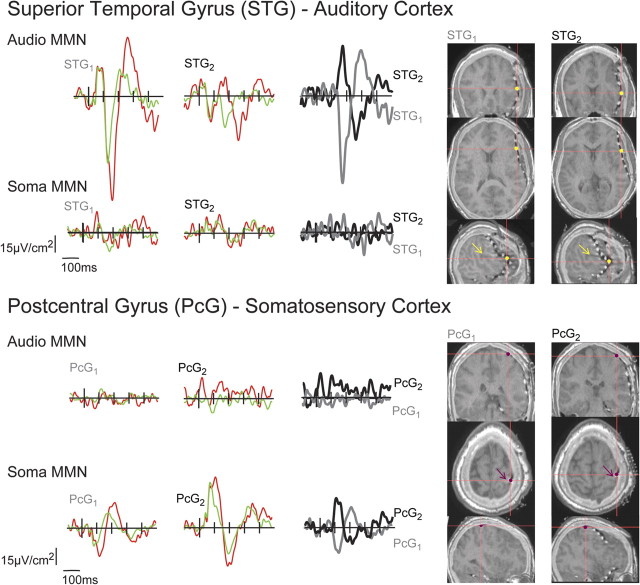
Certain features of objects or events can be represented by more than a single sensory system, such as roughness of a surface (sight, sound, and touch), the location of a speaker (audition and sight), and the rhythm or duration of an event (by all three major sensory systems). Thus, these properties can be said to be sensory-independent or amodal. A key question is whether common multisensory cortical regions process these amodal features, or does each sensory system contain its own specialized region(s) for processing common features? We tackled this issue by investigating simple duration-detection mechanisms across audition and touch; these systems were chosen because fine duration discriminations are possible in both. The mismatch negativity (MMN) component of the human event-related potential provides a sensitive metric of duration processing and has been elicited independently during both auditory and somatosensory investigations. Employing high-density electroencephalographic recordings in conjunction with intracranial subdural recordings, we asked whether fine duration discriminations, represented by the MMN, were generated in the same cortical regions regardless of the sensory modality being probed. Scalp recordings pointed to statistically distinct MMN topographies across senses, implying differential underlying cortical generator configurations. Intracranial recordings confirmed these noninvasive findings, showing generators of the auditory MMN along the superior temporal gyrus with no evidence of a somatosensory MMN in this region, whereas a robust somatosensory MMN was recorded from postcentral gyrus in the absence of an auditory MMN. The current data clearly argue against a common circuitry account for amodal duration processing.
Figures
References
-
- Akatsuka K, Wasaka T, Nakata H, Inui K, Hoshiyama M, Kakigi R. Mismatch responses related to temporal discrimination of somatosensory stimulation. Clin Neurophysiol. 2005;116:1930–1937. - PubMed
-
- Allison T, Puce A, Spencer DD, McCarthy G. Electrophysiological studies of human face perception. I. Potentials generated in occipitotemporal cortex by face and non-face stimuli. Cereb Cortex. 1999;9:415–430. - PubMed
-
- Amenedo E, Escera C. The accuracy of sound duration representation in the human brain determines the accuracy of behavioural perception. Eur J Neurosci. 2000;12:2570–2574. - PubMed
-
- Bolognini N, Papagno C, Moroni D, Maravita A. Tactile temporal processing in the auditory cortex. J Cogn Neurosci. 2010;22:1201–1211. - PubMed
Publication types
MeSH terms
Grants and funding
LinkOut - more resources
Full Text Sources
