Long-term survivals of stage IIb osteosarcoma: a 20-year experience in a single institution
- PMID: 21369478
- PMCID: PMC3042169
- DOI: 10.4055/cios.2011.3.1.48
Long-term survivals of stage IIb osteosarcoma: a 20-year experience in a single institution
Abstract
Background: The purpose of this study is to evaluate the disease-free survival (DFS) and overall survival (OS) of patients with stage IIB osteosarcoma at a single institution for 20 years and to compare the results according to the chemotherapy protocols.
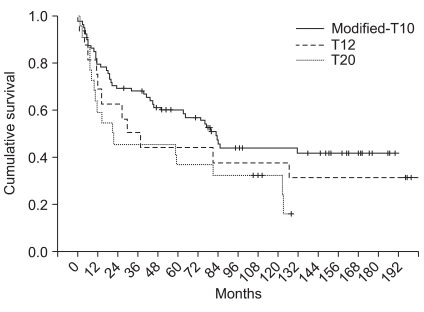
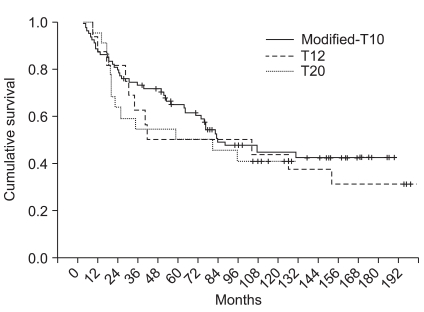
Methods: From Jan 1988 to Nov 2008, 167 patients with osteosarcoma were treated at our hospital and among them, 117 patients (67 males and 50 females) with stage IIB osteosarcoma were evaluable. Their mean age was 22.6 years (range, 8 months to 71 years). Seventy-eight cases underwent the modified T10 (M-T10) protocol (group 1), 23 cases underwent the T20 protocol (group 2) and 16 cases underwent the T12 protocol (group 3). The DFS and OS were calculated and compared according to the chemotherapy protocols.
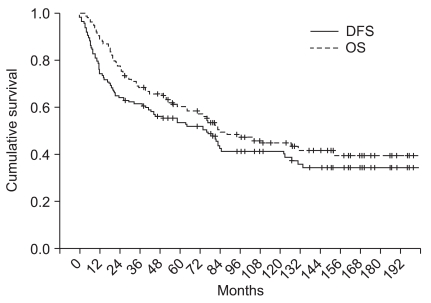
Results: At a mean follow-up of 78.9 months, 63 patients were continuously disease-free (63/117), 6 patients were alive after having metastatic lesions, 7 patients died of other cause and 41 patients died of their disease. The 5- and 10-year OS rates were 60.2% and 44.8%, respectively and the 5- and 10-year DFS rates were 53.5% and 41.4%, respectively. There was no significant difference of the OS and DFS between the chemotherapy protocols (p = 0.692, p = 0.113).
Conclusions: At present, we achieved success rates close to the internationally accepted DFS and OS. We were able to achieve the higher survival rates using the M-T10 protocol over the 20 years. However, there was no significant difference of results between the chemotherapy protocols. We think the M-T10 protocol will achieve more favorable results in the near future.
Keywords: Chemotherapy protocol; Long-term survival rate; Osteosarcoma.
Conflict of interest statement
No potential conflict of interest relevant to this article was reported.
Figures
References
-
- Bacci G, Longhi A, Fagioli F, Briccoli A, Versari M, Picci P. Adjuvant and neoadjuvant chemotherapy for osteosarcoma of the extremities: 27 year experience at Rizzoli Institute, Italy. Eur J Cancer. 2005;41(18):2836–2845. - PubMed
-
- Link MP, Goorin AM, Miser AW, et al. The effect of adjuvant chemotherapy on relapse-free survival in patients with osteosarcoma of the extremity. N Engl J Med. 1986;314(25):1600–1606. - PubMed
-
- Rosen G, Caparros B, Huvos AG, et al. Preoperative chemotherapy for osteogenic sarcoma: selection of postoperative adjuvant chemotherapy based on the response of the primary tumor to preoperative chemotherapy. Cancer. 1982;49(6):1221–1230. - PubMed
-
- Winkler K, Beron G, Kotz R, et al. Neoadjuvant chemotherapy for osteogenic sarcoma: results of a Cooperative German/Austrian study. J Clin Oncol. 1984;2(6):617–624. - PubMed
-
- Bacci G, Ferrari S, Bertoni F, et al. Long-term outcome for patients with nonmetastatic osteosarcoma of the extremity treated at the istituto ortopedico rizzoli according to the istituto ortopedico rizzoli/osteosarcoma-2 protocol: an updated report. J Clin Oncol. 2000;18(24):4016–4027. - PubMed
MeSH terms
Substances
Supplementary concepts
LinkOut - more resources
Full Text Sources
Medical
Research Materials