Phase IIa clinical trial of curcumin for the prevention of colorectal neoplasia
- PMID: 21372035
- PMCID: PMC4136551
- DOI: 10.1158/1940-6207.CAPR-10-0098
Phase IIa clinical trial of curcumin for the prevention of colorectal neoplasia
Erratum in
- Cancer Prev Res (Phila). 2012 Dec;5(12):1407. Dosage error in article text
Abstract
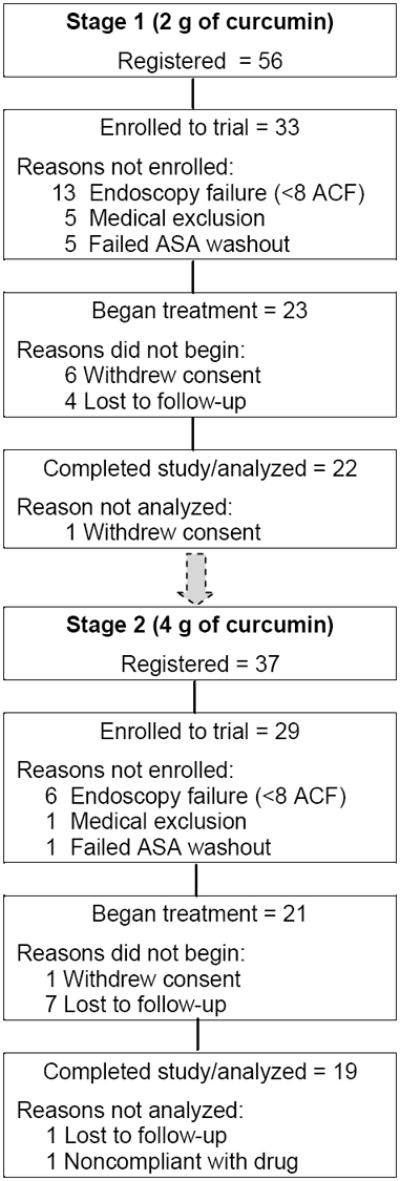
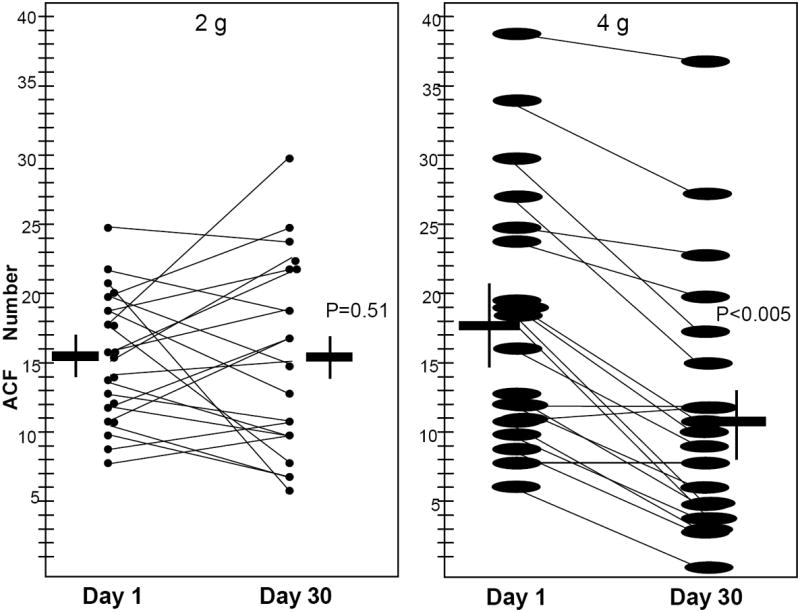
Curcumin is derived from the spice tumeric and has antiinflammatory and antineoplastic effects in vitro and in animal models, including preventing aberrant crypt foci (ACF) and adenomas in murine models of colorectal carcinogenesis. Inhibiting the production of the procarcinogenic eicosanoids prostaglandin E₂ (PGE₂) and 5-hydroxyeicosatetraenoic acid (5-HETE) can suppress carcinogenesis in rodents. Curcumin reduces mucosal concentrations of PGE₂ (via inhibition of cyclooxygenases 1 and 2) and 5-HETE (via inhibition of 5-lipoxygenase) in rats. Although preclinical data support curcumin activity in many sites, the poor bioavailability reported for this agent supports its use in the colorectum. We assessed the effects of oral curcumin (2 g or 4 g per day for 30 days) on PGE₂ within ACF (primary endpoint), 5-HETE, ACF number, and proliferation in a nonrandomized, open-label clinical trial in 44 eligible smokers with eight or more ACF on screening colonoscopy. We assessed pre- and posttreatment concentrations of PGE₂ and 5-HETE by liquid chromatography tandem mass spectroscopy in ACF and normal-tissue biopsies; ACF number via rectal endoscopy; proliferation by Ki-67 immunohistochemistry; and curcumin concentrations by high-performance liquid chromatography in serum and rectal mucosal samples. Forty-one subjects completed the study. Neither dose of curcumin reduced PGE₂ or 5-HETE within ACF or normal mucosa or reduced Ki-67 in normal mucosa. A significant 40% reduction in ACF number occurred with the 4-g dose (P < 0.005), whereas ACF were not reduced in the 2-g group. The ACF reduction in the 4-g group was associated with a significant, five-fold increase in posttreatment plasma curcumin/conjugate levels (versus pretreatment; P = 0.009). Curcumin was well tolerated at both 2 g and 4 g. Our data suggest that curcumin can decrease ACF number, and this is potentially mediated by curcumin conjugates delivered systemically.
Figures
Comment in
-
Curcumin chemoprevention: the long road to clinical translation.Cancer Prev Res (Phila). 2011 Mar;4(3):296-8. doi: 10.1158/1940-6207.CAPR-11-0060. Cancer Prev Res (Phila). 2011. PMID: 21372027
References
-
- Rao CV, Rivenson A, Simi B, Reddy BS. Chemoprevention of colon carcinogenesis by dietary curcumin, a naturally occurring plant phenolic compound. Cancer Res. 1995;55:259–66. - PubMed
-
- Mukhopadhyay A, Basu N, Ghatak N, Gujral PK. Anti-inflammatory and irritant activities of curcumin analogues in rats. Agents Actions. 1982;12:508–15. - PubMed
-
- Srimal RC, Dhawan BN. Pharmacology of diferuloyl methane (curcumin), a non-steroidal anti-inflammatory agent. J Pharm Pharmacol. 1973;25:447–52. - PubMed
-
- Huang M, Lysz T, Ferraro T, Abidi T, Laskin J, Conney A. Inhibitory effects of curcumin on in vitro lipoxygenase and cyclooxygenase activity. Cancer Res. 1991;51:813–9. - PubMed
-
- Moxon D, Raza M, Kenney R, et al. Relationship of aging and tobacco use with the development of aberrant crypt foci in a predominantly African-American population. Clin Gastroenterol Hepatol. 2005;3:271–8. - PubMed
Publication types
MeSH terms
Substances
Grants and funding
LinkOut - more resources
Full Text Sources
Other Literature Sources
Medical