


Complications associated with the administration of dantrolene 1987 to 2006: a report from the North American Malignant Hyperthermia Registry of the Malignant Hyperthermia Association of the United States
- PMID: 21372281
- PMCID: PMC3498049
- DOI: 10.1213/ANE.0b013e31820b5f1f
Complications associated with the administration of dantrolene 1987 to 2006: a report from the North American Malignant Hyperthermia Registry of the Malignant Hyperthermia Association of the United States
Abstract
Background: Dantrolene is the only specific treatment for malignant hyperthermia (MH), a genetic disorder in which life-threatening temperature increase has been induced by inhalation anesthetics and succinylcholine. Because MH presents with nonspecific signs and delay of treatment can be fatal, dantrolene may be given as soon as MH is suspected. We report the complications associated with dantrolene administration as documented in AMRA (adverse metabolic/musculoskeletal reaction to anesthesia) reports submitted to the North American Malignant Hyperthermia Registry.
Methods: AMRA reports were analyzed for differences between subjects with and without complications attributed to dantrolene. Documentation of dantrolene dose and subject weight were inclusion criteria. Because some reported complications were likely due to factors other than dantrolene, a reduced set of cases was also defined. We used χ(2) and Mann-Whitney tests. Logistic regression was applied to describe factors associated with increased risk of complications.
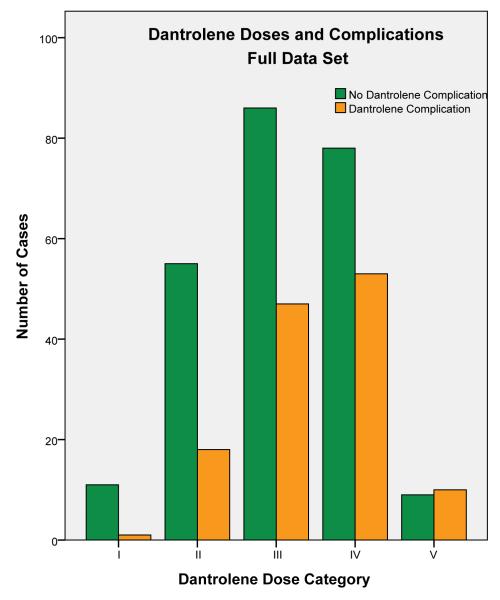
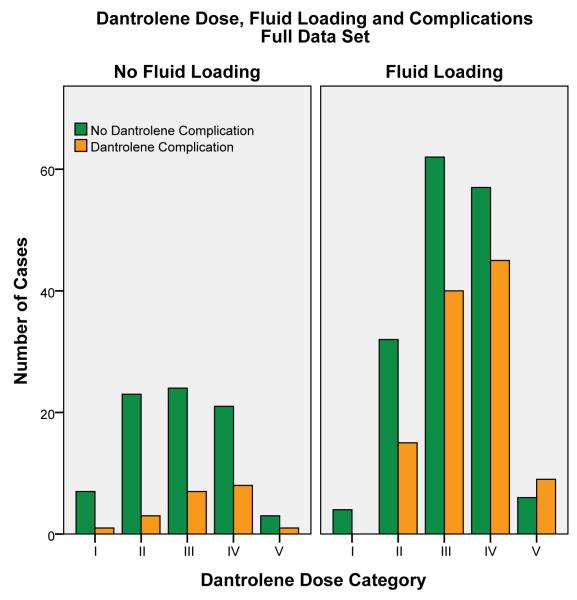
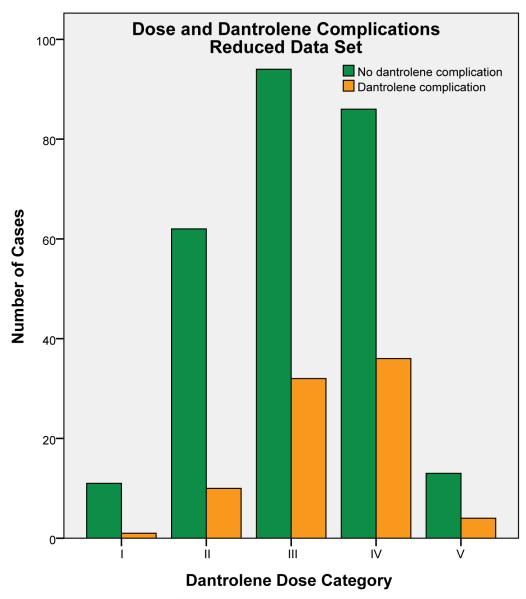
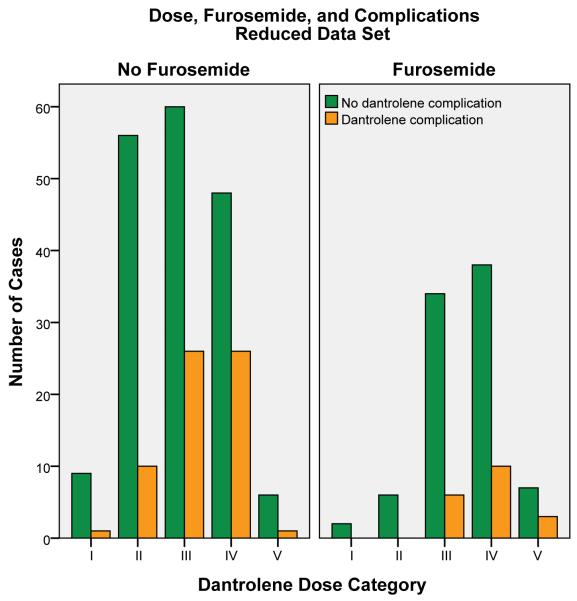
Results: In the full dataset of 368 subjects, the most frequent complications associated with dantrolene were muscle weakness (21.7%), phlebitis (9%), gastrointestinal upset (4.1%), and respiratory failure (3.8%). Logistic regression described a 29% increase in risk of any complication when the total dantrolene dose was doubled, a 144% increase in risk when fluid administration was part of treatment, an 83% decrease in risk in the presence of neurosurgery, and a 74% decrease in risk in the presence of oral surgery. In the dataset reduced by removal of some serious complications that were judged likely to have been due to preexisting disease or the MH event, there were 349 subjects. The most frequent complications associated with dantrolene were muscle weakness (14.6%), phlebitis (9.2%), and gastrointestinal upset (4.3%). In this reduced dataset, logistic regression described a 25% increase in risk of any complication when the total dantrolene dose was doubled, a 572% increase in risk in the presence of obstetric or gynecologic surgery, a 56% decrease in risk if furosemide was given, and no relationship with fluid administration or other types of surgery.
Conclusions: Complications after dantrolene are common, but rarely life threatening. Unidentified factors in the surgical environment are associated with changes in the risk of complications. Fluid management, as part of the treatment of MH, has an important association with the risk of complications after dantrolene administration and should be monitored closely.
© 2011 International Anesthesia Research Society
Figures
Comment in
-
Put out the fire (with apologies to Queen).Anesth Analg. 2011 May;112(5):1011-2. doi: 10.1213/ANE.0b013e318213c5ea. Anesth Analg. 2011. PMID: 21515648 No abstract available.
References
-
- Hainaut K, Desmedt JE. Effect of dantrolene sodium on calcium movements in single muscle fibers. Nature. 1974;252:728–30. - PubMed
-
- Van Winkle WB. Calcium release from skeletal muscle sarcoplasmic reticulum: site of action of dantrolene sodium? Science. 1976;193:1130–1. - PubMed
-
- Kolb ME, Horne ML, Martz R. Dantrolene in human malignant hyperthermia-A multicenter study. Anesthesiology. 1982;56:254–62. - PubMed
-
- Larach MG, Gronert GA, Allen GC, Brandom BW, Lehman EB. Clinical presentation, treatment, and complications of Malignant Hyperthermia in North America from 1987 to 2006. Anesth Analg. 2010;110:498–507. - PubMed
-
- Larach MG, Brandom BW, Allen GC, Gronert GA, Lehman EB. Cardiac arrests and deaths associated with malignant hyperthermia in North America from 1987 to 2006: a report from the North American Malignant Hyperthermia Registry of the Malignant Hyperthermia Association of the United States. Anesthesiology. 2008;108:603–11. - PubMed
Publication types
MeSH terms
Substances
Grants and funding
LinkOut - more resources
Full Text Sources
