


Calibration belt for quality-of-care assessment based on dichotomous outcomes
- PMID: 21373178
- PMCID: PMC3043050
- DOI: 10.1371/journal.pone.0016110
Calibration belt for quality-of-care assessment based on dichotomous outcomes
Abstract
Prognostic models applied in medicine must be validated on independent samples, before their use can be recommended. The assessment of calibration, i.e., the model's ability to provide reliable predictions, is crucial in external validation studies. Besides having several shortcomings, statistical techniques such as the computation of the standardized mortality ratio (SMR) and its confidence intervals, the Hosmer-Lemeshow statistics, and the Cox calibration test, are all non-informative with respect to calibration across risk classes. Accordingly, calibration plots reporting expected versus observed outcomes across risk subsets have been used for many years. Erroneously, the points in the plot (frequently representing deciles of risk) have been connected with lines, generating false calibration curves. Here we propose a methodology to create a confidence band for the calibration curve based on a function that relates expected to observed probabilities across classes of risk. The calibration belt allows the ranges of risk to be spotted where there is a significant deviation from the ideal calibration, and the direction of the deviation to be indicated. This method thus offers a more analytical view in the assessment of quality of care, compared to other approaches.
Conflict of interest statement
Figures
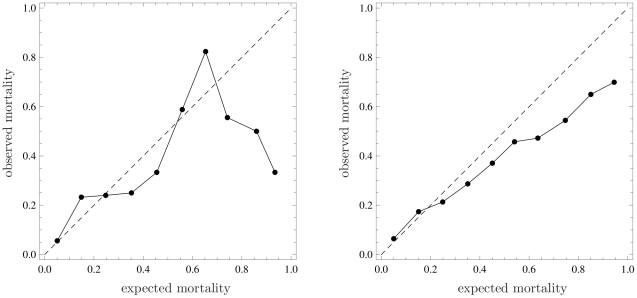
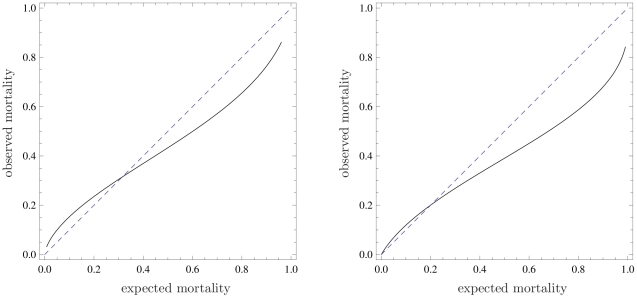
 for the
left curve and
for the
left curve and  for the
right one. To avoid extrapolation the curve have been plotted in the
range of mortality where data are present. Refer to the caption of Fig. 1 for information
about the data sets.
for the
right one. To avoid extrapolation the curve have been plotted in the
range of mortality where data are present. Refer to the caption of Fig. 1 for information
about the data sets.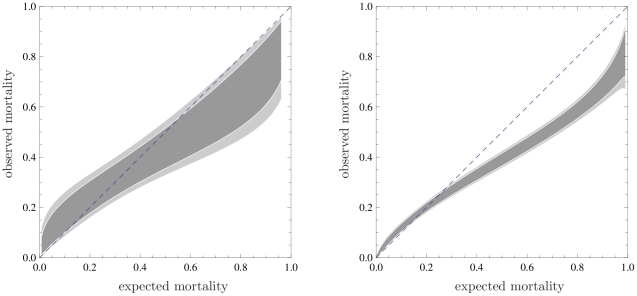
 (dark shaded area) and
 (light shaded area);
 for the
first example (left panel),
for the
first example (left panel),  for the
second (right panel). bisector (dashed line). As in
Fig. 2, the
calibrations bands have been plotted in the range of mortality where
data are present. Refer to the caption of Fig. 1 for information about the data
sets.
for the
second (right panel). bisector (dashed line). As in
Fig. 2, the
calibrations bands have been plotted in the range of mortality where
data are present. Refer to the caption of Fig. 1 for information about the data
sets.References
-
- Donabedian A. The quality of care. how can it be assessed? JAMA. 1988;260:1743–1748. - PubMed
-
- Wyatt J, Altman D. Prognostic models: clinically useful or quickly forgotten? Bmj. 1995;311:1539–1541.
-
- Lemeshow S, Hosmer D. A review of goodness of fit statistics for use in the development of logistic regression models. Am J Epidemiol. 1982;115:92–106. - PubMed
-
- Bertolini G, D'Amico R, Nardi D, Tinazzi A, Apolone G, et al. One model, several results: the paradox of the hosmer–lemeshow goodness-of-fit test for the logistic regression model. J Epidemiol Biostat. 2000;5:251–253. - PubMed
-
- Kramer A, Zimmerman J. Assessing the calibration of mortality benchmarks in critical care: The hosmer–lemeshow test revisited. Crit Care Med. 2007;35:2052–2056. - PubMed
Publication types
MeSH terms
LinkOut - more resources
Full Text Sources
Other Literature Sources
Molecular Biology Databases
