


Age-specific incidence of A/H1N1 2009 influenza infection in England from sequential antibody prevalence data using likelihood-based estimation
- PMID: 21373639
- PMCID: PMC3044152
- DOI: 10.1371/journal.pone.0017074
Age-specific incidence of A/H1N1 2009 influenza infection in England from sequential antibody prevalence data using likelihood-based estimation
Abstract
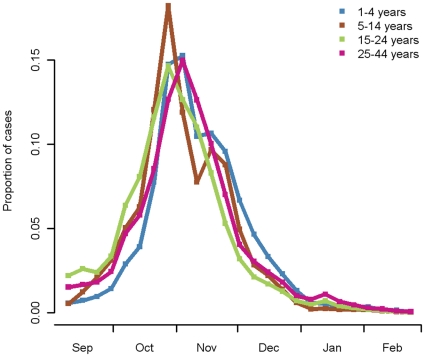
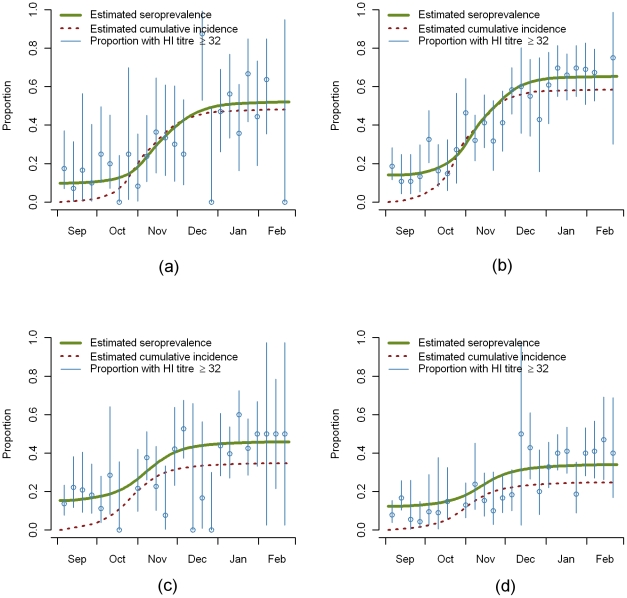
Estimating the age-specific incidence of an emerging pathogen is essential for understanding its severity and transmission dynamics. This paper describes a statistical method that uses likelihoods to estimate incidence from sequential serological data. The method requires information on seroconversion intervals and allows integration of information on the temporal distribution of cases from clinical surveillance. Among a family of candidate incidences, a likelihood function is derived by reconstructing the change in seroprevalence from seroconversion following infection and comparing it with the observed sequence of positivity among the samples. This method is applied to derive the cumulative and weekly incidence of A/H1N1 pandemic influenza in England during the second wave using sera taken between September 2009 and February 2010 in four age groups (1-4, 5-14, 15-24, 25-44 years). The highest cumulative incidence was in 5-14 year olds (59%, 95% credible interval (CI): 52%, 68%) followed by 1-4 year olds (49%, 95% CI: 38%, 61%), rates 20 and 40 times higher respectively than estimated from clinical surveillance. The method provides a more accurate and continuous measure of incidence than achieved by comparing prevalence in samples grouped by time period.
Conflict of interest statement
Figures


References
-
- Baguelin M, Hoek AJV, Jit M, Flasche S, White PJ, et al. Vaccination against pandemic influenza A/H1N1v in England: a real-time economic evaluation. Vaccine; 2010;28(2):2370–2384. doi: 10.1016/j.vaccine.2010.01.002. - DOI - PubMed
-
- Miller M, Hoschler K, Hardelid P, Stanford E, Andrews N, et al. Incidence of 2009 pandemic influenza A H1N1 infection in England: a cross-sectional serologic study. The Lancet; 2010;375(9720), 27:1100–1108. - PubMed
-
- Garske T, Legrand J, Donnelly CA, Ward H, Cauchemez S, et al. Assessing the severity of the novel influenza A/H1N1 pandemic. BMJ. 2009;339:b2840. doi: 10.1136/bmj.b2840. - DOI - PubMed
-
- HPA Seroepidemiology Programme. Available: http://www.hpa.org.uk/webw/HPAweb&Page&HPAwebAutoListName/Page/115831343.... Accessed 2010 Dec 16.
-
- Hardelid P, Andrews NJ, Hoschler K, Stanford E, Baguelin M, et al. Assessment of baseline age-specific antibody prevalence and incidence of infection to novel influenza A H1N1 2009. Health Technology Assessment; 2010;14:no 55. 115–192. - PubMed
Publication types
MeSH terms
Substances
LinkOut - more resources
Full Text Sources
Medical
