. 2011 Sep 7;136(17):3557-65.
doi: 10.1039/c0an00854k. Epub 2011 Mar 4.

Functional groups modulate the sensitivity and electron transfer kinetics of neurochemicals at carbon nanotube modified microelectrodes

Affiliations

Functional groups modulate the sensitivity and electron transfer kinetics of neurochemicals at carbon nanotube modified microelectrodes

Christopher B Jacobs et al. Analyst. .

Abstract

The surface properties of carbon-based electrodes are critically important for the detection of biomolecules and can modulate electrostatic interactions, adsorption and electrocatalysis. Carbon nanotube (CNT) modified electrodes have previously been shown to have increased oxidative sensitivity and reduced overpotential for catecholamine neurotransmitters, but the effect of surface functionalities on these properties has not been characterized. In this study, we modified carbon-fiber microelectrodes (CFMEs) with three differently functionalized single-wall carbon nanotubes and measured their response to serotonin, dopamine, and ascorbic acid using fast-scan cyclic voltammetry. Both carboxylic acid functionalized and amide functionalized CNTs increased the oxidative current of CFMEs by approximately 2-6 fold for the cationic neurotransmitters serotonin and dopamine, but octadecylamine functionalized CNTs resulted in no significant signal change. Similarly, electron transfer was faster for both amide and carboxylic acid functionalized CNT modified electrodes but slower for octadecylamine CNT modified electrodes. Oxidation of ascorbic acid was only increased with carboxylic acid functionalized CNTs although all CNT-modified electrodes showed a trend towards increased reversibility for ascorbic acid. Carboxylic acid-CNT modified disk electrodes were then tested for detection of serotonin in the ventral nerve cord of a Drosophila melanogaster larva, and the increase in sensitivity was maintained in biological tissue. The functional groups of CNTs therefore modulate the electrochemical properties, and the increase in sensitivity from CNT modification facilitates measurements in biological samples.


Figures
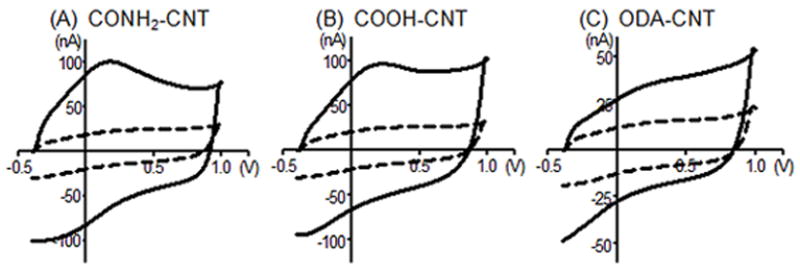
Figure 1
Figure 1
Example fast-scan cyclic voltammograms showing background currents for bare electrodes (dashed line), and functionalized CNT-modified electrodes (solid line) using: (A), amide-, (B) carboxylic acid-, and (C) octadecylamine-functionalized CNTs. Each panel compares data before and after modification for the same electrode. Electrode was scanned from −0.4 to 1.0V and back at 400 V/s at 10 Hz.
Figure 2
Figure 2
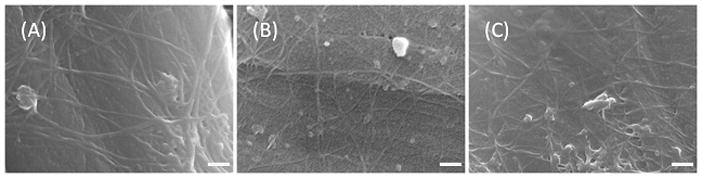
Scanning electron microscopy images of (A) a CONH2-CNT, (B) a COOH-CNT, and (C) an ODA-CNT -modified carbon fiber disk microelectrode display relatively similar layers of nanotubes on the carbon-fiber surface, implying that differences between the three different functionalized CNTs do not largely affect the nanotube layer. The white scale bar represents 100 nm.
Figure 3
Figure 3
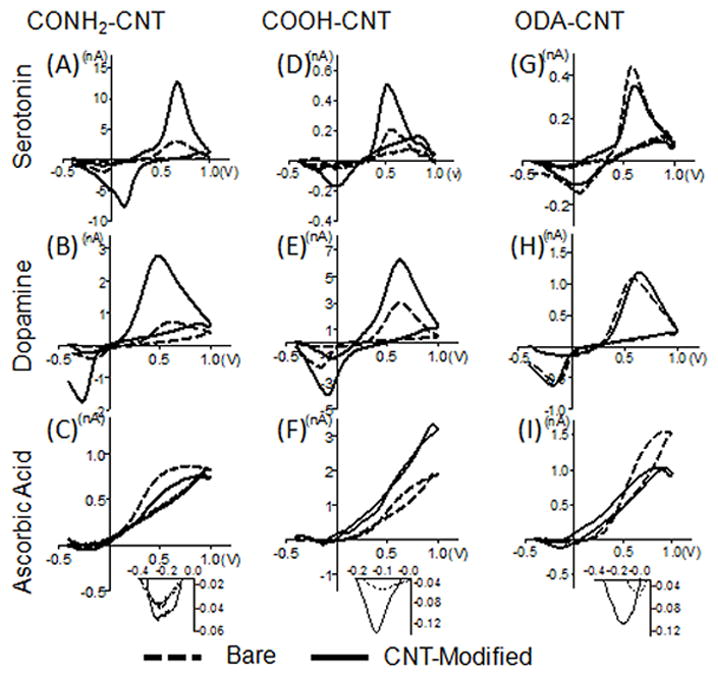
Representative cyclic voltammograms from electrodes before (dashed lines) and after modification with carbon nanotubes (solid line). Vertical columns compare types of functionalized nanotubes: amide-CNTs (panels A–C), carboxylic acid-CNTs (panels D–F) and octadecylamine-CNTs (panels G–I). Horizontal rows compare different compounds 10 μM serotonin (panels A, D, G), 10 μM dopamine (panels B, E, H), and 200 μM ascorbic acid (panels C, F, I). The insets for ascorbic acid show the reduction peaks.
Figure 4
Figure 4
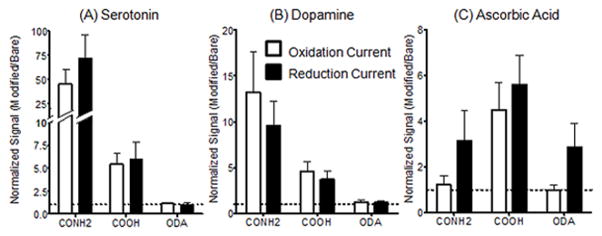
Averaged data comparing normalized peak currents. Signals after CNT modification are normalized by dividing by the current before modification for each electrode. These ratios were then averaged. Error bars are standard error of the mean. The dotted line at 1.0 marks no change in signal after electrode modification. Normalized values for (A) 10 μM serotonin, (B) 10 μM dopamine, and (C) 200 μM ascorbic acid show that the sensitivity to different analytes is dependent on surface functional groups. See Table 1 for sample group sizes.
Figure 5
Figure 5
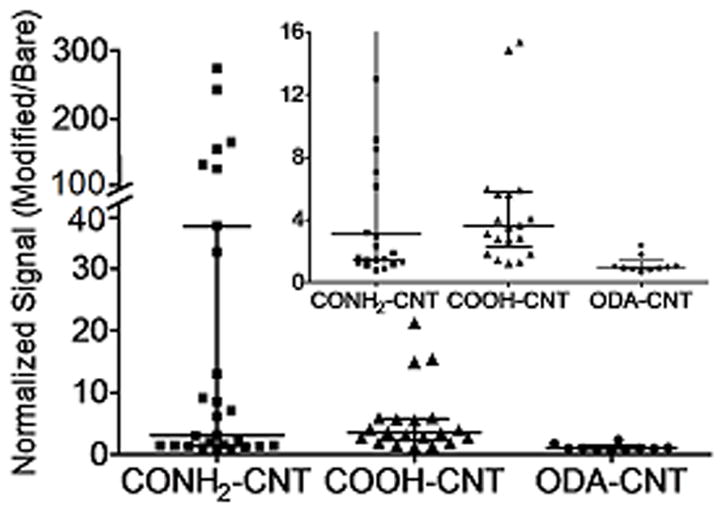
Scatter plots of normalized oxidation signal for 10 μM serotonin comparing the effects of carbon nanotube-modified electrodes with different functional groups: CONH2-CNT, COOH-CNT and ODA-CNT. On the scatter-whisker plots, the short horizontal lines outline the quartiles, long horizontal lines denote the median and points represent individual data points. The inset is magnified to better display lower signals.
Figure 6
Figure 6
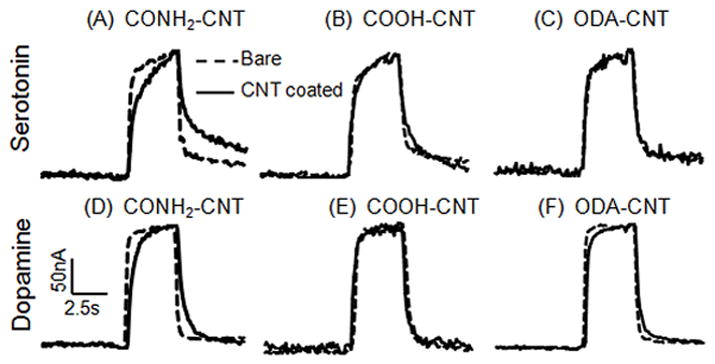
Normalized current vs time plots comparing the electrode time response to a bolus of 10μM serotonin (A–C), and 10μM dopamine (D–F). These responses were averaged from 10 electrodes each, but error bars are not shown for clarity. Bare electrodes are dashed lines and electrodes after CNT-modification are solid lines. Plots of COOH-CNT (A, D), CONH2-CNT (B, E), and ODA-CNT (C, F) responses are compared.
Figure 7
Figure 7
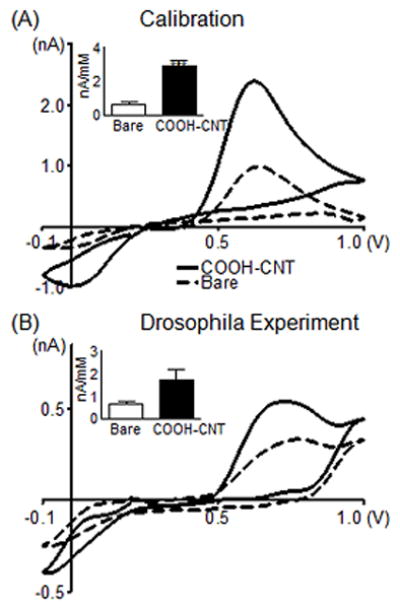
Measurements of endogenous serotonin in Drosophila. (A) Effect of COOH-CNT modification on the detection of 10 μM serotonin using the “serotonin waveform.” Electrode was scanned from 0.2 to 1.0 to −0.1 and back to 0.2 V at 1000 V/s at 10 Hz. The CV compares an electrode before (dashed) and after (solid) CNT modification during in vitro calibration. The inset shows average sensitivity for the oxidation peak (n=5). (B) Detection of serotonin in a larval Drosophila melanogaster ventral nerve cord. Different nerve cords are used for the bare (dashed) and COOH-CNT (solid) electrodes. Converting current to concentration using calibration data shows the COOH-CNT detected 650 nM serotonin with a peak oxidation current of 0.54 nA, while the bare electrode detected 870 nM serotonin with a peak oxidation current of 0.33 nA. The inset shows the average sensitivity for bare electrodes and COOH-CNT modified electrodes in Drosophila (n=5).

References

    1. McCreery RL. Chem Rev. 2008;108:2646. - PubMed
    1. Bath BD, Martin HB, Wightman RM, Anderson MR. Langmuir. 2001;17:7032.
    1. Heien ML, Phillips PE, Stuber GD, Seipel AT, Wightman RM. Analyst. 2003;128:1413. - PubMed
    1. Duvall SH, McCreery RL. J Am Chem Soc. 2000;122:6759.
    1. Allred CD, McCreery RL. Anal Chem. 1992;64:444.

Publication types

LinkOut - more resources