


To stop or not to stop, that's the question: about persistence and mood of workaholics and work engaged employees
- PMID: 21373772
- PMCID: PMC3212689
- DOI: 10.1007/s12529-011-9143-z
To stop or not to stop, that's the question: about persistence and mood of workaholics and work engaged employees
Abstract
Background: Although workaholics and work engaged employees both work long hours, they seem to have a different underlying motivation to do so. The mood as input model might offer an explanation for the difference in work persistence of these employees. This model suggests that the interplay of mood and "persistence rules" (enough and enjoyment rules) may lead to different kinds of persistence mechanisms.
Purpose: The aims of this study are to present a scale for measuring persistence rules, the Work Persistence rules Checklist (WoPeC), to analyze its psychometric properties and to test the mood as input model in relationship with workaholism and work engagement.
Method: Structural equation modeling was used to analyze the data.
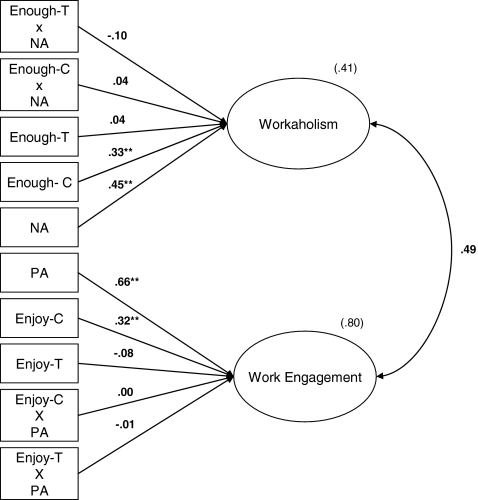
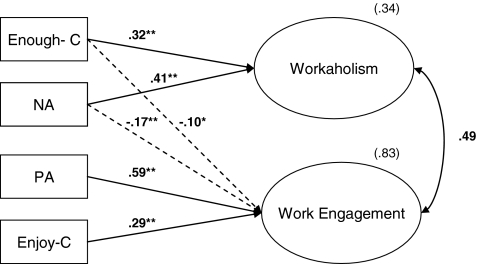
Results: Results of a confirmatory factor analysis in study 1 provided support for the hypothesized factor structure of the WoPeC. In study 2, it appeared that the use of an enough and an enjoyment rule for determining when to continue working is related to workaholism and work engagement, respectively. Furthermore, it was hypothesized and found that negative mood is related to workaholism, whereas positive mood is associated with work engagement. The expected interactions between mood and persistence rules on workaholism and work engagement were not demonstrated.
Conclusion: Mood and persistence rules seem relevant for explaining the difference between workaholism and work engagement.
Figures
References
-
- Sullivan C. What’s in a name? Definitions and conceptualisations of teleworking and homeworking. New Technol Work Employ. 2006;18(3):158–165. doi: 10.1111/1468-005X.00118. - DOI
-
- Forlano L. Working on the move: the social and digital ecologies of mobile work places. In: Hislop D, editor. Mobility and technology in the workplace. London: Routledge; 2007.
-
- Cascio W. Strategies for responsible restructuring. Acad Manage Exec. 2002;16(3):80–91. doi: 10.5465/AME.2002.8540331. - DOI
-
- Galinsky E, Kim SS, Bond JT. Feeling overworked? When work becomes too much. New York: Families and Work Institute; 2001.
Publication types
MeSH terms
LinkOut - more resources
Full Text Sources
