


doi: 10.1007/s10803-010-1150-4.
Brief report: face-specific recognition deficits in young children with autism spectrum disorders
Affiliations
- PMID: 21373955
- PMCID: PMC4871156
- DOI: 10.1007/s10803-010-1150-4
Item in Clipboard
Brief report: face-specific recognition deficits in young children with autism spectrum disorders
J Autism Dev Disord.
2011 Oct.
Abstract
This study used eyetracking to investigate the ability of young children with autism spectrum disorders (ASD) to recognize social (faces) and nonsocial (simple objects and complex block patterns) stimuli using the visual paired comparison (VPC) paradigm. Typically developing (TD) children showed evidence for recognition of faces and simple objects, but not complex block patterns. Children with ASD were successful at recognizing novel objects and block patterns, but showed no evidence for face recognition. These findings suggest that young children with ASD have specific impairments in face recognition, and that they may have advantage over TD controls when processing complex nonsocial stimuli.
Figures
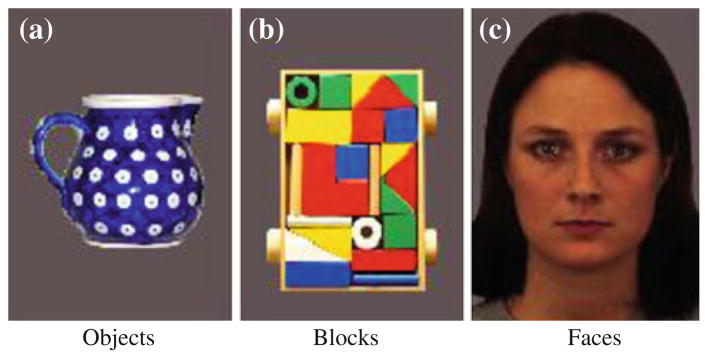
Images employed in object (a), block (b), and face (c) conditions
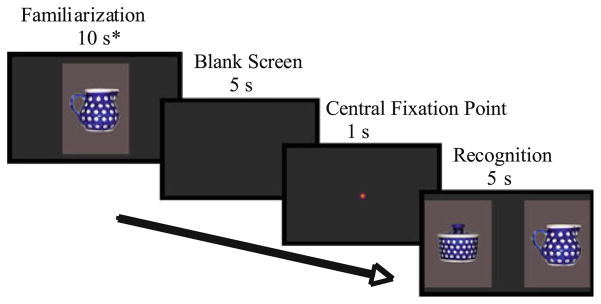
Example of visual paired comparison paradigm. * Duration of familiarization was dependent on the child’s looking time; the 10 s shown here indicates 10 s of accumulated looking
References
-
- American Psychiatric Association. Diagnostic and statistical manual of mental disorders. 4. Washington DC: American Psychiatric Association; 1994.
-
- Bushnell I. Mother’s face recognition in newborn infants: Learning and memory. Infant and Child Development. 2001;10(1–2):67–74. doi: 10.1002/icd.248. - DOI
Publication types
MeSH terms
Grants and funding
LinkOut - more resources
Full Text Sources
