The effects of multiple freeze-thaw cycles on the biomechanical properties of the human bone-patellar tendon-bone allograft
- PMID: 21374710
- PMCID: PMC3132590
- DOI: 10.1002/jor.21373
The effects of multiple freeze-thaw cycles on the biomechanical properties of the human bone-patellar tendon-bone allograft
Abstract
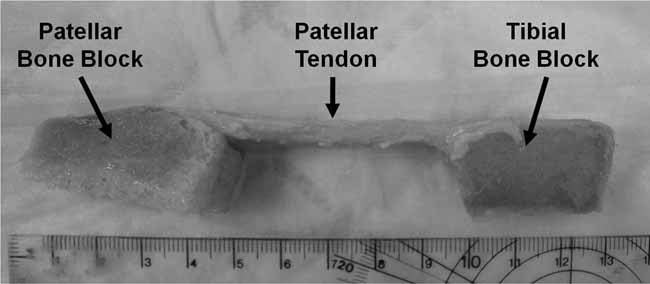
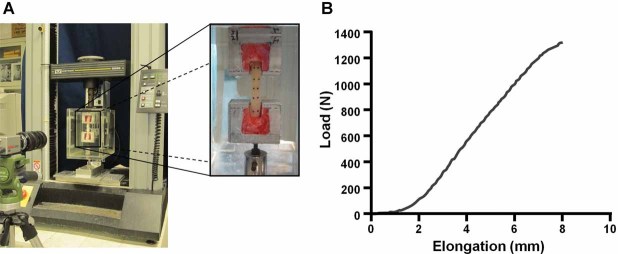
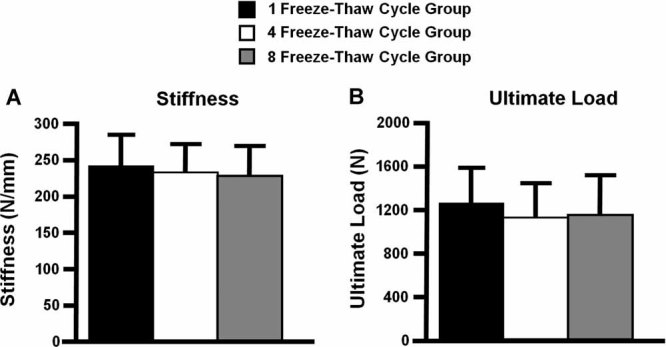
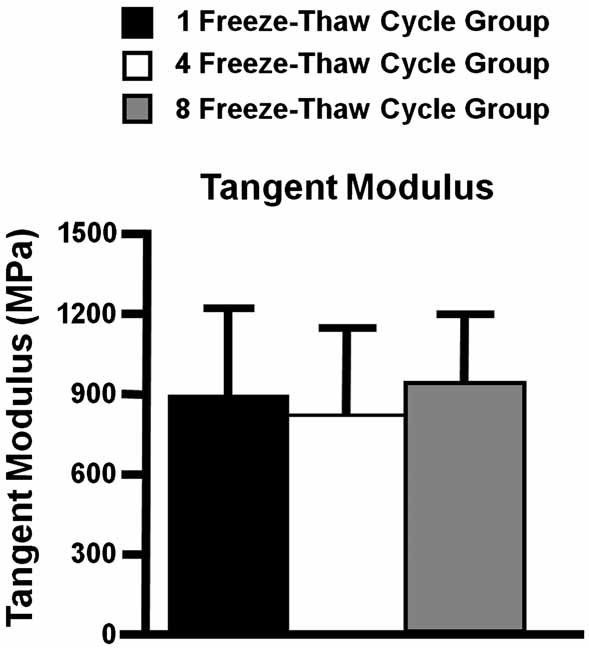
Soft tissue allografts, such as the bone-patellar tendon-bone (BPTB) graft, have been frequently used for anterior cruciate ligament (ACL) reconstruction. As allografts are subjected to freezing and thawing for multiple cycles, the objective of this study was to measure the changes of the biomechanical properties of the human BPTB allograft after 4 and 8 freeze-thaw cycles in comparison to a single freeze-thaw cycle. Three BPTB specimens were procured from 21 human donors and divided into three groups: 1, 4, or 8 freeze-thaw cycles. Each freeze-thaw cycle consisted of freezing at -20 ± 10°C for more than 6 h and thawing at 22 ± 3°C for at least 6 h. Tensile testing of the BPTB specimens consisted of loading between 50 N and 250 N for 100 cycles and then loading to failure. Cyclic loading revealed a similar amount of creep (∼0.5 mm) among the three freeze-thaw cycles groups (p = 0.38). The stiffness of the BPTB graft for the 1, 4, and 8 freeze-thaw cycle groups were 244 ± 42 N/mm, 235 ± 39 N/mm, and 231 ± 40 N/mm, respectively (p = 0.43). Similar findings were obtained for the ultimate load of the BPTB graft (p = 0.14) and the tangent modulus of the PT substance (p = 0.41). The results of this study suggest that there would be little measurable effect on the structural properties of the BPTB graft or mechanical properties of the PT tissue substance following 8 freeze-thaw cycles. These BPTB allografts could potentially be re-frozen without a loss in their biomechanical properties, given appropriate storage and care.
Copyright © 2011 Orthopaedic Research Society.
Figures
References
-
- Goldstein JL, Verma N, McNickle AG, et al. Avoiding mismatch in allograft anterior cruciate ligament reconstruction: Correlation between patient height and patellar tendon length. Arthroscopy. 2010;26:643–650. - PubMed
-
- Barker JU, Drakos MC, Maak TG, et al. Effect of graft selection on the incidence of postoperative infection in anterior cruciate ligament reconstruction. Am J Sports Med. 2010;38:281–286. - PubMed
-
- Poehling GG, Curl WW, Lee CA, et al. Analysis of outcomes of anterior cruciate ligament repair with 5-year follow-up: Allograft versus autograft. Arthroscopy. 2005;21:774–785. - PubMed
-
- Kurosaka M, Yoshiya S, Andrish JT. A biomechanical comparison of different surgical techniques of graft fixation in anterior cruciate ligament reconstruction. Am J Sports Med. 1987;15:225–229. - PubMed
Publication types
MeSH terms
LinkOut - more resources
Full Text Sources
Other Literature Sources
Research Materials