


doi: 10.1002/anie.201005853.
Epub 2011 Mar 4.
Highly efficient capture of circulating tumor cells by using nanostructured silicon substrates with integrated chaotic micromixers
Affiliations
- PMID: 21374764
- PMCID: PMC3085082
- DOI: 10.1002/anie.201005853
Item in Clipboard
Highly efficient capture of circulating tumor cells by using nanostructured silicon substrates with integrated chaotic micromixers
Angew Chem Int Ed Engl.
.
No abstract available
Figures
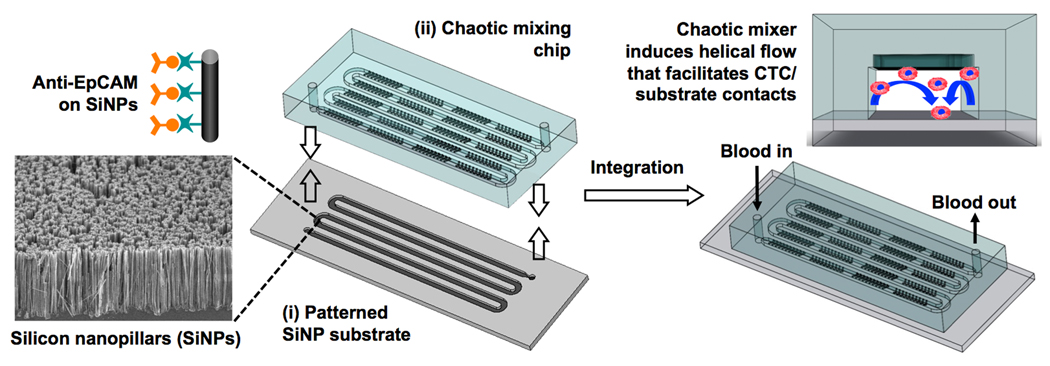
Schematic representation of the configuration and operational mechanism of an integrated device for capturing circulating tumor cells (CTCs). The device is composed two functional components, (i) a patterned silicon nanopillar (SiNP) substrate with anti-EpCAM-coating exhibiting vastly enhanced CTC-capture affinity, and (ii) an overlaid microfluidic chaotic mixing chip capable of promoting cell/substrate contact frequency. The embedded chevron-shaped micropatterns on the roof of the chaotic mixing chip channel induce vertical flow that facilitates CTC/substrate contact. Thus, highly efficient CTC capture can be achieved by the synergistic effects associated with enhanced CTC/substrate affinity and contact frequency.
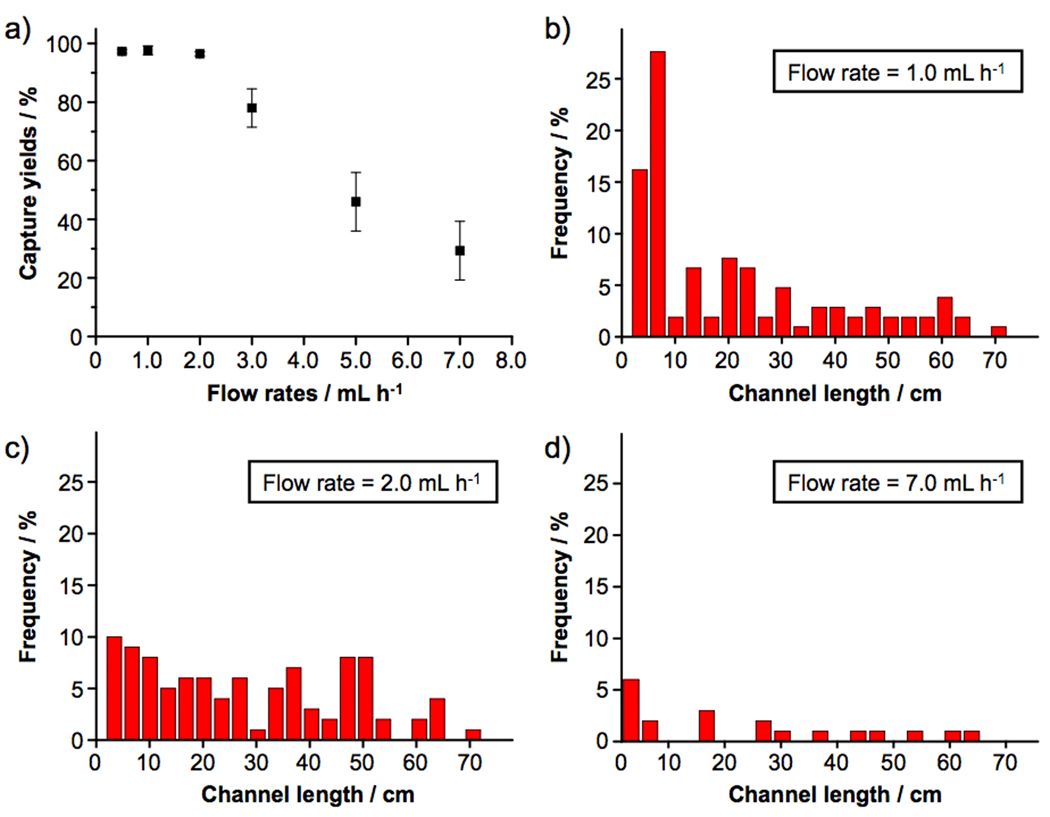
a) Cell-capture efficiency of the integrated CTC-capture device at flow rates of 0.5, 1, 2, 3, 5 and 7 mL h−1. Error bars show standard deviations (n = 3). 1.0-mL Cell suspensions containing EpCAM-positive MCF7 breast cancer cells (100 cells mL−1) were employed as a model system. The error bars of the first three data points are very small. Spatial distribution of substrate-immobilized MCF7 cells along the serpentine microchannels at different flow rates of b) 1, c) 2, and d) 7 mL h−1.
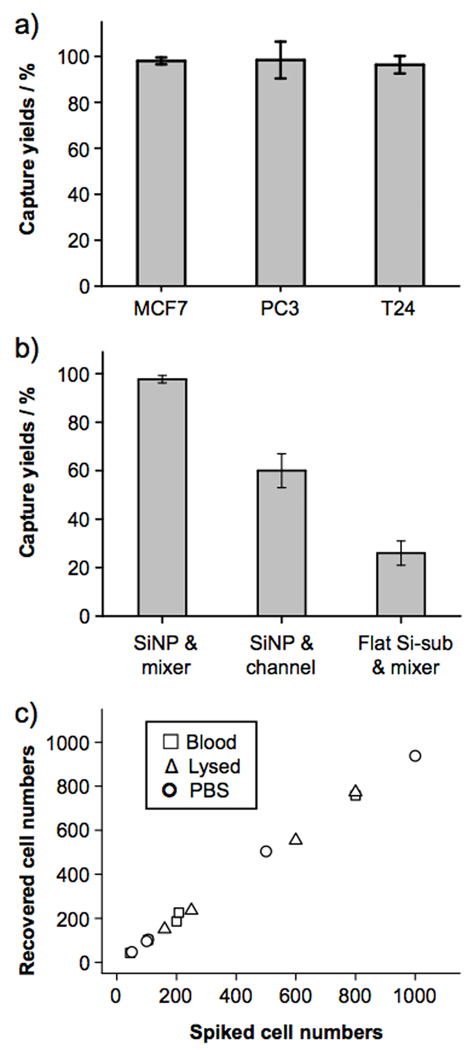
a) Cell-capture efficiency of the integrated CTC-capture device using suspensions of breast (MCF7), prostate (PC3) and bladder (T-24) cell lines. Error bars show standard deviations (n = 3). b) Comparison of cell-capture between the integrated CTC-capture device and two control devices (i) without SiNPs on the patterned substrate and (ii) without the chevron-shaped micropatterns in the microfluidic channels. c) Comparison of cell-capture efficiency at different cell numbers ranging from 50–1000 cells mL−1. Three different types of samples, including whole blood (□), lysed blood (△) and PBS buffer (○) were examined.
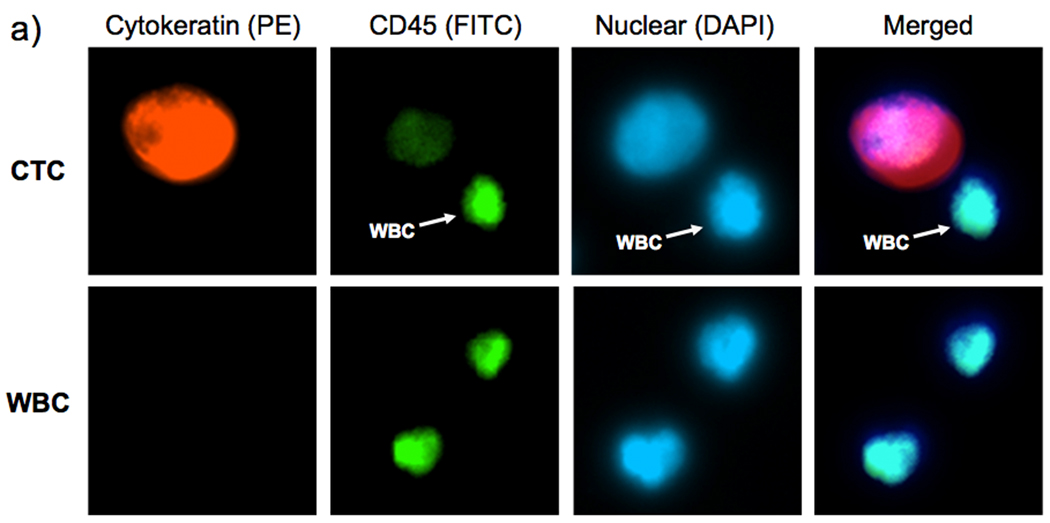
a) Fluorescent micrographs of CTCs captured from blood samples from a prostate cancer (PC) patients. Three-color immunocytochemistry protocol based on PE-labeled anti-Cytokeratin (a protein marker for epithelium cells), FITC-labeled anti-CD45 (a marker for WBCs) and DAPI nuclear staining was applied to identify and enumerate CTCs from non-specifically trapped WBCs on the SiNP substrates. Side-by-side comparison of CTC enumeration results obtained from b) our integrated CTC-capture technology (red columns, normalized to 7.5 mL of blood) and a CellSearch® assay (blue columns) on matched samples from 26 PC patients. **The raw data without normalization from 1.0 to 7.5 mL using our integrated devices and by CellSearch® assay are summarized in Supporting Information (Table S2).
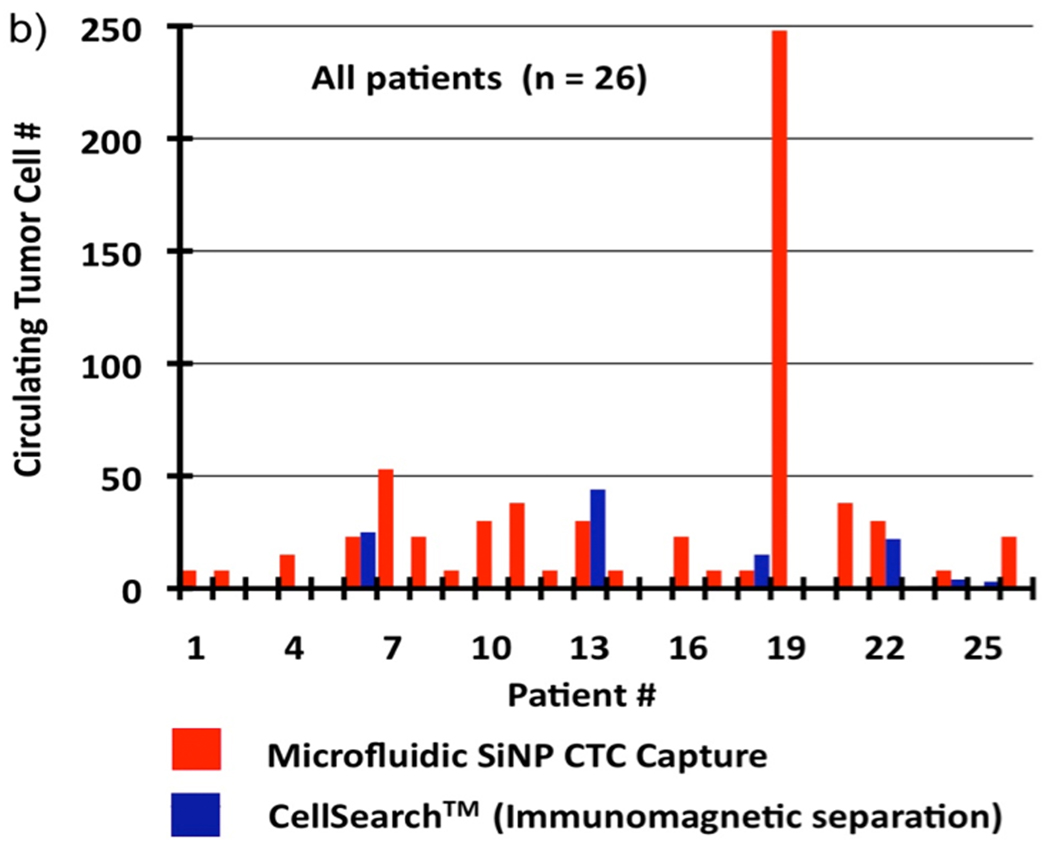
a) Fluorescent micrographs of CTCs captured from blood samples from a prostate cancer (PC) patients. Three-color immunocytochemistry protocol based on PE-labeled anti-Cytokeratin (a protein marker for epithelium cells), FITC-labeled anti-CD45 (a marker for WBCs) and DAPI nuclear staining was applied to identify and enumerate CTCs from non-specifically trapped WBCs on the SiNP substrates. Side-by-side comparison of CTC enumeration results obtained from b) our integrated CTC-capture technology (red columns, normalized to 7.5 mL of blood) and a CellSearch® assay (blue columns) on matched samples from 26 PC patients. **The raw data without normalization from 1.0 to 7.5 mL using our integrated devices and by CellSearch® assay are summarized in Supporting Information (Table S2).
References
Publication types
MeSH terms
Substances
Grants and funding
LinkOut - more resources
Full Text Sources
Other Literature Sources
Medical
