


Impaired safety signal learning may be a biomarker of PTSD
- PMID: 21377482
- PMCID: PMC3146576
- DOI: 10.1016/j.neuropharm.2011.02.023
Impaired safety signal learning may be a biomarker of PTSD
Abstract
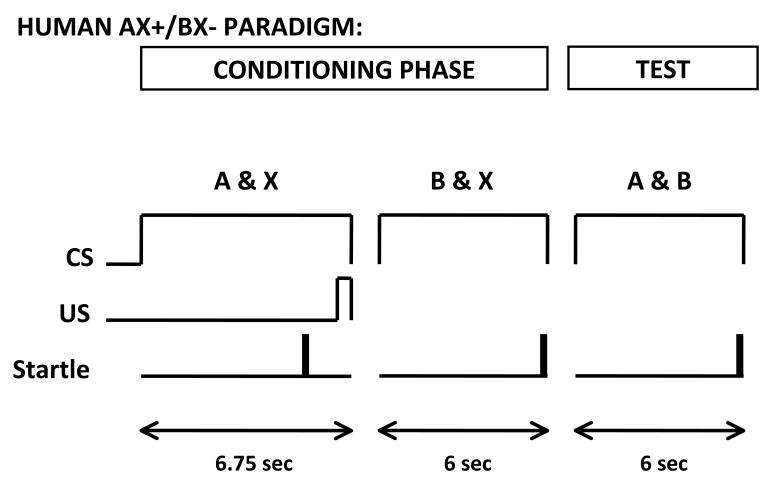
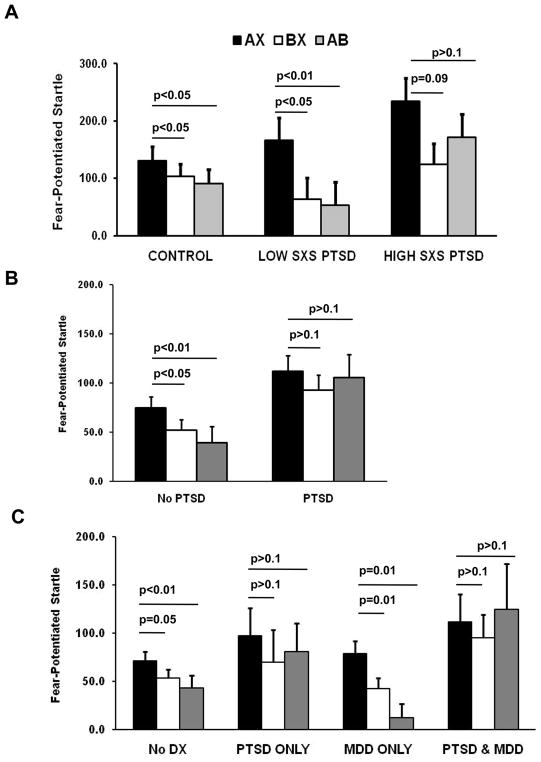
A dysregulated fear response is one of the hallmark clinical presentations of patients suffering from posttraumatic stress disorder (PTSD). These patients show over-generalization of fear and in tandem an inability to inhibit fear responses in the presence of safety. Here, we summarize our recent findings using a conditional discrimination paradigm, which assesses safety signal processing (AX+/BX-) in combat and civilian PTSD populations. Overall, PTSD subjects demonstrate a lack of safety signal learning and an inability to modulate the fear responses with safety cues. We then review studies of the neurobiology of fear expression and inhibition in humans and non-humans, in order to provide a background for preliminary studies using reverse translation procedures in which the same AX+/BX- paradigm was used in rhesus macaques. This article is part of a Special Issue entitled 'Post-Traumatic Stress Disorder'.
Copyright © 2011 Elsevier Ltd. All rights reserved.
Figures

References
-
- Aggleton JP, Passingham RE. Syndrome produce by lesions of the amygdala in monkeys (Macaca mulatta) Journal of Comparative and Physiological Psychology. 1981;95:961–977. - PubMed
-
- Ameli R, Ip C, Grillon C. Contextual fear-potentiated startle conditioning in humans: replication and extension. Psychophysiology. 2001;38:383–390. - PubMed
Publication types
MeSH terms
Grants and funding
- R21 MH086947/MH/NIMH NIH HHS/United States
- R33 MH086947/MH/NIMH NIH HHS/United States
- R21 MH092576/MH/NIMH NIH HHS/United States
- 1F32 MH070129-01A2/MH/NIMH NIH HHS/United States
- R37 MH047840/MH/NIMH NIH HHS/United States
- R01 MH058846/MH/NIMH NIH HHS/United States
- UL1 RR025008/RR/NCRR NIH HHS/United States
- HD35471/HD/NICHD NIH HHS/United States
- R37 MH47840/MH/NIMH NIH HHS/United States
- MH086947/MH/NIMH NIH HHS/United States
- F32 MH070129/MH/NIMH NIH HHS/United States
- P01 HD035471/HD/NICHD NIH HHS/United States
- UL1 TR000454/TR/NCATS NIH HHS/United States
- MH-58846/MH/NIMH NIH HHS/United States
LinkOut - more resources
Full Text Sources
Medical
