. 2011 Apr;37(4):316-23.
doi: 10.1016/j.ijantimicag.2010.12.019. Epub 2011 Mar 5.

Combined treatment of Pseudomonas aeruginosa biofilm with lactoferrin and xylitol inhibits the ability of bacteria to respond to damage resulting from lactoferrin iron chelation

Affiliations

Combined treatment of Pseudomonas aeruginosa biofilm with lactoferrin and xylitol inhibits the ability of bacteria to respond to damage resulting from lactoferrin iron chelation

Mary Cloud B Ammons et al. Int J Antimicrob Agents. 2011 Apr.

Abstract

With an ageing and ever more obese population, chronic wounds such as diabetic ulcers, pressure ulcers and venous leg ulcers are an increasingly relevant medical concern. Identification of bacterial biofilm contamination as a major contributor to non-healing wounds demands biofilm-targeted strategies to manage chronic wounds. Pseudomonas aeruginosa has been identified as a principal biofilm-forming opportunistic pathogen in chronic wounds. The innate immune molecule lactoferrin and the rare sugar alcohol xylitol have been demonstrated to be co-operatively efficacious against P. aeruginosa biofilms in vitro. Data presented here propose a model for the molecular mechanism behind this co-operative antimicrobial effect. Lactoferrin iron chelation was identified as the primary means by which lactoferrin destabilises the bacterial membrane. By microarray analysis, 183 differentially expressed genes of ≥ 1.5-fold difference were detected. Interestingly, differentially expressed transcripts included the operon encoding components of the pyochelin biosynthesis pathway. Furthermore, siderophore detection verified that xylitol is the component of this novel synergistic treatment that inhibits the ability of the bacteria to produce siderophores under conditions of iron restriction. The findings presented here demonstrate that whilst lactoferrin treatment of P. aeruginosa biofilms results in destabilisation of the bacterial cell membrane though iron chelation, combined treatment with lactoferrin and xylitol inhibits the ability of P. aeruginosa biofilms to respond to environmental iron restriction.


Figures

Fig. 1.
Fig. 1.
Lactoferrin treatment of Pseudomonas aeruginosa biofilms results in permeabilisation of the bacterial membrane mediated primarily through iron chelation. (A) Membrane permeabilisation assayed using quantitative image analysis of harvested bacterial cells stained with propidium iodide. (B) Pseudomonas aeruginosa biofilm (right) and planktonic cultures (left) were allowed to establish prior to treatment with either apo-lactoferrin (2% lactoferrin) or halo-lactoferrin (2% lactoferrin pre-saturated with 0.25 μM Fe/mg lactoferrin) and bacterial growth was monitored. Treated samples are normalised to the untreated control. Data presented are representative of repeat experiments.
Fig. 2.
Fig. 2.
Venn diagram of differentially expressed genes across the three treatments with either lactoferrin alone (Lf), xylitol alone (X), or lactoferrin and xylitol in combination (LfX). Transcript detection was selected for differential expression of ≥1.5-fold relative to the control sample.
Fig. 3.
Fig. 3.
Pie charts of the functional classes of differentially expressed transcripts from three treatment conditions: (A) 2% lactoferrin; (B) 5% xylitol; and (C) combined treatment. Transcript detection was selected for differential gene expression of ≥1.5-fold relative to the control. Differentially expressed genes belonging to various functional categories were annotated from the Pseudomonas Genome Database V2 (http://www.pseudomonas.com/).
Fig. 4.
Fig. 4.
Combined treatment of Pseudomonas aeruginosa biofilms with lactoferrin and xylitol inhibits the ability of bacteria to respond to iron stress from lactoferrin through transcriptional regulation of the pyochelin biosynthesis pathway. Quantitative real-time polymerase chain reaction (qPCR) analysis of the genes for the pyochelin biosynthesis operon transcriptional regulator (pchR), the salicylate biosynthesis isochorismate synthase enzyme (pchA), the pyochelin synthetase enzyme (pchF), the Fe(III)-pyochelin outer membrane receptor (fptA), the biofilm-associated periplasmic nitrate reductase chaperone (napD) and the cytochrome o ubiquinol oxidase (cyoC) is presented. Data are presented as fold change in the transcript relative to the untreated control. Differential transcript expression was normalised to the endogenous 16S rRNA cDNA. Data are representative of repeat experiments.
Fig. 5.
Fig. 5.
Xylitol inhibits Pseudomonas aeruginosa response to iron restriction. (A) Comparison of growth rates of P. aeruginosa in King’s B (KB) medium (control), KB medium supplemented with xylitol (5%), or KB medium supplemented with lactoferrin (2%). Growth rate was measured as culture turbidity at 600 nm (A600) and was normalised to non-inoculated control media. (B) Detection of siderophore production by P. aeruginosa in KB medium supplemented with either xylitol (5%) or lactoferrin (2%). Data presented as fold chrome azurol S (CAS) activity relative to the untreated control grown in KB medium. Relative CAS activity is normalised to growth rate.
Fig. 6.
Fig. 6.
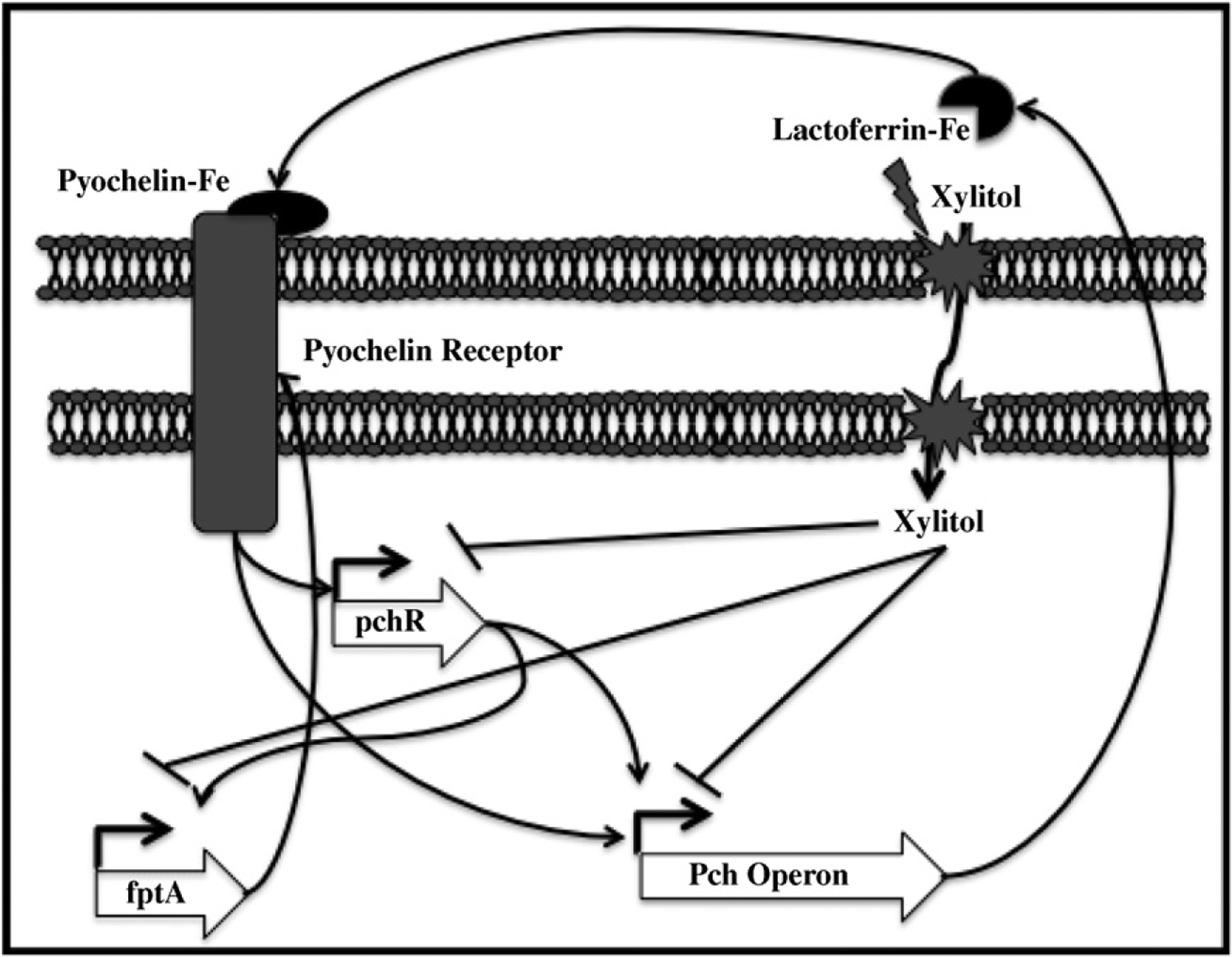
Schematic diagram of a proposed model for the antimicrobial synergy of lactoferrin and xylitol treatment on Pseudomonas aeruginosa biofilms. Lactoferrin treatment permeabilises the bacterial membrane, potentially enhancing the ability of xylitol to penetrate into the bacterial cells. Xylitol then inhibits transcription of the pyochelin biosynthesis pathway and the bacteria are thus unable to respond to lactoferrin iron chelation, enhancing the antimicrobial activity of lactoferrin.

References

    1. James GA, Swogger E, Wolcott R, Pulcini E, Secor P, Sestrich J, et al. Biofilms in chronic wounds. Wound Repair Regen 2008;16:37–44. - PubMed
    1. Konturek PC, Brzozowski T, Konturek SJ, Kwiecien S, Dembinski A, Hahn EG. Influence of bacterial lipopolysaccharide on healing of chronic experimental ulcer in rat. Scand J Gastroenterol 2001;36:1239–47. - PubMed
    1. Power C, Wang JH, Sookhai S, Street JT, Redmond HP. Bacterial wall products induce downregulation of vascular endothelial growth factor receptors on endothelial cells via a CD14-dependent mechanism: implications for surgical wound healing. J Surg Res 2001;101:138–45. - PubMed
    1. Costerton JW, Stewart PS, Greenberg EP. Bacterial biofilms: a common cause of persistent infections. Science 1999;284:1318–22. - PubMed
    1. Rhoads DD, Wolcott RD, Percival SL. Biofilms in wounds: management strategies. J Wound Care 2008;17:502–8. - PubMed

Publication types

MeSH terms