


Shorter anogenital distance predicts poorer semen quality in young men in Rochester, New York
- PMID: 21377950
- PMCID: PMC3222997
- DOI: 10.1289/ehp.1103421
Shorter anogenital distance predicts poorer semen quality in young men in Rochester, New York
Abstract
Background: In male rodents, anogenital distance (AGD) provides a sensitive and continuous correlate of androgen exposure in the intrauterine environment and predicts later reproductive success. Some endocrine-disrupting chemicals can alter male reproductive tract development, including shortening AGD, in both rodents and humans. Whether AGD is related to semen quality in human is unknown.
Objective: We examined associations between AGD and semen parameters in adult males.
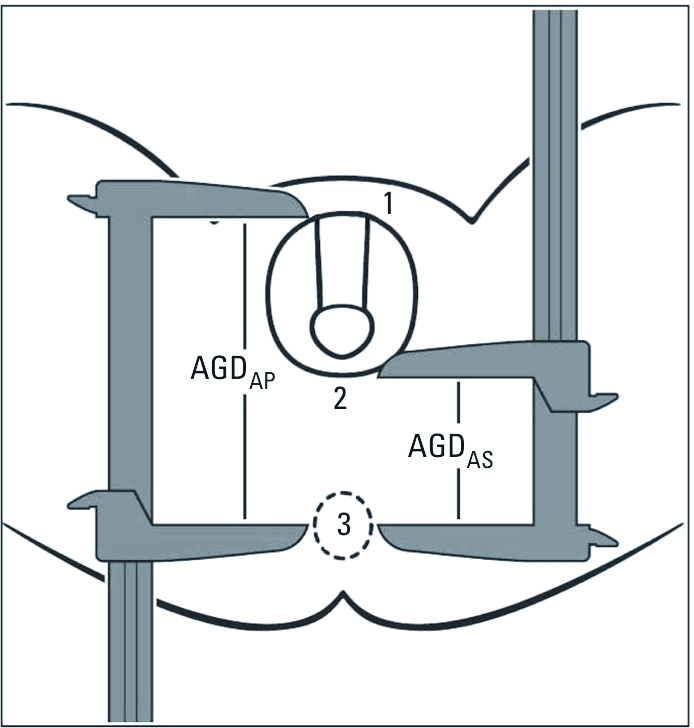
Methods: We used multiple regression analyses to model the relationships between sperm parameters and two alternative measures of AGD [from the anus to the posterior base of the scrotum (AGD(AS)) and to the cephalad insertion of the penis (AGD(AP))] in 126 volunteers in Rochester, New York.
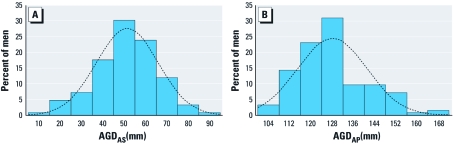
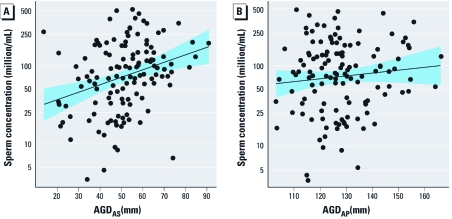
Results: AGD(AS), but not AGD(AP), was associated with sperm concentration, motility, morphology, total sperm count, and total motile count (p-values, 0.002-0.048). Men with AGD(AS) below (vs. above) the median were 7.3 times more likely (95% confidence interval, 2.5-21.6) to have a low sperm concentration (< 20 × 10⁶/mL). For a typical study participant, sperm concentrations were 34.7 × 10⁶/mL and 51.6 × 10⁶/mL at the 25th and 75th percentiles of (adjusted) AGD(AS).
Conclusions: In our population, AGD(AS) was a strong correlate of all semen parameters and a predictor of low sperm concentration. In animals, male AGD at birth reflects androgen levels during the masculinization programming window and predicts adult AGD and reproductive function. Our results suggest, therefore, that the androgenic environment during early fetal life exerts a fundamental influence on both AGD and adult sperm counts in humans, as demonstrated in rodents.
Conflict of interest statement
The authors declare they have no actual or potential competing financial interests.
Figures
References
-
- Andersson AM, Jensen TK, Juul A, Petersen JH, Jørgensen T, Skakkebaek NE. Secular decline in male testosterone and sex hormone binding globulin serum levels in Danish population surveys. J Clin Endocrinol Metab. 2007;92:4696–4705. - PubMed
-
- Barlow NJ, McIntyre BS, Foster PM. Male reproductive tract lesions at 6, 12, and 18 months of age following in utero exposure to di(n-butyl) phthalate. Toxicol Pathol. 2004;32:79–90. - PubMed
-
- Centers for Disease Control and Prevention. Growth Charts. 2010. Available: http://www.cdc.gov/growthcharts/ [accessed 15 March 2011]
-
- Dohrenwend BS, Krasnoff L, Askenasy AR, Dohrenwend BP. Exemplification of a method for scaling life events: the Peri Life Events Scale. J Health Soc Behav. 1978;19:205–229. - PubMed
Publication types
MeSH terms
Substances
LinkOut - more resources
Full Text Sources
Medical
Research Materials