Randomized Controlled Trial
. 2011 Jul;56(7):2088-97.
doi: 10.1007/s10620-011-1653-7. Epub 2011 Mar 8.

Therapy with the opioid antagonist naltrexone promotes mucosal healing in active Crohn's disease: a randomized placebo-controlled trial

Affiliations
Randomized Controlled Trial

Therapy with the opioid antagonist naltrexone promotes mucosal healing in active Crohn's disease: a randomized placebo-controlled trial

Jill P Smith et al. Dig Dis Sci. 2011 Jul.

Abstract

Background: Endogenous opioid peptides have been shown to play a role in the development and/or perpetuation of inflammation. We hypothesize that the endogenous opioid system is involved in inflammatory bowel disease, and antagonism of the opioid-opioid receptor will lead to reversal of inflammation.

Aims: A randomized double-blind placebo-controlled study was designed to test the efficacy and safety of an opioid antagonist for 12 weeks in adults with active Crohn's disease.

Methods: Forty subjects with active Crohn's disease were enrolled in the study. Randomized patients received daily oral administration of 4.5-mg naltrexone or placebo. Providers and patients were masked to treatment assignment. The primary outcome was the proportion of subjects in each arm with a 70-point decline in Crohn's Disease Activity Index score (CDAI). The secondary outcome included mucosal healing based upon colonoscopy appearance and histology.

Results: Eighty-eight percent of those treated with naltrexone had at least a 70-point decline in CDAI scores compared to 40% of placebo-treated patients (p = 0.009). After 12 weeks, 78% of subjects treated with naltrexone exhibited an endoscopic response as indicated by a 5-point decline in the Crohn's disease endoscopy index severity score (CDEIS) from baseline compared to 28% response in placebo-treated controls (p = 0.008), and 33% achieved remission with a CDEIS score <6, whereas only 8% of those on placebo showed the same change. Fatigue was the only side effect reported that was significantly greater in subjects receiving placebo.

Conclusions: Naltrexone improves clinical and inflammatory activity of subjects with moderate to severe Crohn's disease compared to placebo-treated controls. Strategies to alter the endogenous opioid system provide promise for the treatment of Crohn's disease.


Conflict of interest statement

Conflict of interest

Drs. Smith and Zagon have intellectual property rights and have a patent for the use of naltrexone in IBD. This disclosure was provided to all study participants. The statistical analysis of the entire data sets pertaining to efficacy (specifically primary and major secondary efficacy endpoints) and safety (specifically, serious adverse events as defined in federal guidelines) have been independently confirmed by a biostatistician who has no conflict of interest.

Figures

Fig. 1
Fig. 1
Patient disposition according to CONSORT (consolidated standards of reporting trials). The numbers of subjects who enrolled in the trial and were randomized to either placebo or naltrexone therapy is shown. The outcome of those in each arm is demonstrated and the number of subjects rolling over into the extended open labeled study
Fig. 2
Fig. 2
Endoscopic and histological scores improve with naltrexone therapy. a After 12 weeks, 78% of subjects treated with naltrexone exhibited an endoscopic response as indicated by a 5-point decline in the CDEIS score from baseline compared to 28% response in placebo-treated controls (p = 0.008). Thirty-three percent of naltrex-one treated subjects showed endoscopic remission with CDEIS scores of less than six compared to 8% of placebo treated subjects. b Histology scores to assess microscopic inflammation and structural architecture were determined at baseline and after 12 weeks of either naltrexone therapy or placebo by mucosal biopsy samples obtained during colonoscopies. No difference in histology scores was noted at baseline between those randomized to placebo or naltrexone (p = 0.8). Histology inflammation scores significantly improved in those treated with naltrexone compared to baseline values (p = 0.016) and compared to placebo-treated controls (p = 0.048). No improvement was noted histologically in placebo-treated patients at 12 weeks compared to baseline (p = 0.06). Columns represent means ± SEM. N.S. not statistically significant
Fig. 3
Fig. 3
Naltrexone promotes mucosal healing in Crohn’s disease. The endoscopic appearance of representative patients’ colonic mucosa is shown at baseline (a, c) demonstrating erythema, edema, ulceration, and loss of vascularity. Corresponding H & E histologic sections obtained from the same areas demonstrate marked inflammation and ulceration with crypt distortion at baseline (a1 and c1). No change was found in the endoscopic appearance (b) or the histological score (b1) in subjects randomized to placebo for 12 weeks. In contrast, the subjects treated with naltrexone for 12 weeks exhibited endoscopic mucosal healing (d) and histologic examination showed decreased inflammatory cells with restoration of crypt architecture (d1)
Fig. 4
Fig. 4
Quality of life surveys. Changes from baseline scores for the IBDQ (left) and the SF36 (right) quality of life surveys are shown. Although the quality of life indices improved to a greater extent in subjects treated with naltrexone compared to placebo, this difference was not significant
Fig. 5
Fig. 5
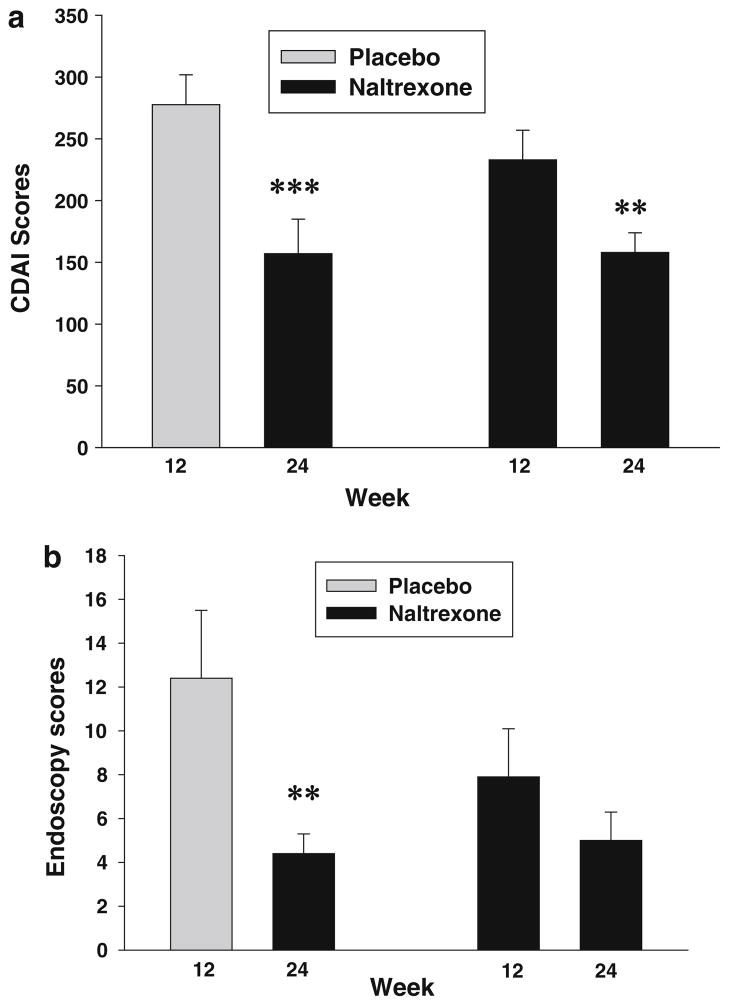
Extended open-labeled study. a With the extended naltrexone therapy (24-weeks), CDAI scores demonstrated further significant reduction compared to the 12-week naltrexone treatment values. When subjects who had been on placebo for 12 weeks were then treated with naltrexone, a significant decline in CDAI scores also occurred. Columns represent means ± SEM. (Significantly different from corresponding week 12 at **p < 0.01 and ***p < 0.005). b Mucosal healing as determined by endoscopic appearance was maintained when naltrexone was extended beyond the 12-week time point to 24 weeks. Although a decrease by 36% in endoscopic scores was reported in those continued on naltrexone compared to week 12, this difference was not significant. However, the week-24 values were significantly improved (p = 0.005) compared to baseline. Mucosal healing was evident in those who had taken placebo for 12 weeks and then subsequently were treated with naltrexone. **Significantly different from corresponding week 12 level at p < 0.01

References

    1. Strober W, James SP. The immunopathogenesis of gastrointestinal and hepatobiliary diseases. JAMA. 1992;268:2910–2917. - PubMed
    1. Fiocchi C. Inflammatory bowel disease: etiology and pathogenesis. Gastroenterology. 1998;115:182–205. - PubMed
    1. Gurudu S, Fiocchi C, Katz JA. Inflammatory bowel disease. Best Pract Res Clin Gastroenterol. 2002;16:77–90. - PubMed
    1. Targan SR, Murphy LK. Clarifying the causes of Crohn’s. Nat Med. 1995;1:1241–1243. - PubMed
    1. Kelly JK, Sutherland LR. The chronological sequence in the pathology of Crohn’s disease. J Clin Gastroenterol. 1988;10:28–33. - PubMed

Publication types