Prevalence and correlates of eating disorders in adolescents. Results from the national comorbidity survey replication adolescent supplement
- PMID: 21383252
- PMCID: PMC5546800
- DOI: 10.1001/archgenpsychiatry.2011.22
Prevalence and correlates of eating disorders in adolescents. Results from the national comorbidity survey replication adolescent supplement
Abstract
Context: Eating disorders are severe conditions, but little is known about the prevalence or correlates of these disorders from population-based surveys of adolescents.
Objectives: To examine the prevalence and correlates of eating disorders in a large, reprefentative sample of US adolescents.
Design: Cross-sectional survey of adolescents with face-to-face interviews using a modified version of the Composite International Diagnostic Interview.
Setting: Combined household and school adolescent samples.
Participants: Nationally representative sample of 10,123 adolescents aged 13 to 18 years.
Main outcome measures: Prevalence and correlates of eating disorders and subthreshold conditions.
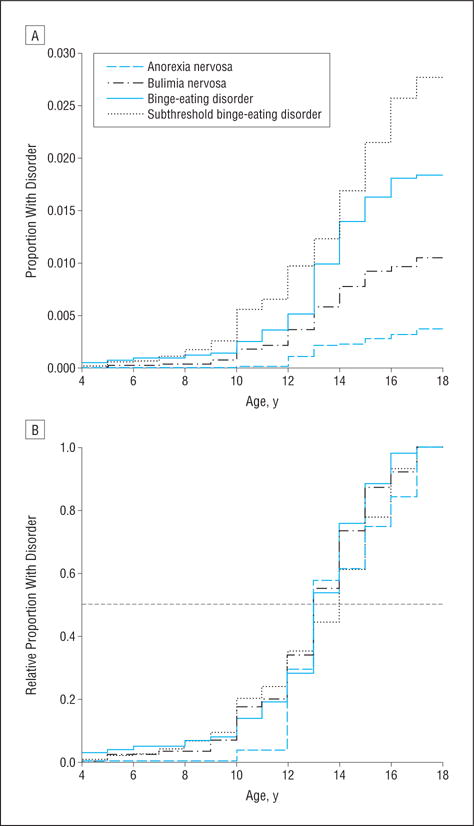
Results: Lifetime prevalence estimates of anorexia nervosa, bulimia nervosa, and binge-eating disorder were 0.3%, 0.9%, and 1.6%, respectively. Important differences were observed between eating disorder subtypes concerning sociodemographic correlates, psychiatric comorbidity, role impairment, and suicidality. Although the majority of adolescents with an eating disorder sought some form of treatment, only a minority received treatment specifically for their eating or weight problems. Analyses of 2 related subthreshold conditions suggest that these conditions are often clinically significant.
Conclusions: Eating disorders and subthreshold eating conditions are prevalent in the general adolescent population. Their impact is demonstrated by generally strong associations with other psychiatric disorders, role impairment, and suicidality. The unmet treatment needs in the adolescent population place these disorders as important public health concerns.
Figures
References
-
- Preti A, Girolamo G, Vilagut G, Alonso J, Graaf R, Bruffaerts R, Demyttenaere K, Pinto-Meza A, Haro JM, Morosini P, ESEMeD-WMH Investigators The epidemiology of eating disorders in six European countries: results of the ESEMeD-WMH project. J Psychiatr Res. 2009;43(14):11, 25–1132. - PubMed
-
- Garfinkel PE, Lin E, Goering P, Spegg C, Goldbloom D, Kennedy S, Kaplan AS, Woodside DB. Should amenorrhoea be necessary for the diagnosis of anorexia nervosa? evidence from a Canadian community sample. Br J Psychiatry. 1996;168(4):500–506. - PubMed
-
- Walters EE, Kendler KS. Anorexia nervosa and anorexic-like syndromes in a population-based female twin sample. Am J Psychiatry. 1995;152(1):64–71. - PubMed
-
- Bijl RV, Ravelli A, van Zessen G. Prevalence of psychiatric disorder in the general population: results of the Netherlands Mental Health Survey and Incidence Study (NEMESIS) Soc Psychiatry Psychiatr Epidemiol. 1998;33(12):587–595. - PubMed
Publication types
MeSH terms
Grants and funding
LinkOut - more resources
Full Text Sources
Other Literature Sources
Medical