. 2010 Dec 1;5(6):553-569.
doi: 10.1016/j.nantod.2010.10.007.

Emerging links between surface nanotechnology and endocytosis: impact on nonviral gene delivery

Affiliations

Emerging links between surface nanotechnology and endocytosis: impact on nonviral gene delivery

Andrew F Adler et al. Nano Today. .

Abstract

Significant effort continues to be exerted toward the improvement of transfection mediated by nonviral vectors. These endeavors are often focused on the design of particulate carriers with properties that encourage efficient accumulation at the membrane surface, particle uptake, and endosomal escape. Despite its demonstrated importance in successful nonviral transfection, relatively little investigation has been done to understand the pressures driving internalized vectors into favorable nondegradative endocytic pathways. Improvements in transfection efficiency have been noted for complexes delivered with a substrate-mediated approach, but the reasons behind such enhancements remain unclear. The phenotypic changes exhibited by cells interacting with nano- and micro-featured substrates offer hints that may explain these effects. This review describes nanoscale particulate and substrate parameters that influence both the uptake of nonviral gene carriers and the endocytic phenotype of interacting cells, and explores the molecular links that may mediate these interactions. Substrate-mediated control of endocytosis represents an exciting new design parameter that will guide the creation of efficient transgene carriers.


Figures

Figure 1
Figure 1. Barriers to nonviral gene delivery
(1) Transgenic DNA can be lost due to incomplete complexation with cationic polymer/lipid. (2) Complexes may be cleared from the circulation before they are able to bind to the cell surface. (3) Some of the complexes bound to the cell surface will not be internalized. (4) Following endocytosis, a portion of DNA may be degraded within the acidic late endosomes and lysosomes. (5) DNA successfully escaping the endosomal compartment may be further degraded by cytoplasmic DNAse. (6) A portion of the DNA reaching the nucleus may be unable to induce transcription. (7) Some of the exported mRNA may be incapable of translation into useful transgenic protein.
Figure 2
Figure 2. Endocytic pathways traversed by nonviral carriers
Cationic particles bind to anionic heparan sulfate proteoglycans (HSPGs) and may be internalized via macropinocytosis (A), a form of fluid-phase endocytosis. Macropinosomes are fluid-filled vesicles formed by actin-driven membrane ruffling; these vesicles may fuse with degradative late endosomes, or may be trafficked directly to the nucleus. Nonviral vectors can also be internalized by clathrin-mediated endocytosis (B), which progresses by receptor clustering, formation of the clathrin coat, and actin-driven internalization, forming early endosomes. Some early endosomes are recycled to the cell surface, while others are uncoated, acidified, and progress to late endosomes and lysosomes on their way to the nucleus. Caveolae-mediated endocytosis (C) proceeds by oligomerization of caveolin, actin-dependent internalization of caveolae to form cavicles, and merger with the degradative lysosomal compartment, or non-degradative trafficking to the nucleus via caveosomes. Each pathway relies on microtubules for rapid transport of endocytic vesicles.
Figure 3
Figure 3. Particulate parameter modifications and the resulting effects on endocytic uptake, trafficking, and transgene expression
DOTAP lipoplexes are taken up by clathrin-mediated endocytosis, while expression-competent PEI polyplexes are endocytosed by a caveolae-dependant process. Large lipoplexes are generally taken up more efficiently, and large PLGA particles tend to depend more heavily on caveolae-mediated processing. Positively-charged particles usually bind to and are taken up by cells more efficiently than those with negative zeta potentials. Low aspect ratio PEG cylinders show a significantly lower extent of uptake than high aspect ratio equi-volume counterparts. Particles with a high density of octaargine functionalization induce macropinocytosis and are taken up more efficiently than those with sparse modification. Each of these differences has been supported by peer-reviewed publications, but may differ by cell type and culture conditions.
Figure 4
Figure 4. Effect of density and presentation of surface-bound complexes on the efficiency of reverse (substrate-mediated) transfection
Low densities of adsorbed complexes lead to low levels of particle uptake and expression upon cell seeding (A). Increasing the density of adsorbed complexes may lead to proportionally increased expression (B), but over-tight immobilization of complexes renders cells unable to internalize bound complexes, and diminishes transgene expression (C). Complexes co-immobilized with extracellular matrix components often support superior internalization and transfection (D) by incompletely-understood mechanisms.
Figure 5
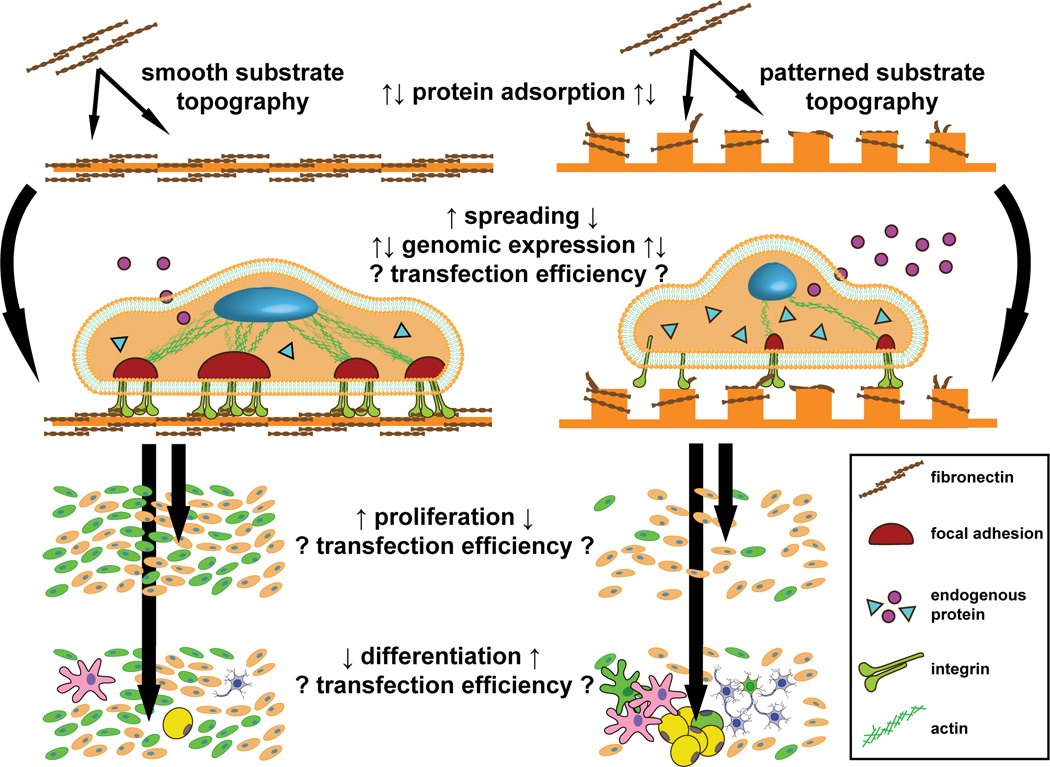
Figure 5. Known micro- and nano-topographical effects on cell phenotype, and their possible impact on nonviral gene delivery
The quantity and denaturation of matrix proteins adsorbed to patterns can be increased or decreased, depending on the specifics of the substrate topography and chemistry. These differences in the adsorbed protein layer mediate alterations in a number of cell phenotypes. In general, cells cultured on patterned topographies have decreased spreading and proliferation, reduced integrin clustering, and smaller focal adhesion complexes compared to smooth controls. Proliferative cells are often more susceptible to nonviral gene delivery. Further, actin-mediated transduction of tension from integrin-nucleated focal adhesions to the nucleus alters the expression of a multitude of secreted and intracellular proteins; many of these proteins play a role in endocytosis, and therefore likely in the endocytic uptake of nonviral carriers. Finally, patterned topography can control the differentiation state of many cell types, plausibly leading to altered transfectability.
Figure 6
Figure 6. Two possible routes for the direct modulation of nonviral carrier uptake by integrin signaling
Actin filaments localized to the cell surface by integrin-containing focal adhesions bind to the HIP1/HIP1R complex, which recruits AP-2 to assemble the clathrin coat on nascent vesicles. Cortactin is thought to induce and localize the polymerization of actin at internalizing vesicles by linking dynamin and the actin-nucleating complex Arp2/3. Integrin disassembly and internalization is a clathrin-mediated process, and high rates of this activity on patterned topography could compete with or augment complex uptake. Integrin engagement also results in local sequestration of caveolin-1 and stabilization of caveolae at the cell surface. Subsequent integrin release induces caveolae internalization, but it is unknown what effect this may have on the uptake of nearby gene carriers. Nanotopographical control of integrin engagement and turnover (depicted) may be a useful tool in the study of these effects.

References

    1. Ratko TA, Cummings JP, Blebea J, Matuszewski KA. The American Journal of Medicine. 2003;115:560–569. - PubMed
    1. van Gaal EVB, Oosting RS, Hennink WE, Crommelin DJA, Mastrobattista E. International Journal of Pharmaceutics. In Press, Corrected Proof.
    1. Belting M, Sandgren S, Wittrup A. Adv Drug Deliver Rev. 2005;57:505–527. - PubMed
    1. Medina-Kauwe LK, Xie J, Hamm-Alvarez S. Gene Ther. 2005;12:1734–1751. - PubMed
    1. Grigsby CL, Leong KW. Journal of the Royal Society Interface. 7:S67–S82. - PMC - PubMed

LinkOut - more resources