. 2010 Mar 18;2(2):73-94.

Structure, function, and pharmacology of acid-sensing ion channels (ASICs): focus on ASIC1a

Structure, function, and pharmacology of acid-sensing ion channels (ASICs): focus on ASIC1a

Stefan Gründer et al. Int J Physiol Pathophysiol Pharmacol. .

Abstract

Acid-sensing ion channels (ASICs) are H(+)-gated Na(+) channels, which are present in most, if not all, neurons. The typical ASIC current is transient and is elicited by a rapid drop in the extracellular pH. In the human genome, four genes for ASICs are present: asic1 - 4. In this review, we will focus on ASIC1a, one of the key subunits in the central nervous system. We will describe the structure of this channel, a topic that has enormously profited from the recent elucidation of the first crystal structure of an ASIC. We will then relate the ASIC1 structure to current models of the gating mechanism of ASICs. Finally, we will review the pharmacology of ASIC1a. Advances in the pharmacological inhibition of individual ASIC currents have greatly contributed to our current knowledge of the functional roles of this channel in physiology, including learning, memory, and fear conditioning, and in pathophysiological states, including the neurodegeneration accompanying stroke, and axonal degeneration in autoimmune inflammation.


Figures
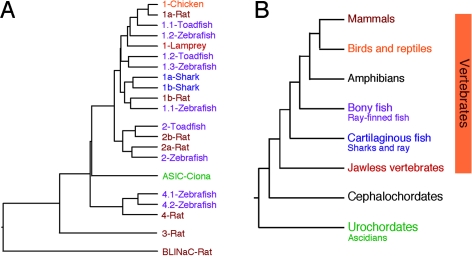
Figure 1
Figure 1
A) Phylogenetic tree illustrating the relationship of selected ASICs. Note that a clear ASIC1 ortholog is present in all vertebrate lineages, whereas ASIC3 has so far only been identified in mammalian species. The urochordate Ciona contains a single asic gene [7], whereas in mammals the number of asic genes has increased to four. Amino acid sequences of selected ASICs were aligned and the tree for the cladogram established by neighbor joining using ClustalX (DNAstar software); sequences at the N- and C-termini had been deleted. The related brain-liver-intestine Na+ channel (BLINaC) form rat [156] was included for comparison. B) Phylogenetic tree of the chordate phylum. Main chordate clades are shown. The color corresponds to the color of ASICs from organisms of these clades in (A). So far, no ASICs have been reported from cephalochordates and amphibians; their existence in these clades is, however, likely.
Figure 2
Figure 2
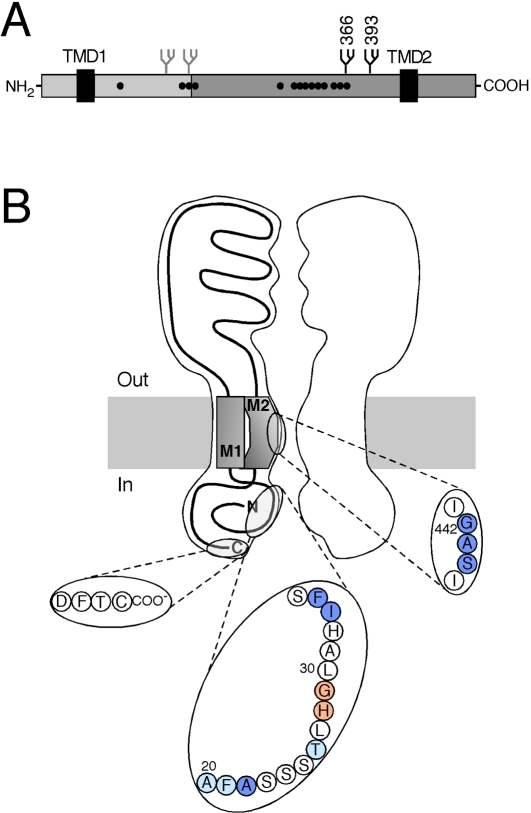
A) Linear model of ASIC1a. The first one-third of the protein, which is different between ASIC1a and lb, is indicated in light grey. The two J-COOH hydrophobic domains are shown as black boxes. The position of the two glycosylation sites of ASIC1a are indicated by a branched symbol and the two additional glycosylation sites, which are specific for ASIC1b, are shown in grey. The 14 cysteines that are conserved in ASICs are shown as black dots; 10 of them cluster in one region. B) Model of the transmembrane topology of ASIC1a from the pre-crystal era. TMD2 faces the ion pore, the three residues (G-A-S) that probably form the ion-selective part of the molecular sieve [53, 55, 59] are magnified in the inset Residues within the intracellular N-terminus that have been implicated in contributing to the internal pore of ASIC1a [65] or ASIC2 [66] are marked in the inset in dark and light blue, respectively. Amino acids in this region also determine Ca2+-permeability of ASIC1a [18]. The amino acid sequence from rat ASIC1a is shown. The two invariably conserved amino acids (H-G) in the cytoplasmic N-terminus that are involved in gating of ENaC [67, 68] are marked in orange. The four amino acids (D-F-T-C) at the cytoplasmic C-terminus that bind to the PDZ domain of PICK1 [69, 70] are also magnified in an inset.
Figure 3
Figure 3
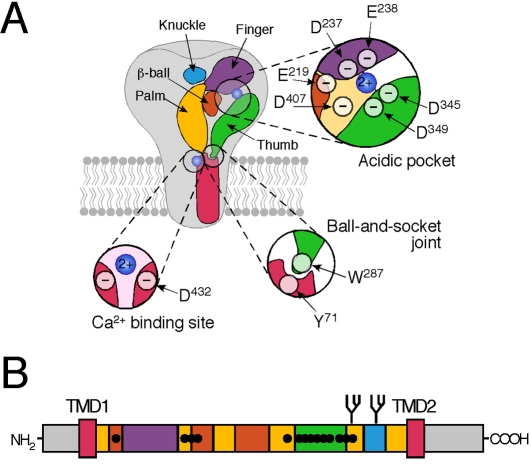
A) Model of the transmembrane topology of ASIC1a from the post-crystal era (based on reference [19]). Three features of the structure and their crucial amino acids are magnified in the insets: the acidic pocket, the ball-and-socket joint and the Ca2+ binding site in the ion pore. Binding of a Ca2+ ion in the acidic pocket is hypothetical. Note that all amino acids are numbered based on the sequence of rat ASIC1a. B) Linear model of ASIC1a highlighting the relation of the primary sequence to the five subdomains of the ECD. It becomes apparent that the α-helices of the finger, thumb and knuckle subdomains are contained within contiguous stretches of the poiypeptide chain, whereas the palm and (β-ball domains are formed by (β-sheets that are scattered over the poiypeptide chain. Those (β-sheets connect the finger, thumb and knuckle subdomains. Note also that most of the cysteines (black dots) cluster within the thumb subdomain (green), giving it a rigid structure. The structure of the cytopiasmic termini is unresolved.
Figure 4
Figure 4
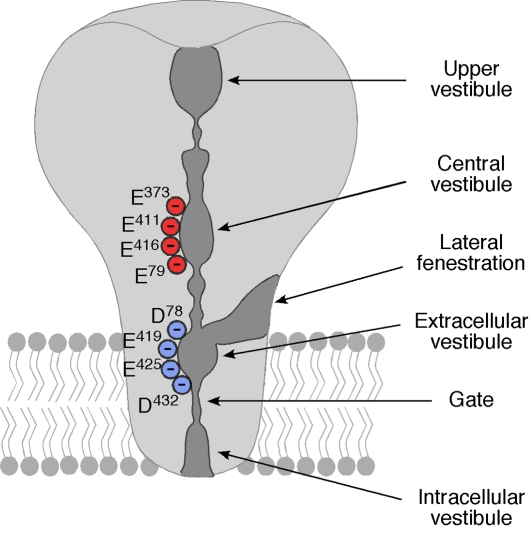
Model of ASIC1a showing the three vestibules in the ECD and the lateral access to the extracellular vestibule via a lateral fenestration (based on reference [72]). Acidic amino acids that line the central and extracellular vestibules are indicated; they are numbered based on the sequence of rat ASIC1a. The negative charge of their side chains could attract cations to the vestibules.

References

    1. Krishtal OA, Pidoplichko VI. Receptor for protons in the membrane of sensory neurons. Brain Res. 1981;214:150–154. - PubMed
    1. Krishtal OA, Pidoplichko VI. A receptor for protons in the membrane of sensory neurons may participate in nociception. Neuroscience. 1981;6:2599–2601. - PubMed
    1. Waldmann R, Champigny G, Bassilana F, Heurteaux C, Lazdunski M. A proton-gated cation channel involved in acid-sensing. Nature. 1997;386:173–177. - PubMed
    1. Golubovic A, Kuhn A, Williamson M, Kalbacher H, Holstein TW, Grimmelikhuijzen CJ, Gründer S. A peptide-gated ion channel from the freshwater polyp Hydra. J Biol Chem. 2007;282:35098–35103. - PubMed
    1. Lingueglia E, Champigny G, Lazdunski M, Barbry P. Cloning of the amiloride-sensitive FMRFamide peptide-gated sodium channel. Nature. 1995;378:730–733. - PubMed

LinkOut - more resources