Review
. 2010 Nov 19:8:e005.
doi: 10.1621/nrs.08005.

Deciphering the nuclear bile acid receptor FXR paradigm

Affiliations
Review

Deciphering the nuclear bile acid receptor FXR paradigm

Salvatore Modica et al. Nucl Recept Signal. .

Abstract

Originally called retinoid X receptor interacting protein 14 (RIP14), the farnesoid X receptor (FXR) was renamed after the ability of its rat form to bind supra-physiological concentrations of farnesol. In 1999 FXR was de-orphanized since primary bile acids were identified as natural ligands. Strongly expressed in the liver and intestine, FXR has been shown to be the master transcriptional regulator of several entero-hepatic metabolic pathways with relevance to the pathophysiology of conditions such as cholestasis, fatty liver disease, cholesterol gallstone disease, intestinal inflammation and tumors. Furthermore, given the importance of FXR in the gut-liver axis feedbacks regulating lipid and glucose homeostasis, FXR modulation appears to have great input in diseases such as metabolic syndrome and diabetes. Exciting results from several cellular and animal models have provided the impetus to develop synthetic FXR ligands as novel pharmacological agents. Fourteen years from its discovery, FXR has gone from bench to bedside; a novel nuclear receptor ligand is going into clinical use.


Figures
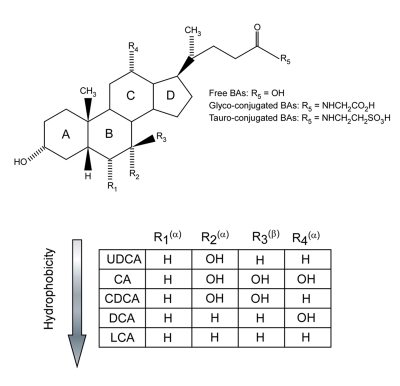
Figure 1
Figure 1. Structure and hydrophobic/hydrophilic profile of the most common bile acids.
Cholic acid (CA) and chenodeoxycholic acid (CDCA) are primary BAs. Deoxycholic acid (DCA) and lithocholic acid (LCA) are secondary BAs. Ursodeoxycholic acid (UDCA) is a primary BA predominantly produced in bears. Hydroxyl groups that are in α-orientation are located below the steroid nucleus and are axial to the plane of the steroid nucleus. Hydroxyl groups that are in β-orientation are located above the steroid nucleus and are equatorial to the plane of the steroid nucleus. The hydrophobicity increases as follows: UDCA, CA, CDCA, DCA, LCA.
Figure 2
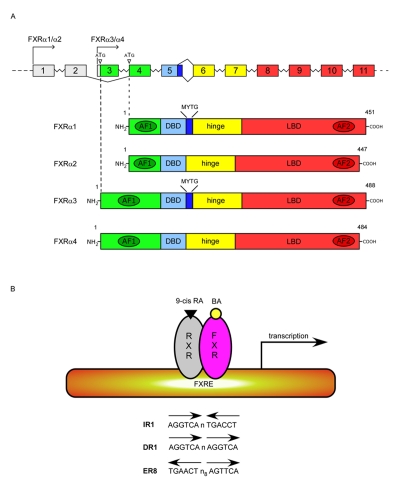
Figure 2. Structure and transcripts of the mouse FXRα gene.
A) Similar to the human FXRα gene (mapped to chromosome 12 (q23.1)), the mouse FXRα gene (mapped to chromosome 10 (c2)) is characterized by 11 exons and two distinct promoters that initiate transcription from either exon 1 or exon 3. Four distinct transcripts, FXRα1, FXRα2, FXRα3, FXRα4 are generated from the same gene, as a consequence of the alternative splicing of exon 5 and the use of two distinct promoters. ATG indicate the translational starting sites. In blue is indicated the alternative splicing of the 12 bp of exon 5 that encode the MYTG motif in the hinge region. The four FXRα transcripts are shown with the different classical NR receptor domains color coded. B) Upon ligand binding, FXRα binds to FXR response elements (FXRE) of its target genes as a heterodimer with RXR. Examples of consensus sequences are shown.
Figure 3
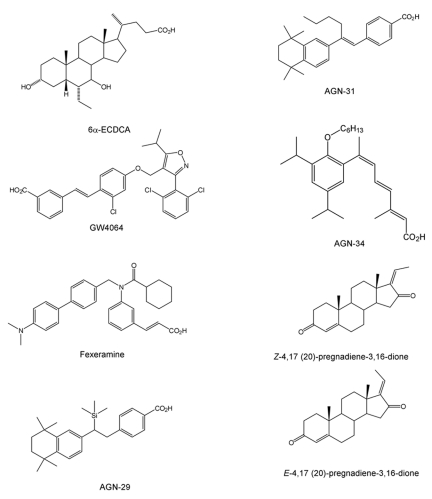
Figure 3. FXR ligands.
Examples of FXR semisynthetic (6α-ECDCA), synthetic (GW4064, Fexeramine, AGN-29, AGN-31, AGN-34) and natural (Z-4,17(20)-pregnadiene-3,16-dione and E-4,17(20)-pregnadiene-3,16-dione) ligands.
Figure 4
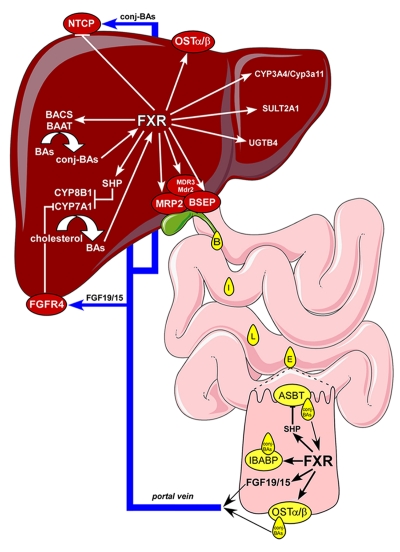
Figure 4. FXR regulates BA metabolism.
BAs that recirculate in the enterohepatic system activate hepatic and intestinal FXR to regulate genes important for BA metabolism. Hepatic FXR 1) represses BA synthesis by reducing CYP7A1 and CYP8B1 expression via SHP and 2) efficiently promotes BA conjugation (conj-BAs) with taurine or glycine via BACS and BAAT. FXR controls BA secretion in the small intestine by upregulating the expression of ABC transporters such as MRP2, BSEP and MDR3/Mdr2. When reaching the distal ileum, unconjugated BAs are passively reabsorbed, while conj-BAs are taken up by ASBT at the luminal membrane, shuttled to the basolateral membrane of the ileal enterocyte by the cytosolic transporter IBABP, then secreted in the portal blood via the OSTα/β transporter to travel back to the liver and be taken up by the NTCP transporter (repressed by FXR) and complete the enterohepatic circulation. In addition to regulating genes involved in active BA reabsorption in the distal ileum, activation of FXR by BAs also induces FGF19/15, a hormone that is secreted in the portal circulation and that signals to the liver through FGFR4 to repress CYP7A1. During cholestasis, when BAs reach high levels in the liver, FXR also induces OSTα/β to allow BAs to spill over from the liver in the systemic circulation for their final elimination with urine. Under these pathological conditions FXR also induces phase I (CYP3A4/Cyp3a11) and phase II (SULT2A1 and UGTB4) reactions to turn BAs into more hydrophilic and less toxic molecules that are efficiently excreted.
Figure 5
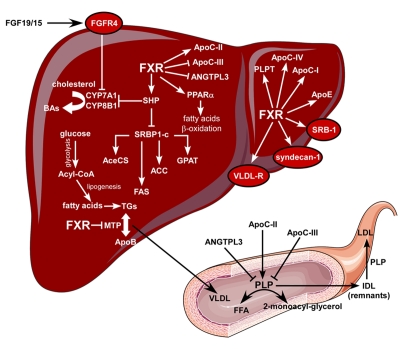
Figure 5. FXR regulates lipid metabolism.
By repressing CYP7A1 and CYP8B1 via SHP and FGF19, FXR activation may result in hepatic cholesterol accumulation. In the liver, FXR activation results in increased expression of PLPT for the transfer of phospholipids and cholesterol from LDL to HDL, SRB1 for the hepatic uptake of HDL and lipoproteins ApoE, ApoC-I and ApoC-IV. Activation of FXR also leads to the repression of hepatic lipogenesis by reducing the expression of SREBP1-c in a SHP-dependent manner. SREBP1-c induces the expression of key genes for fatty acids synthesis and lipogenesis such as AceCS, FAS, ACC, and GPAT. By increasing the expression of PPARα, FXR also promotes FFA catabolism via β-oxidation. By repressing the expression of MTP, an enzyme that controls VLDL assembly, FXR reduces VLDL production. Activation of FXR increases TG clearance by promoting PLP activity, via induction of ApoC-II, and by upregulating the expression of VLDL-R and syndecan-1 for the hepatic uptake of LDL and IDL (remnants). Activation of FXR also reduces TG clearance by decreasing the expression of ApoC-III and ANGPTL3, two PLP inhibitors.
Figure 6
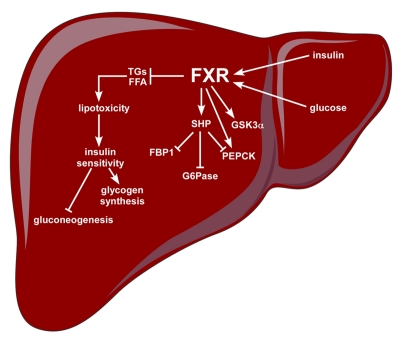
Figure 6. FXR regulates glucose metabolism.
Activation of hepatic FXR can increase insulin sensitivity not only in the liver, but also in peripheral tissues (skeletal muscle and adipose tissue) by reducing the levels of TGs and FFA. High levels of circulating TGs and FFA can impair insulin signaling and reduce pancreatic insulin secretion, a phenomenon known as “lipotoxicity”. The increased insulin sensitivity due to the attenuation of the “lipotoxicity” phenomenon following FXR activation, results in increased glycogen synthesis and reduced gluconeogenesis, two desirable events for the management of diabetes. Activation of FXR induces GSKα expression to promote glycogen synthesis and repress in a SHP-dependent way three key enzymes involved in gluconeogenesis such as PEPCK, FBP1 and G6Pase, but an induction of PEPCK after FXR agonist treatment has been also reported. In this scenario of glucose metabolism regulated by FXR, glucose and insulin increase the expression of FXR.

References

    1. Ananthanarayanan M., Li S., Balasubramaniyan N., Suchy F. J., Walsh M. J. Ligand-dependent activation of the farnesoid X-receptor directs arginine methylation of histone H3 by CARM1. J Biol Chem. 2004;279:54348–57. - PubMed
    1. Angelin B., Hershon K. S., Brunzell J. D. Bile acid metabolism in hereditary forms of hypertriglyceridemia: evidence for an increased synthesis rate in monogenic familial hypertriglyceridemia. Proc Natl Acad Sci U S A. 1987;84:5434–8. - PMC - PubMed
    1. Anisfeld A. M., Kast-Woelbern H. R., Lee H., Zhang Y., Lee F. Y., Edwards P. A. Activation of the nuclear receptor FXR induces fibrinogen expression: a new role for bile acid signaling. J Lipid Res. 2005;46:458–68. - PubMed
    1. Anisfeld A. M., Kast-Woelbern H. R., Meyer M. E., Jones S. A., Zhang Y., Williams K. J., Willson T., Edwards P. A. Syndecan-1 expression is regulated in an isoform-specific manner by the farnesoid-X receptor. J Biol Chem. 2003;278:20420–8. - PubMed
    1. Araya Z., Wikvall K. 6alpha-hydroxylation of taurochenodeoxycholic acid and lithocholic acid by CYP3A4 in human liver microsomes. Biochim Biophys Acta. 1999;1438:47–54. - PubMed

Publication types

MeSH terms

LinkOut - more resources