


Is qualitative research second class science? A quantitative longitudinal examination of qualitative research in medical journals
- PMID: 21383987
- PMCID: PMC3044713
- DOI: 10.1371/journal.pone.0016937
Is qualitative research second class science? A quantitative longitudinal examination of qualitative research in medical journals
Abstract
Background: Qualitative research appears to be gaining acceptability in medical journals. Yet, little is actually known about the proportion of qualitative research and factors affecting its publication. This study describes the proportion of qualitative research over a 10 year period and correlates associated with its publication.
Design: A quantitative longitudinal examination of the proportion of original qualitative research in 67 journals of general medicine during a 10 year period (1998-2007). The proportion of qualitative research was determined by dividing original qualitative studies published (numerator) by all original research articles published (denominator). We used a generalized estimating equations approach to assess the longitudinal association between the proportion of qualitative studies and independent variables (i.e. journals' country of publication and impact factor; editorial/methodological papers discussing qualitative research; and specific journal guidelines pertaining to qualitative research).
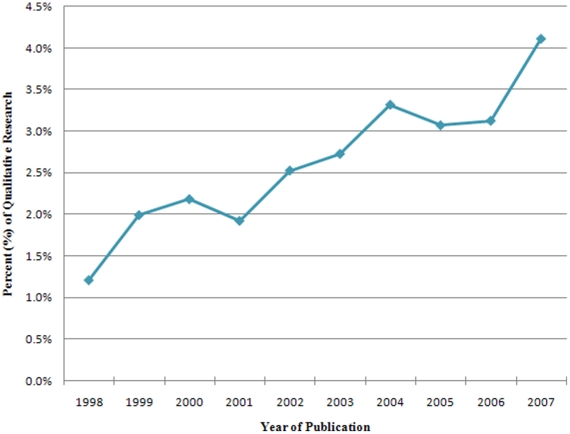
Findings: A 2.9% absolute increase and 3.4-fold relative increase in qualitative research publications occurred over a 10 year period (1.2% in 1998 vs. 4.1% in 2007). The proportion of original qualitative research was independently and significantly associated with the publication of editorial/methodological papers in the journal (b = 3.688, P = 0.012); and with qualitative research specifically mentioned in guidelines for authors (b = 6.847, P<0.001). Additionally, a higher proportion of qualitative research was associated only with journals published in the UK in comparison to other countries, yet with borderline statistical significance (b = 1.776, P = 0.075). The journals' impact factor was not associated with the publication of qualitative research.
Conclusions: Despite an increase in the proportion of qualitative research in medical journals over a 10 year period, the proportion remains low. Journals' policies pertaining to qualitative research, as expressed by the appearance of specific guidelines and editorials/methodological papers on the subject, are independently associated with the publication of original qualitative research; irrespective of the journals' impact factor.
Conflict of interest statement
Figures

References
-
- Ebell MH, Siwek J, Weiss BD, Wolf SH, Susman J, et al. Strength of recommendation taxonomy (SORT): a patient-centered approach to grading evidence in the medical literature. J Am Board Fam Pract. 2004;17:59–67. - PubMed
-
- Finkelstein A. Levels of evidence: how they help in applying study findings to clinical practice. J Fam Pract. 2005;54:1032. - PubMed
-
- Grypdonck MH. Qualitative health research in the era of evidence-based practice. Qual Health Res. 2006;16:1371–1385. - PubMed
Publication types
MeSH terms
LinkOut - more resources
Full Text Sources
