


Clonality and α-a recombination in the Australian Cryptococcus gattii VGII population--an emerging outbreak in Australia
- PMID: 21383989
- PMCID: PMC3044715
- DOI: 10.1371/journal.pone.0016936
Clonality and α-a recombination in the Australian Cryptococcus gattii VGII population--an emerging outbreak in Australia
Abstract
Background: Cryptococcus gattii is a basidiomycetous yeast that causes life-threatening disease in humans and animals. Within C. gattii, four molecular types are recognized (VGI to VGIV). The Australian VGII population has been in the spotlight since 2005, when it was suggested as the possible origin for the ongoing outbreak at Vancouver Island (British Columbia, Canada), with same-sex mating being suggested as the driving force behind the emergence of this outbreak, and is nowadays hypothesized as a widespread phenomenon in C. gattii. However, an in-depth characterization of the Australian VGII population is still lacking. The present work aimed to define the genetic variability within the Australian VGII population and determine processes shaping its population structure.
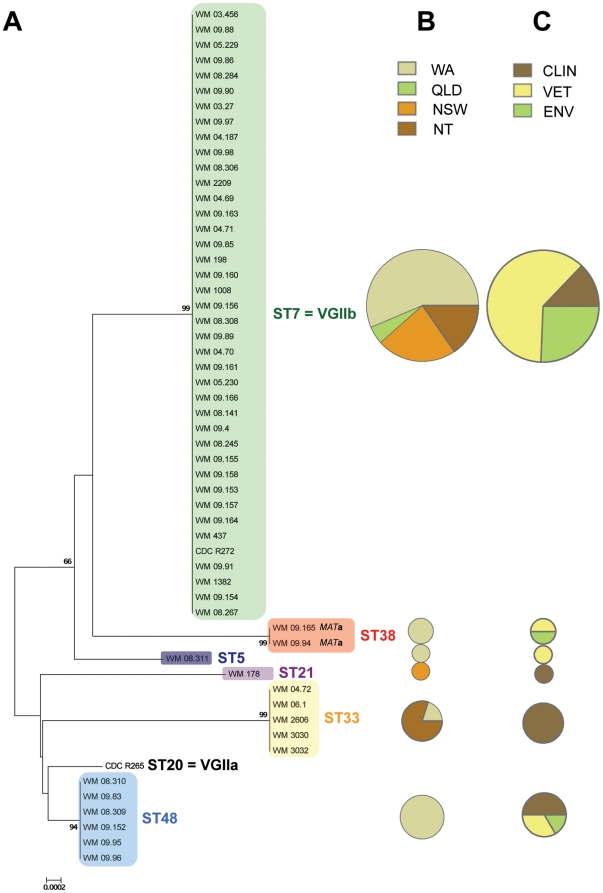
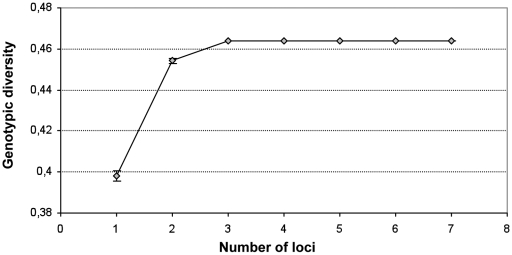
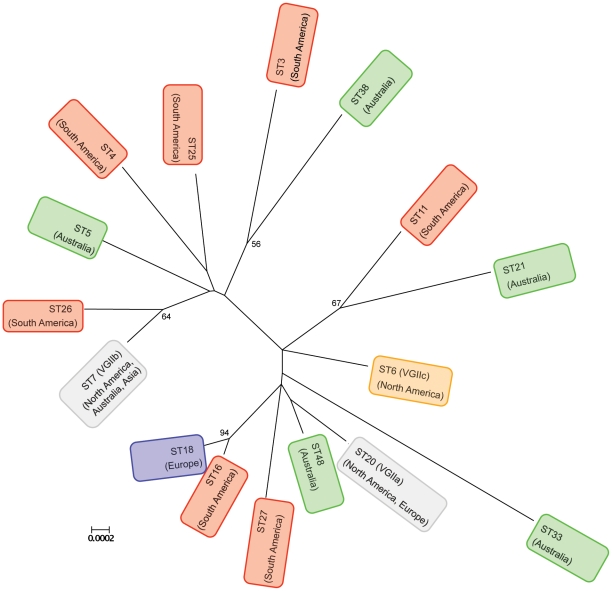
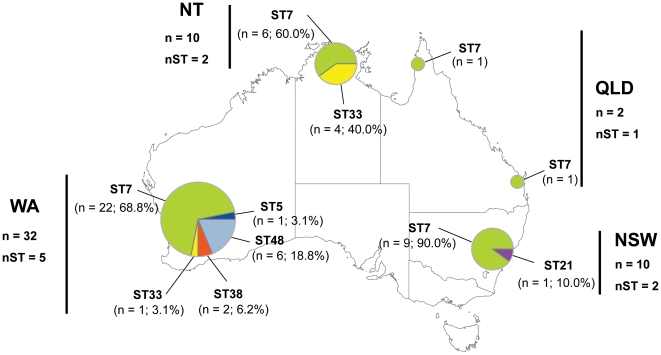
Methodology/principal findings: A total of 54 clinical, veterinary and environmental VGII isolates from different parts of the Australian continent were studied. To place the Australian population in a global context, 17 isolates from North America, Europe, Asia and South America were included. Genetic variability was assessed using the newly adopted international consensus multi-locus sequence typing (MLST) scheme, including seven genetic loci: CAP59, GPD1, LAC1, PLB1, SOD1, URA5 and IGS1. Despite the overall clonality observed, the presence of MATa VGII isolates in Australia was demonstrated for the first time in association with recombination in MATα-MATa populations. Our results also support the hypothesis of a "smouldering" outbreak throughout the Australian continent, involving a limited number of VGII genotypes, which is possibly caused by a founder effect followed by a clonal expansion.
Conclusions/significance: The detection of sexual recombination in MATα-MATa population in Australia is in accordance with the natural life cycle of C. gattii involving opposite mating types and presents an alternative to the same-sex mating strategy suggested elsewhere. The potential for an Australian wide outbreak highlights the crucial issue to develop active surveillance procedures.
Conflict of interest statement
Figures
References
-
- McNeil MM, Nash SL, Hajjeh RA, Phelan MA, Conn LA, et al. Trends in mortality due to invasive mycotic diseases in the United States, 1980–1997. Clin Infect Dis. 2001;33:641–647. - PubMed
-
- Wilson LS, Reyes CM, Stolpman M, Speckman J, Allen K, et al. The direct cost and incidence of systemic fungal infections. Value Health. 2002;5:26–34. - PubMed
-
- Rees JR, Pinner RW, Hajjeh RA, Brandt ME, Reingold AL. The epidemiological features of invasive mycotic infections in the San Francisco Bay Area, 1992–1993: results of population-based laboratory active surveillance. Clin Infect Dis. 1998;27:1138–1147. - PubMed
-
- Casadevall A, Perfect JR. Washington, DC: ASM Press; 1998. Cryptococcus neoformans.
Publication types
MeSH terms
LinkOut - more resources
Full Text Sources
Miscellaneous
