Ethnicity and academic performance in UK trained doctors and medical students: systematic review and meta-analysis
- PMID: 21385802
- PMCID: PMC3050989
- DOI: 10.1136/bmj.d901
Ethnicity and academic performance in UK trained doctors and medical students: systematic review and meta-analysis
Abstract
Objective: To determine whether the ethnicity of UK trained doctors and medical students is related to their academic performance.
Design: Systematic review and meta-analysis.
Data sources: Online databases PubMed, Scopus, and ERIC; Google and Google Scholar; personal knowledge; backwards and forwards citations; specific searches of medical education journals and medical education conference abstracts.
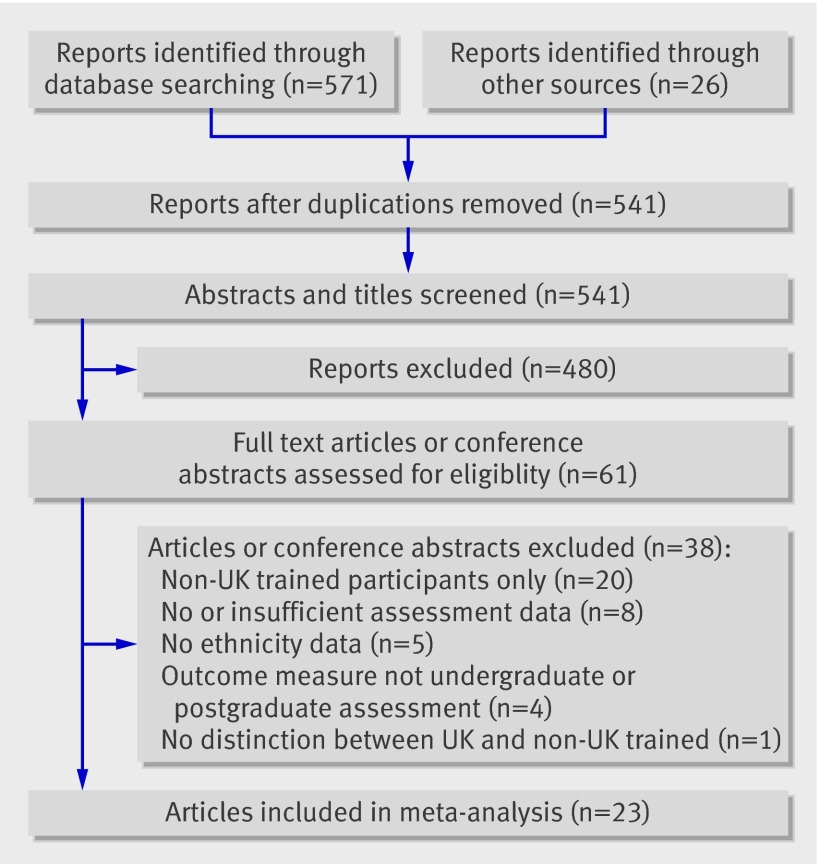
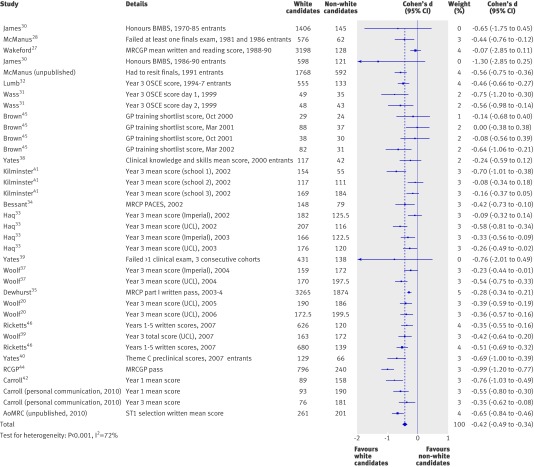
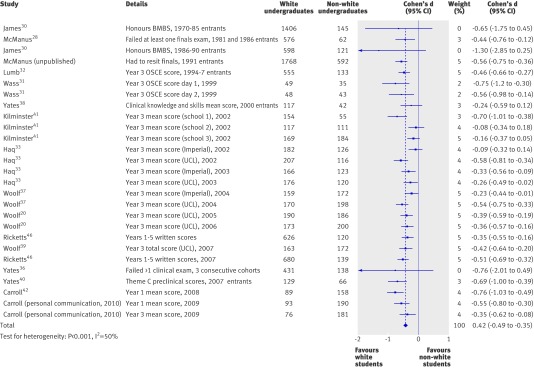
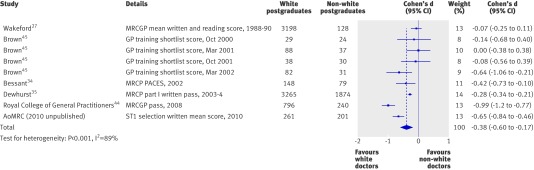
Study selection: The included quantitative reports measured the performance of medical students or UK trained doctors from different ethnic groups in undergraduate or postgraduate assessments. Exclusions were non-UK assessments, only non-UK trained candidates, only self reported assessment data, only dropouts or another non-academic variable, obvious sampling bias, or insufficient details of ethnicity or outcomes. Results 23 reports comparing the academic performance of medical students and doctors from different ethnic groups were included. Meta-analyses of effects from 22 reports (n = 23,742) indicated candidates of "non-white" ethnicity underperformed compared with white candidates (Cohen's d = -0.42, 95% confidence interval -0.50 to -0.34; P<0.001). Effects in the same direction and of similar magnitude were found in meta-analyses of undergraduate assessments only, postgraduate assessments only, machine marked written assessments only, practical clinical assessments only, assessments with pass/fail outcomes only, assessments with continuous outcomes only, and in a meta-analysis of white v Asian candidates only. Heterogeneity was present in all meta-analyses.
Conclusion: Ethnic differences in academic performance are widespread across different medical schools, different types of exam, and in undergraduates and postgraduates. They have persisted for many years and cannot be dismissed as atypical or local problems. We need to recognise this as an issue that probably affects all of UK medical and higher education. More detailed information to track the problem as well as further research into its causes is required. Such actions are necessary to ensure a fair and just method of training and of assessing current and future doctors.
Conflict of interest statement
Competing interests: All authors have completed the Unified Competing Interest form at
Figures
Comment in
-
Ethnicity and academic performance in the UK.BMJ. 2011 Mar 8;342:d709. doi: 10.1136/bmj.d709. BMJ. 2011. PMID: 21385801 No abstract available.
-
Widening access to medical school. Could proficiency in English be a factor?BMJ. 2011 Mar 29;342:d1942. doi: 10.1136/bmj.d1942. BMJ. 2011. PMID: 21447574 No abstract available.
-
Widening access to medical school. Ethnicity and academic performance.BMJ. 2011 Mar 29;342:d1943. doi: 10.1136/bmj.d1943. BMJ. 2011. PMID: 21447575 No abstract available.
References
-
- Broecke S, Nicholls T. Ethnicity and degree attainment. Research report RW92. Department for Education and Skills, 2007.
-
- Fielding A, Charlton C, Kounali D, Leckie G. Degree attainment, ethnicity and gender: interactions and the modification of effects. A quantitative analysis. Equality Challenge Unit, Higher Education Academy, 2008.
-
- Richardson JTE. Degree attainment, ethnicity and gender: a literature review. Higher Education Academy, 2008.
Publication types
MeSH terms
LinkOut - more resources
Full Text Sources