. 2011 May 20;286(20):18048-55.
doi: 10.1074/jbc.M111.232355. Epub 2011 Mar 8.

Model for the exceptional reactivity of peroxiredoxins 2 and 3 with hydrogen peroxide: a kinetic and computational study

Affiliations

Model for the exceptional reactivity of peroxiredoxins 2 and 3 with hydrogen peroxide: a kinetic and computational study

Péter Nagy et al. J Biol Chem. .

Abstract

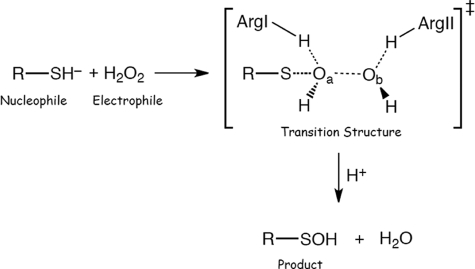
Peroxiredoxins (Prx) are thiol peroxidases that exhibit exceptionally high reactivity toward peroxides, but the chemical basis for this is not well understood. We present strong experimental evidence that two highly conserved arginine residues play a vital role in this activity of human Prx2 and Prx3. Point mutation of either ArgI or ArgII (in Prx3 Arg-123 and Arg-146, which are ∼3-4 Å or ∼6-7 Å away from the active site peroxidative cysteine (C(p)), respectively) in each case resulted in a 5 orders of magnitude loss in reactivity. A further 2 orders of magnitude decrease in the second-order rate constant was observed for the double arginine mutants of both isoforms, suggesting a cooperative function for these residues. Detailed ab initio theoretical calculations carried out with the high level G4 procedure suggest strong catalytic effects of H-bond-donating functional groups to the C(p) sulfur and the reactive and leaving oxygens of the peroxide in a cooperative manner. Using a guanidinium cation in the calculations to mimic the functional group of arginine, we were able to locate two transition structures that indicate rate enhancements consistent with our experimentally observed rate constants. Our results provide strong evidence for a vital role of ArgI in activating the peroxide that also involves H-bonding to ArgII. This mechanism could explain the exceptional reactivity of peroxiredoxins toward H(2)O(2) and may have wider implications for protein thiol reactivity toward peroxides.


Figures

FIGURE 1.
FIGURE 1.
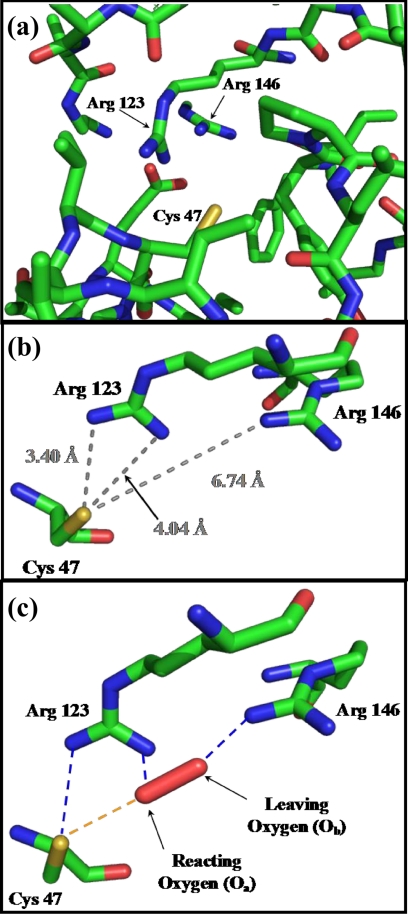
There are two highly conserved arginine residues at the active site of Prx3, which play major roles in its peroxidase activity. a, active site structure of bovine Prx3 (Protein Data Bank code 1ZYE) around its peroxidative cysteine (Cys-47) residue. b, distances of ArgI (Arg-123) and ArgII (Arg-146) nitrogens from the Cp sulfur in the crystal structure of bovine Prx3 (Protein Data Bank code 1ZYE). c, proposed transition structure for the reaction of H2O2 with Prx3 in which ArgI (Arg-123) donates an H-bond to the Cp (Cys-47) sulfur as well as to Oa and ArgII (Arg-146) assists in the protonation of the leaving ObH moiety.
FIGURE 2.
FIGURE 2.
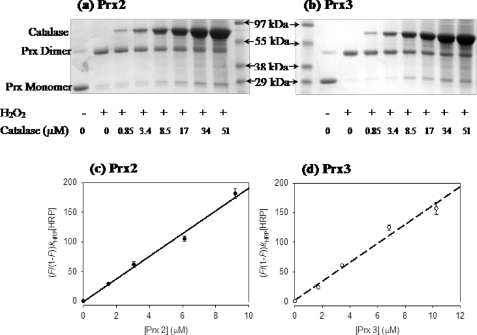
Kinetic assays of recombinant WT Prx2 and Prx3. Competition of Prx2 (a) and Prx3 (b) with bovine catalase. The first and second lanes show the ratio of reduced and oxidized Prx at time 0 and after 15 s of incubation, respectively. Other lanes represent the ratios after reaction with H2O2 in the presence of stated amount of catalase. Protection is apparent as an increase in the Prx monomer band with increasing amounts of catalase. Gels are representative of three independent experiments. Measurement of the second-order rate constants for reaction of Prx2 (c) and Prx3 (d) with H2O2 by competition with HRP. The second-order rate constants (see Table 1) were calculated from the slopes of linear plots of (F/1 − F)kHRP[HRP] versus [Prx2]; F = fractional inhibition. Error bars represent S.D. of triplicate measurements. The experiment was repeated on a different day with similar results. For experimental details, see “Experimental Procedures.”
FIGURE 3.
FIGURE 3.
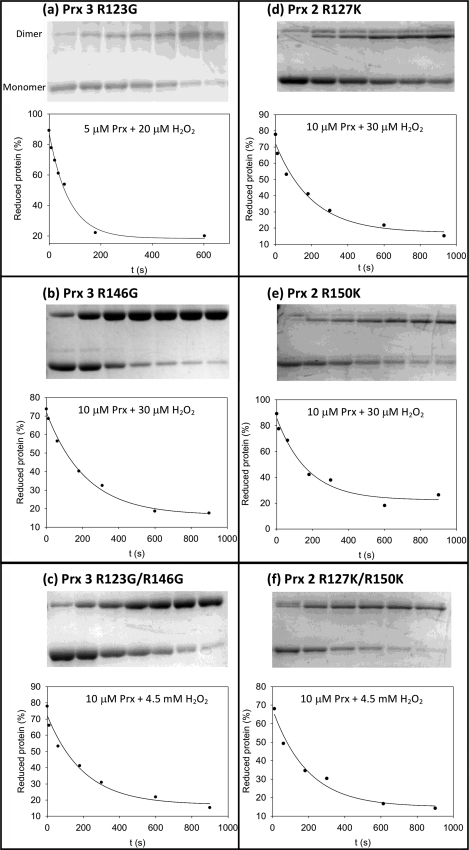
Time course for conversion of reduced (monomer) to oxidized (dimer) of the ArgI, ArgII, and ArgI/ArgII mutants for reaction with H2O2. The arginine residues of Prx3 (a–c) and Prx2 (d–f) were converted to Gly in Prx3 or Lys in Prx2. Data points on the kinetic traces represent the loss of reduced Prx as a % of total Prx (dimer + monomer; obtained from the depicted gels). Second-order rate constants obtained from the single exponential fits are shown in Table 1. Reactions were quenched by catalase (a) or N-ethylmaleimide (b–f). For experimental details, see “Experimental Procedures.”
FIGURE 4.
FIGURE 4.
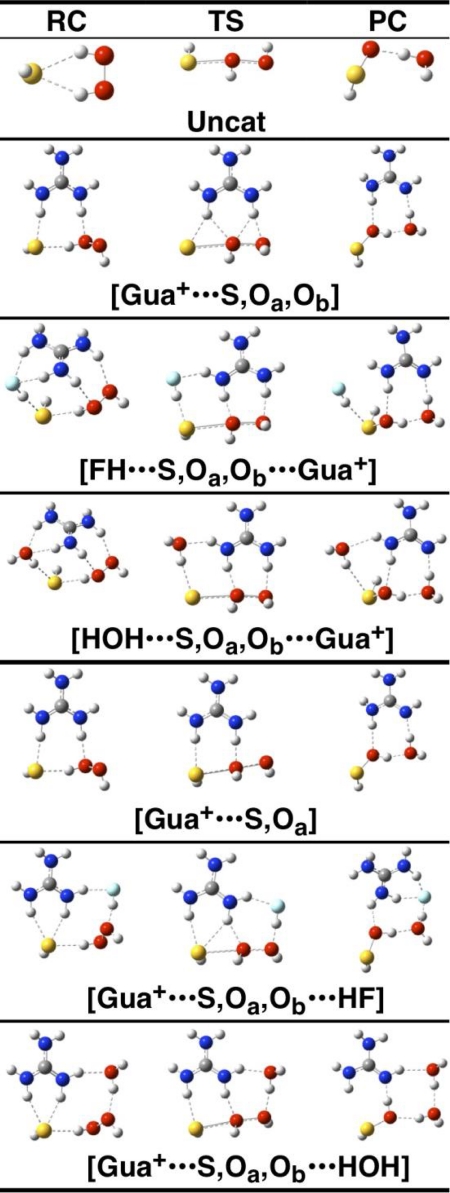
Ab initio calculations for the catalytic role of H-bonding interactions by guanidinium, HF, and H2O moieties in the reaction of HS with H2O2. Calculated reactant complexes (RC), TS, and product complexes (PC) located on the potential energy surface for the uncatalyzed reduction and for the reactions catalyzed by guanidinium, HF, and H2O moieties. Hydrogen bonds are shown as dashed lines, and partial bonds in the SN2 transition structures are shown as parallel dashed and solid lines. The atomic color scheme is as follows: white, H; gray, C; blue, N; red, O; cyan, F; yellow, S).
SCHEME 1
SCHEME 1

References

    1. Cox A. G., Winterbourn C. C., Hampton M. B. (2010) Biochem. J. 425, 313–325 - PubMed
    1. Fourquet S., Huang M. E., D'Autreaux B., Toledano M. B. (2008) Antioxid. Redox. Signal. 10, 1565–1576 - PubMed
    1. Cox A. G., Peskin A. V., Paton L. N., Winterbourn C. C., Hampton M. B. (2009) Biochemistry 48, 6495–6501 - PubMed
    1. Parsonage D., Karplus P. A., Poole L. B. (2008) Proc. Natl. Acad. Sci. U.S.A. 105, 8209–8214 - PMC - PubMed
    1. Peskin A. V., Low F. M., Paton L. N., Maghzal G. J., Hampton M. B., Winterbourn C. C. (2007) J. Biol. Chem. 282, 11885–11892 - PubMed

Publication types