


The prevalence of overweight, obesity, and substandard fitness in a population-based firefighter cohort
- PMID: 21386691
- PMCID: PMC5826653
- DOI: 10.1097/JOM.0b013e31820af362
The prevalence of overweight, obesity, and substandard fitness in a population-based firefighter cohort
Abstract
Objective: To examine the prevalence of overweight and obesity in firefighters.
Methods: Body mass index (BMI), waist circumference, and body fat percentage (BF%) were assessed in 478 career and 199 volunteer male firefighters from randomly selected departments.
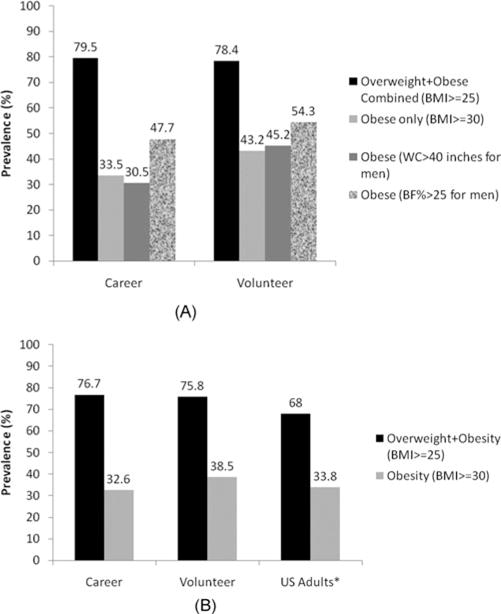
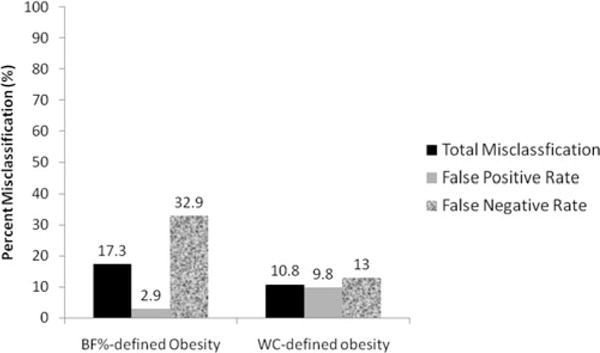
Results: High prevalence rates of overweight + obesity (BMI ≥ 25 kg/m) and obesity (BMI ≥ 30 kg/m) were found in career (79.5%; 33.5%) and volunteer firefighters (78.4%; 43.2%). False-positive obesity misclassification based on BMI, compared to waist circumference and BF%, was low (9.8% and 2.9%, respectively). False negatives were much higher: 32.9% and 13.0%. Obese firefighters demonstrated unfavorable cardiovascular disease (CVD) profiles.
Conclusions: The prevalence of overweight and obesity exceeded that of the US general population. Contrary to common wisdom, obesity was even more prevalent when assessed by BF% than by BMI, and misclassifying muscular firefighters as obese by using BMI occurred infrequently.
Figures
References
-
- National Association of Emergency Medical Technicians. About EMS. Available at: http://www.naemt.org/become_a_member/careers/aboutems.aspx. Accessed May 16, 2010.
-
- US Fire Administration. Fire fighters statistics. http://www.usfa.dhs.gov/statistics/firefighters/index.shtm. Published April 22, 2010. Accessed May 16, 2010.
-
- International Association of Fire Fighters. The Fire Service Joint Labor Management Wellness-Fitness Initiative. Washington, DC: International Association of Fire Fighters; 2008.
-
- Donovan R, Nelson T, Peel J, Lipsey T, Voyles W, Israel RG. Cardiorespiratory fitness and the metabolic syndrome in firefighters. Occup Med (Lond) 2009;59:487–492. - PubMed
-
- National Fire Protection Association. NFPA 1582, Standards on Comprehensive Occupational Medicine Programs for Fire Departments. Quincy, MA: National Fire Protection Association; 2006.
Publication types
MeSH terms
Substances
Grants and funding
LinkOut - more resources
Full Text Sources
Other Literature Sources
Medical
Miscellaneous
