Review
. 2011 Apr;12(4):191-203.
doi: 10.1038/nrn2996. Epub 2011 Mar 9.

Second messengers and membrane trafficking direct and organize growth cone steering

Affiliations
Review

Second messengers and membrane trafficking direct and organize growth cone steering

Takuro Tojima et al. Nat Rev Neurosci. 2011 Apr.

Abstract

Graded distributions of extracellular cues guide developing axons toward their targets. A network of second messengers - Ca(2+) and cyclic nucleotides - shapes cue-derived information into either attractive or repulsive signals that steer growth cones bidirectionally. Emerging evidence suggests that such guidance signals create a localized imbalance between exocytosis and endocytosis, which in turn redirects membrane, adhesion and cytoskeletal components asymmetrically across the growth cone to bias the direction of axon extension. These recent advances allow us to propose a unifying model of how the growth cone translates shallow gradients of environmental information into polarized activity of the steering machinery for axon guidance.


Figures
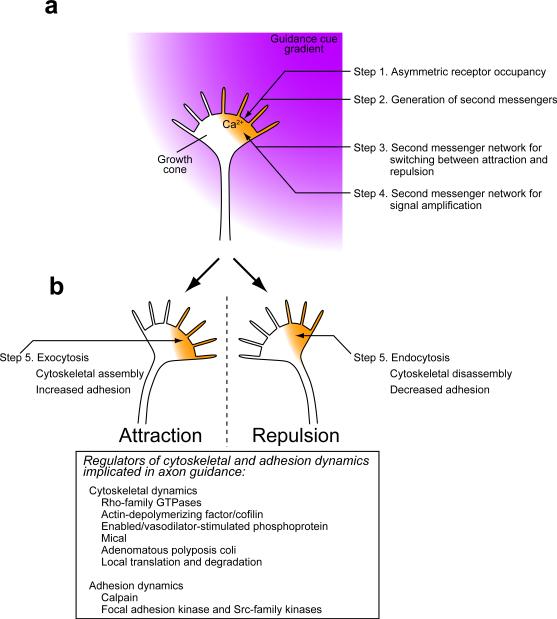
Figure 1
Figure 1. Overview of signaling and mechanical events during bidirectional growth cone guidance
(a) Involvement of second messengers in signal transduction. A guidance cue gradient causes asymmetric occupancy of guidance cue receptors across the growth cone (Step 1) and initial generation of second messengers such as Ca2+ (orange) and cyclic nucleotides (Step 2). Second messenger networks determine whether the growth cone turns toward or away from the side with Ca2+ signals (Step 3) and may amplify guidance information into steeply graded or even compartmentalized signals in the growth cone (Step 4). Steps 3 and 4 may be functionally coupled and temporally overlapping processes. (b) Steering machinery for growth cone guidance. Amplified signals on one side of the growth cone break the symmetry of membrane trafficking, cytoskeletal organization and adhesiveness, which causes attractive or repulsive turning of the growth cone (Step 5). Listed in the box are examples of regulators of the cytoskeleton and adhesion dynamics that are either activated or inactivated by Ca2+, cyclic nucleotides, and other signaling components.
Figure 2
Figure 2. Second messenger systems for growth cone guidance
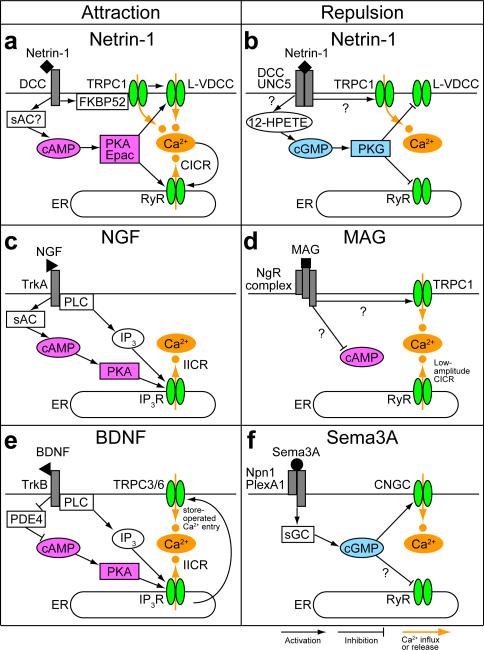
(a) Netrin-1-induced attraction involves Ca2+ influx through transient receptor potential type C1 (TRPC1) and L-type voltage-dependent Ca2+ channels (L-VDCC) and Ca2+-induced Ca2+ release (CICR) from the endoplasmic reticulum (ER) through ryanodine receptors (RyR). Upon netrin-1 binding to the receptor deleted in colorectal cancer (DCC), the peptidyl-prolyl isomerase FK506-binding protein 52 (FKBP52) mediates the isomerization-elicited opening of TRPC1 (REF. 49). The activated TRPC1 triggers membrane depolarization leading to further Ca2+ entry through L-VDCC (REF. 37). This Ca2+ entry most likely triggers CICR that causes growth cone attraction. Gating of L-VDCC and RyR requires the activity of the cyclic AMP (cAMP)-protein kinase A (PKA) pathway,. A sufficient cAMP level is maintained possibly by the action of soluble adenylate cyclase (sAC) (REF. 50), although conflicting results have been reported. The cAMP effector Epac has also been implicated in netrin-1-induced attraction. (b) Netrin-1-induced repulsion is probably mediated by Ca2+ influx through TRPC1 only, because the cyclic GMP (cGMP)-protein kinase G (PKG) pathway inactivates L-VDCC (REF. 37) and RyR (REF. 38). The DCC-uncoordinated 5 (UNC5) receptor complex, which mediates netrin-1-induced repulsion, has been postulated to stimulate the production of cGMP via the lipid mediator 12-hydroperoxyeicosatetraenoic acid (12-HPETE) (REF. 37). (c) Nerve growth factor (NGF)-induced attraction involves the receptor tropomyosin-related kinase A (TrkA) and its downstream effector, phospholipase C (PLC) (REF. 53) that catalyzes the production of inositol 1,4,5-trisphosphate (IP3) in the cytosol. NGF also increases cAMP levels via sAC (REF. 54), facilitating IP3-induced Ca2+ release (IICR) upon IP3 binding to the IP3 receptor (IP3R) (REF. 11). (d) Myelin-associated glycoprotein (MAG) binds the Nogo-66 receptor complex (NgR complex) and repels growth cones via low-amplitude Ca2+ release from the ER (REF. 7) and potentially Ca2+ influx through TRPC1 (REF. 34). The TRPC1 may also participate in maintaining ER-stored Ca2+. MAG antagonizes neurotrophin-induced cAMP elevations in postnatal rat neurons under conditions in which MAG inhibits axon growth, suggesting that MAG has a bias toward inhibiting the cAMP pathway during repulsive guidance. (e) Brain-derived neurotrophic factor (BDNF)-induced TrkB-mediated attraction requires IICR together with Ca2+ influx through TRPC3/6, in which TRPC3/6 may participate in store-operated Ca2+ entry for replenishment of the ER with Ca2+ (REF. 8). BDNF also increases cAMP levels via inhibition of phosphodiesterase 4 (PDE4) (REF. 55). (f) Semaphorin 3A (Sema3A) binds a complex of neuropilin 1 (Npn1) and plexinA1 (PlexA1) and repels growth cones by elevating cGMP levels via soluble guanylate cyclase (sGC), which in turn triggers Ca2+ influx through cyclic nucleotide-gated channel (CNGC) (REF. 10). Whether RyR is inactivated downstream of cGMP remains unclear.
Figure 3
Figure 3. Second messenger network shapes attractive and repulsive Ca2+ signals
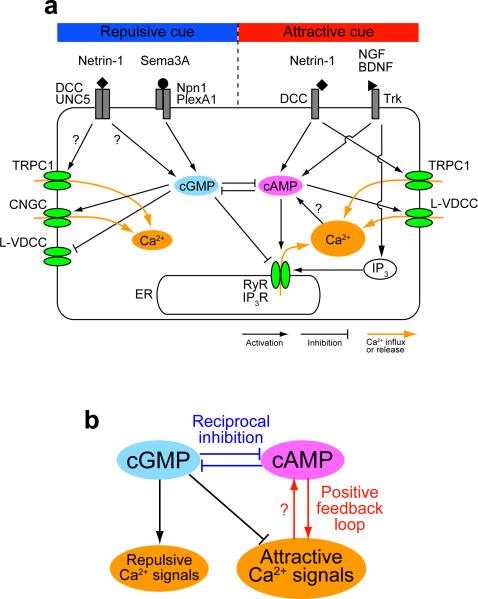
(a) Signaling network and Ca2+ mobilization downstream of guidance cue receptors. A growth cone expresses transient receptor potential type C1 (TRPC1) channels, cyclic nucleotide-gated channels (CNGC) and L-type voltage-dependent Ca2+ channels (L-VDCC) in the plasma membrane and ryanodine receptors (RyR) and inositol 1,4,5-trisphosphate (IP3) receptors (IP3R) in the endoplasmic reticulum (ER) membrane. Cyclic AMP (cAMP) and cyclic GMP (cGMP) counteractively regulate Ca2+ mobilization: e.g., Ca2+ release through RyR is facilitated by cAMP and inhibited by cGMP. Ca2+ might in turn increase the cAMP level, forming a positive-feedback loop between Ca2+ and cAMP. Reciprocal inhibition pathways exist between cAMP and cGMP. BDNF, brain-derived neurotrophic factor; DCC, deleted in colorectal cancer; NGF, nerve growth factor; Npn1, neuropilin 1; PlexA1, plexinA1; Sema3A, Semaphorin 3A; Trk, tropomyosin-related kinase; UNC5, uncoordinated 5. (b) The core signaling network for growth cone guidance. The interactions among Ca2+ and cyclic nucleotides, including positive-feedback loops and the reciprocal inhibition, would shape either of the two types of Ca2+ signals: high-amplitude Ca2+ signals accompanied by Ca2+ release from the ER (attractive Ca2+ signals) or low-amplitude Ca2+ influx that does not trigger Ca2+ release from the ER (repulsive Ca2+ signals).
Figure 4
Figure 4. Asymmetric membrane trafficking drives bidirectional growth cone turning
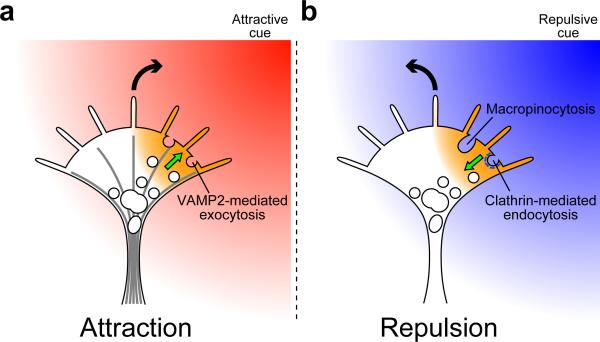
Extracellular gradients of guidance cues trigger the generation of Ca2+ signals on one side of growth cones (orange areas). (a) Attractive Ca2+ signals promote centrifugal transport of vesicle-associated membrane protein 2 (VAMP2)-containing vesicles (white circles) along microtubules (radial lines), with exocytosis ensuing in the growth cone periphery. (b) Repulsive Ca2+ signals facilitate the formation of clathrin (white dashes)-coated pits that migrate toward the growth cone center followed by internalization. The migration of clathrin-coated pits depends on retrograde flow of actin filaments. Asymmetric macropinocytosis has been implicated in repulsive guidance, although it remains unclear whether repulsive Ca2+ signals enhance this type of endocytosis in growth cones. The curved arrows indicate the direction of growth cone turning. The straight arrows indicate the transport direction of VAMP2-containing vesicles and clathrin-coated pits.
Figure 5
Figure 5. Working model of the growth cone steering machinery: membrane trafficking as a master organizer
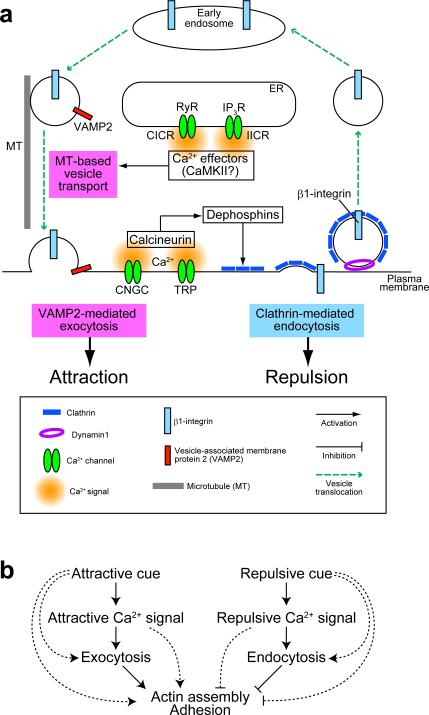
(a) Trafficking of membrane vesicles and their cargo proteins in growth cones. Repulsive Ca2+ signals, e.g., Ca2+ influx through cyclic nucleotide-gated channels (CNGC) or transient receptor potential (TRP) channels, facilitate the formation of clathrin-coated pits perhaps via calcineurin-mediated dephosphorylation of dephosphins. β1-integrin can be captured by coated pits for internalization and most likely sorted into early endosomes. Attractive Ca2+ signals, e.g., Ca2+ release from the endoplasmic reticulum (ER) through ryanodine receptors (RyR) or inositol 1,4,5-trisphosphate receptors (IP3R), facilitate microtubule-based centrifugal transport of vesicle-associated membrane protein 2 (VAMP2)-containing vesicles and subsequent exocytosis in the growth cone periphery. Ca2+/calmodulin-dependent protein kinase II (CaMKII) might link attractive Ca2+ signals to exocytic trafficking. In non-neuronal cells, β1-integrin is recycled to the plasma membrane via VAMP2-dependent exocytosis. Endocytic and exocytic vesicles could also carry cytoskeletal regulators (not shown). CICR, Ca2+-induced Ca2+ release; IICR, IP3-induced Ca2+ release. (b) Mechanistic model for growth cone guidance. Attractive and repulsive Ca2+ signals promote exocytosis and endocytosis, respectively, on the side with elevated Ca2+. Such asymmetric membrane trafficking is likely to control the surface addition and removal of membrane and cargo proteins including adhesion molecules and cytoskeletal regulators. The polarized targeting of driving machinery would generate asymmetric traction and protrusion forces that are essential for growth cone turning. The parallel pathways also operate that bypass Ca2+ signals or membrane trafficking (broken lines).
Figure 6
Figure 6. Hypothetical model for growth cone guidance by multiple cues
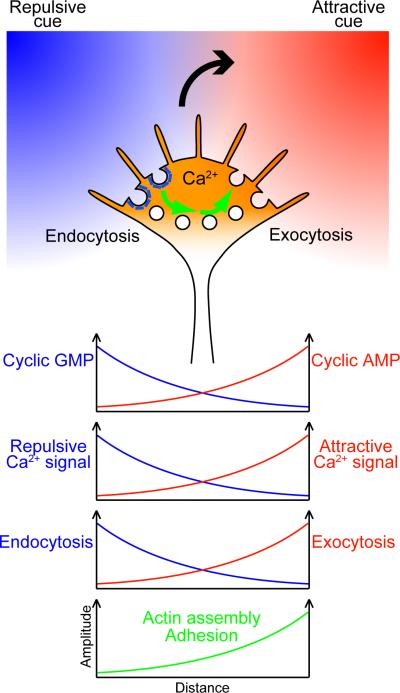
When a growth cone encounters both an attractant on the right side and a repellent on the left side, counter gradients of cyclic AMP and cyclic GMP could be created via several mechanisms described in the text. These counter gradients control the open probability of ryanodine receptors and inositol 1,4,5-trisphosphate receptors, leading to asymmetric release of Ca2+ from the endoplasmic reticulum across the growth cone. Even if the two guidance cues together were to cause symmetric elevations of cytoplasmic Ca2+ concentrations, the nature of Ca2+ signals would differ between both sides of the growth cone: i.e., attractive and repulsive Ca2+ signals would be reciprocally distributed. These reciprocal Ca2+ signals elicit the counter gradients of exocytic and endocytic activities that cause relatively increased filamentous actin assembly and growth cone adhesiveness on the attractant side. The larger curved arrow indicates the direction of growth cone turning. The smaller arrows indicate intracellular vesicle trafficking, although it remains unclear whether endocytosed membrane components are recycled directly to the other side of the growth cone. The x-axis of each graph corresponds to the width of the growth cone.

References

    1. Sanes JR, Yamagata M. Many paths to synaptic specificity. Annu Rev Cell Dev Biol. 2009;25:161–195. - PubMed
    1. Pecho-Vrieseling E, Sigrist M, Yoshida Y, Jessell TM, Arber S. Specificity of sensory-motor connections encoded by Sema3e-Plxnd1 recognition. Nature. 2009;459:842–846. - PMC - PubMed
    1. Sakano H. Neural map formation in the mouse olfactory system. Neuron. 2010;67:530–542. - PubMed
    1. Kennedy TE, Wang H, Marshall W, Tessier-Lavigne M. Axon guidance by diffusible chemoattractants: a gradient of netrin protein in the developing spinal cord. J Neurosci. 2006;26:8866–8874. - PMC - PubMed
    1. Flanagan JG. Neural map specification by gradients. Curr Opin Neurobiol. 2006;16:59–66. - PubMed

Publication types