Comparative Study
. 2011 Feb 28;6(2):e16522.
doi: 10.1371/journal.pone.0016522.

Differences in candidate gene association between European ancestry and African American asthmatic children

Affiliations
Comparative Study

Differences in candidate gene association between European ancestry and African American asthmatic children

Tesfaye M Baye et al. PLoS One. .

Abstract

Background: Candidate gene case-control studies have identified several single nucleotide polymorphisms (SNPs) that are associated with asthma susceptibility. Most of these studies have been restricted to evaluations of specific SNPs within a single gene and within populations from European ancestry. Recently, there is increasing interest in understanding racial differences in genetic risk associated with childhood asthma. Our aim was to compare association patterns of asthma candidate genes between children of European and African ancestry.

Methodology/principal findings: Using a custom-designed Illumina SNP array, we genotyped 1,485 children within the Greater Cincinnati Pediatric Clinic Repository and Cincinnati Genomic Control Cohort for 259 SNPs in 28 genes and evaluated their associations with asthma. We identified 14 SNPs located in 6 genes that were significantly associated (p-values <0.05) with childhood asthma in African Americans. Among Caucasians, 13 SNPs in 5 genes were associated with childhood asthma. Two SNPs in IL4 were associated with asthma in both races (p-values <0.05). Gene-gene interaction studies identified race specific sets of genes that best discriminate between asthmatic children and non-allergic controls.

Conclusions/significance: We identified IL4 as having a role in asthma susceptibility in both African American and Caucasian children. However, while IL4 SNPs were associated with asthma in asthmatic children with European and African ancestry, the relative contributions of the most replicated asthma-associated SNPs varied by ancestry. These data provides valuable insights into the pathways that may predispose to asthma in individuals with European vs. African ancestry.


Conflict of interest statement

Competing Interests: The authors have declared that no competing interests exist.

Figures

Figure 1
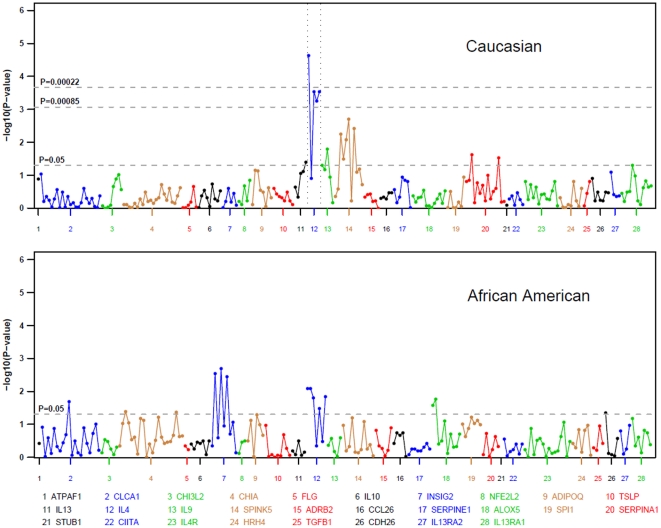
Figure 1. Associations between European and African Ancestry asthmatics vs. non-allergic controls.
Associations between the 230 total SNPs within the 28 candidate genes were tested using the additive model after adjusting for age, gender and population stratification. The upper line corresponds to the conservative Bonferroni adjusted p value 0.00022. The middle line corresponds to the Bonferroni adjusted p value 0.00085 considering a LD correlation of 0.25. SNPs significant at this level (all in IL4) include rs2243250, rs243268, rs2243274 and rs43282. The lower line is a nominal significance p value = 0.05. SNPs are plotted on the x-axis according to their position on each candidate gene across the chromosome against association with asthma on the y axis (shown as log10 p value).
Figure 2
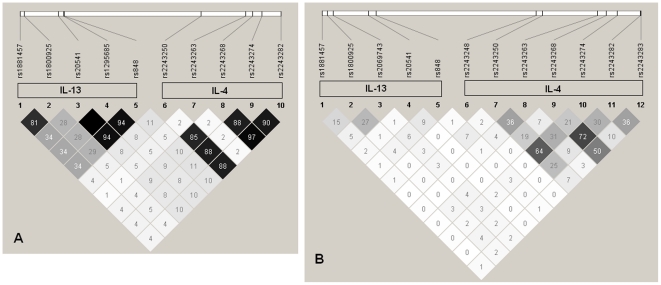
Figure 2. Pair-wise LD statistics.
Pairs of common SNPs in genomic regions containing IL4 and IL13 in the Caucasian (A) and African American (B) population. The positions of SNPs within the IL4 and IL13 genes are shown above the plot. Values in boxes are r2 measures on a decimal scale (i.e. 97 represent r2 = 0.97), indicating extent of LD between two SNPs. Box without numbers have r2 = 1. The shade of each square indicates the strength of the LD relationship between pairs of SNPs.
Figure 3
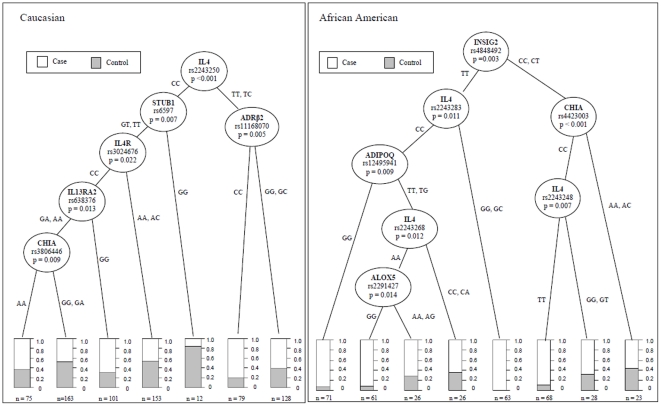
Figure 3. RP based gene-gene interactions of asthmatics vs. non-allergic controls.
Using the program PARTY (implemented in R), non-parametric recursive partitioning was performed to identify combination of SNPs that together had the greatest ability to discriminate between asthmatic and non-allergic controls. All the 257 SNPs within the 28 candidate genes were evaluated in the process. For the stopping criterion we use the nominal level of the conditional independence test of α = 0.05. The final trees were enough to achieve 62% discrimination accuracy between the asthmatic and non-allergic control individuals for Caucasian population and 77% for African American population. The number of subgroup is indicated below each terminal node.
Figure 4
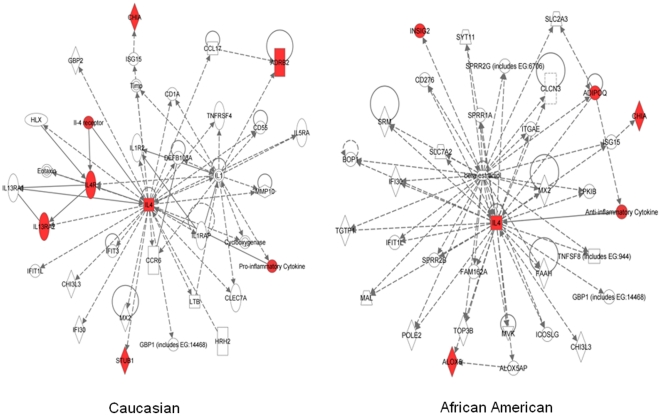
Figure 4. Ingenuity Pathway Analysis (IPA) Interactive network.
IPA network for recursive partitioning prioritized genes. Genes with red node are focused genes in our analysis, others are generated through the network analysis from the Ingenuity Pathways Knowledge Base (http://www.ingenuity.com). Edges are displayed with labels that describe the nature of the relationship between the nodes. All edges are supported by at least one reference from the literature, or from canonical information stored in the Ingenuity Pathways Knowledge Base. Edges are displayed with labels that describe the nature of the relationship between the nodes. The lines between genes represent known interactions, with solid lines representing direct interactions and dashed lines representing indirect interactions. Nodes are displayed using various shapes that represent the functional class of the gene product. Nodes are displayed using various shapes that represent the functional class of the gene product (see legend).

References

    1. Zhang J, Pare PD, Sandford AJ. Recent advances in asthma genetics. Respir Res. 2008;9:4. - PMC - PubMed
    1. Eder W, Ege MJ, von Mutius E. The asthma epidemic. N Engl J Med. 2006;355:2226–2235. - PubMed
    1. Chinchilli VM. General principles for systematic reviews and meta-analyses and a critique of a recent systematic review of long-acting beta-agonists. J Allergy Clin Immunol. 2007;119:303–306. - PubMed
    1. Szalai C, Ungvari I, Pelyhe L, Tolgyesi G, Falus A. Asthma from a pharmacogenomic point of view. Br J Pharmacol. 2008;153:1602–1614. - PMC - PubMed
    1. Cooper RS, Tayo B, Zhu X. Genome-wide association studies: implications for multiethnic samples. Hum Mol Genet. 2008;17:R151–155. - PMC - PubMed

Publication types