


Transcranial doppler ultrasound blood flow velocity and pulsatility index as systemic indicators for Alzheimer's disease
- PMID: 21388892
- PMCID: PMC3117072
- DOI: 10.1016/j.jalz.2010.09.002
Transcranial doppler ultrasound blood flow velocity and pulsatility index as systemic indicators for Alzheimer's disease
Abstract
Background: Multiple lines of evidence suggest that cardiovascular co-morbidities hasten the onset of Alzheimer's disease (AD) or accelerate its course.
Methods: To evaluate the utility of cerebral vascular physical function and/or condition parameters as potential systemic indicators of AD, transcranial Doppler (TCD) ultrasound was used to assess cerebral blood flow and vascular resistance of the 16 arterial segments comprising the circle of Willis and its major tributaries.
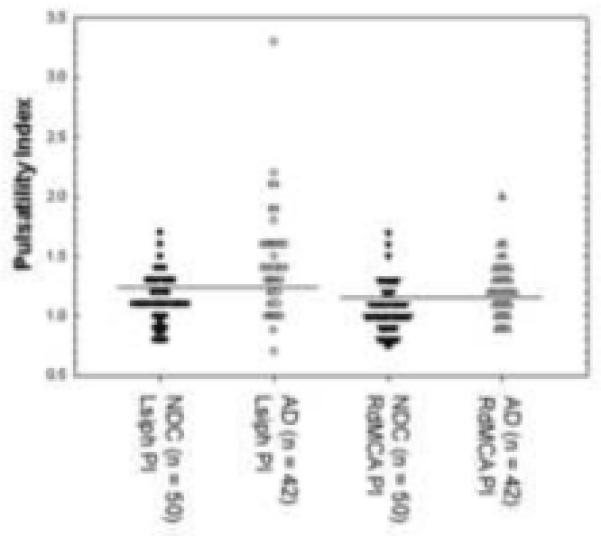
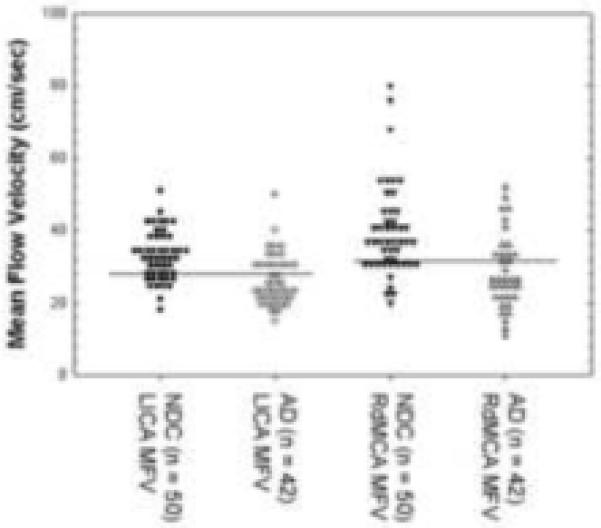
Results: Our study showed that decreased arterial mean flow velocity and increased pulsatility index are associated with a clinical diagnosis of presumptive AD. Cerebral blood flow impairment shown by these parameters reflects the global hemodynamic and structural consequences of a multifaceted disease process yielding diffuse congestive microvascular pathology, increased arterial rigidity, and decreased arterial compliance, combined with putative age-associated cardiovascular output declines.
Conclusions: TCD evaluation offers direct physical confirmation of brain perfusion impairment and might ultimately provide a convenient and a noninvasive means to assess the efficacy of medical interventions on cerebral blood flow or reveal incipient AD. In the near term, TCD-based direct assessments of brain perfusion might offer the prospect of preventing or mitigating AD simply by revealing patients who would benefit from interventions to improve circulatory system function.
Copyright © 2011 The Alzheimer's Association. Published by Elsevier Inc. All rights reserved.
Figures



References
-
- Alzheimer’s Association 2009 Alzheimer’s disease facts and figures. Alzheimers Dement. 2009;5:234–70. - PubMed
-
- Gaziano JM. Global Burden of Cardiovascular Disease. In: Zipes DP, Libby P, Bonow RO, Braunwald E, editors. Braunwald’s Heart Disease. Elsevier Saunders; Philadelphia: pp. 1–19.
-
- Devous MD., Sr. Functional brain imaging in the dementias: role in early detection, differential diagnosis, and longitudinal studies. Eur J Nucl Med Mol Imaging. 2002;29:1685–96. - PubMed
-
- Roher AE, Esh C, Kokjohn TA, Kalback W, Luehrs DC, Seward JD, et al. Circle of Willis atherosclerosis is a risk factor for sporadic Alzheimer’s disease. Arterioscler Thromb Vasc Biol. 2003;23:2055–62. - PubMed
Publication types
MeSH terms
Grants and funding
LinkOut - more resources
Full Text Sources
Medical
