. 2011 Apr 15;71(8):3121-31.
doi: 10.1158/0008-5472.CAN-10-4417. Epub 2011 Mar 9.

Deletion of the proline-rich region of the murine metastasis susceptibility gene Brd4 promotes epithelial-to-mesenchymal transition- and stem cell-like conversion

Affiliations

Deletion of the proline-rich region of the murine metastasis susceptibility gene Brd4 promotes epithelial-to-mesenchymal transition- and stem cell-like conversion

Jude Alsarraj et al. Cancer Res. .

Abstract

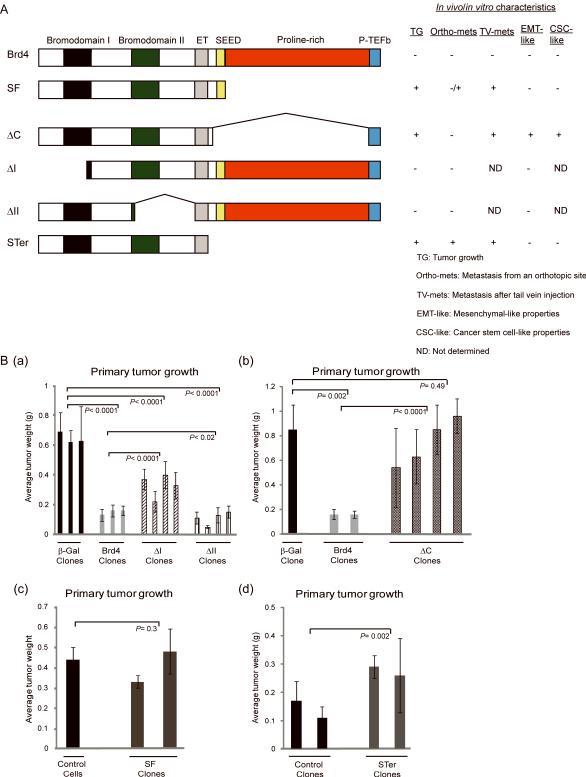
The bromodomain-containing chromatin-modifying factor BRD4 is an inherited susceptibility gene for breast cancer progression and metastasis, but its functionality in these settings has yet to be explored. Here we show that deletion of either of the BRD4 bromodomains had modest effects on the metastatic suppression ability of BRD4. In contrast, expression of the natural short isoform of BRD4 that truncates the protein after the SEED domain restored progression and metastatic capacity. Unexpectedly, deletion of the proline-rich region induced mesenchymal-like conversion and acquisition of cancer stem cell-like properties, which are mediated by the carboxy-terminal P-TEFb binding domain. Deletion of this proline-rich region also induced a gene expression signature that predicted poor outcome in human breast cancer data sets and that overlapped G3 grade human breast tumors. Thus our findings suggest that BRD4 may be altering the predisposition of tumors to undergo conversion to a more de-differentiated or primitive state during metastatic progression.


Figures

Figure 1
Figure 1
Tumor suppressive property of Brd4 is mediated by the proline-rich domain. A, modular structure of BRD4 and BRD4 deletion mutants. In vivo/in vitro characteristics demonstrated throughout the study are summarized. EMT-like is represented here by cellular morphology. B, a, b, c, d, primary tumor weight of FVB/NJ female mice injected with 1×10⁵ cells expressing ΔI, ΔII, Brd4 and β-Gal (a), ΔC, Brd4 and β-Gal (b), SF and controls (c), STer and controls (d) 25–26 days after orthotopic injection into the mammary fat pad. Means ± SD, n=5 for each clone were used. Mann-Whitney test was used to calculate the P-value.
Figure 2
Figure 2
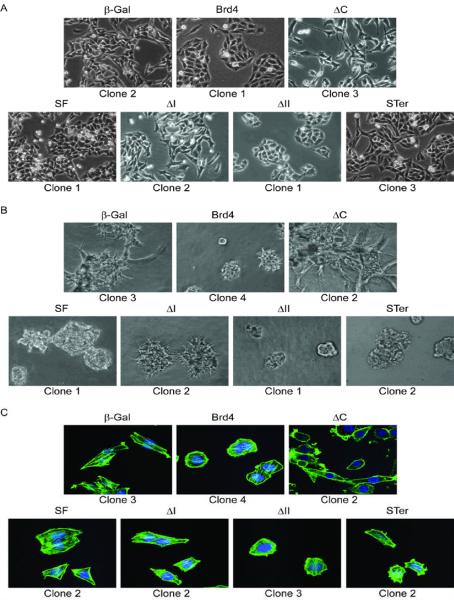
In vitro characteristics of cells expressing BRD4 deletion mutants or SF. A, two-dimensional culture of one clone of the seven different cell lines. Pictures were taken at 40x magnification using light microscopy. B, F-actin fluorescence staining of one clone of the cells. Pictures were taken at 63x magnification using confocal microscopy. C, growth of one clone on top of a solidified basement membrane extract in a 3D culture. Pictures were taken at 40× magnification using light microscopy.
Figure 3
Figure 3
ΔC suppresses metastasis from an orthotopic site but not when directly administered into the circulation. A, a, b, c and d, quantification of pulmonary metastasis nodules from mice injected orthotopically with clones expressing ΔI, ΔII, Brd4 and β-Gal (a), SF and controls (b), STer and controls (c) and ΔC, Brd4 and β-Gal (d) after sectioning and H&E staining of the lungs. B, a, b and c, quantification of pulmonary metastasis nodules from tail vein injection of mice with one clone of ΔC, Brd4 or β-Gal (a), two clones of SF-expressing cells and control Mvt-1 cells (b), two clones of STer or controls (c) after sectioning and H&E staining. Means ± SD, n=5 for each clone were used. Mann-Whitney test was used to calculate the P-value.
Figure 4
Figure 4
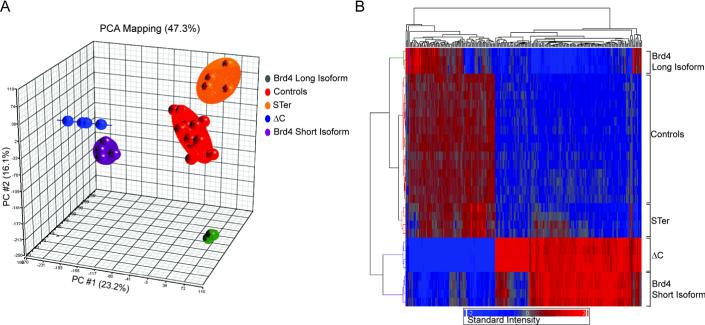
Gene expression profiles of cells expressing ΔC, SF, STer, Brd4 and control cells. A, PCA of the gene expression profile. The first principal component is plotted on the X axis and captures 23.2% of the variance and the second principal component is plotted on the Y axis and captures 16.1% of the variance. B, hierarchical clustering of the expression profiles. The dendogram (top and left side) measures samples degree of relatedness in gene expression. Red and blue colors indicate intensity.
Figure 5
Figure 5
ΔC and SF microarray expression signatures predict poor outcome in human breast cancer datasets. A and B, Kaplan-Meier curves of four independent human breast cancer microarray datasets performed in Affymetrix GeneChips for ΔC-expressing cells or controls (A) and SF-expressing cells or controls (B). The endpoint for the GSE2034 and GSE4922 datasets differ in that disease-free survival was measured. Log rank test was used to calculate the P-value.
Figure 6
Figure 6
ΔC-expressing cells exhibit a cancer stem cell-like phenotype. A, ΔC- or β-Gal-expressing clones were seeded at a density of 3×10³ cells/well onto 24-well Ultra-low attachment plates in serum-free media for 3 and 6 days. Pictures were taken at 40x magnification using light microscopy. B, quantitation of Abcb1a and Abcb1b expression by qRT-PCR. Expression of Abcb1a and Abcb1b was compared in four clones expressing ΔC, Brd4 or β-Gal. Ppib was used for normalization. Mann-Whitney test was used to calculate the P-value. C, expression of Cd24a in clones expressing ΔC, Brd4 or β-Gal was measured by FACS analysis (upper panel) and qRTPCR (lower panel). Unpaired t-test was used to calculate the P-value.

References

    1. Chung CT, Carlson RW. Goals and objectives in the management of metastatic breast cancer. Oncologist. 2003;8:514–20. - PubMed
    1. Lifsted T, Le VT, Williams M, Muller W, Klein-Szanto A, Buetow KH, et al. Identification of inbred mouse strains harboring genetic modifiers of mammary tumor age of onset and metastatic progression. Int J Cancer. 1998;77:640–4. - PubMed
    1. Crawford NP, Ziogas A, Peel DJ, Hess J, nton-Culver H, Hunter KW. Germline polymorphisms in SIPA1 are associated with metastasis and other indicators of poor prognosis in breast cancer. Breast Cancer Res. 2006;8:R16. - PMC - PubMed
    1. Crawford NP, Qian X, Ziogas A, Papageorge AG, Boersma BJ, Walker RC, et al. Rrp1b, a new candidate susceptibility gene for breast cancer progression and metastasis. PLoS Genet. 2007;3:e214. - PMC - PubMed
    1. Crawford NP, Alsarraj J, Lukes L, Walker RC, Officewala JS, Yang HH, et al. Bromodomain 4 activation predicts breast cancer survival. Proc Natl Acad Sci U S A. 2008;105:6380–5. - PMC - PubMed