


Disorder-specific dysfunctions in patients with attention-deficit/hyperactivity disorder compared to patients with obsessive-compulsive disorder during interference inhibition and attention allocation
- PMID: 21391250
- PMCID: PMC6870444
- DOI: 10.1002/hbm.21048
Disorder-specific dysfunctions in patients with attention-deficit/hyperactivity disorder compared to patients with obsessive-compulsive disorder during interference inhibition and attention allocation
Abstract
Background: Abnormalities in inhibitory control and underlying fronto-striatal networks is common to both attention deficit hyperactivity disorder (ADHD) and obsessive-compulsive-disorder (OCD). The aim of this study was to investigate disorder-specific abnormalities in neural networks mediating interference inhibition and selective attention.
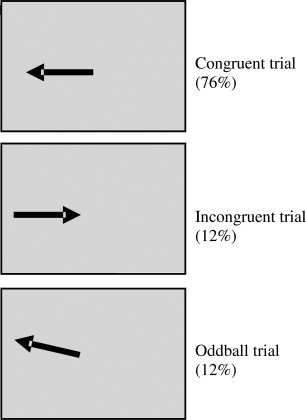
Method: Event-related functional magnetic resonance imaging (fMRI) was used to compare brain activation of boys with ADHD (18), with OCD (10), and healthy boys during (20) during a Simon task that measures interference inhibition and controls for and therefore comeasures attention allocation.
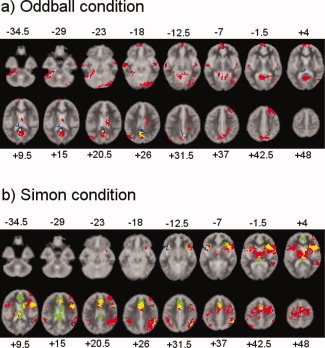
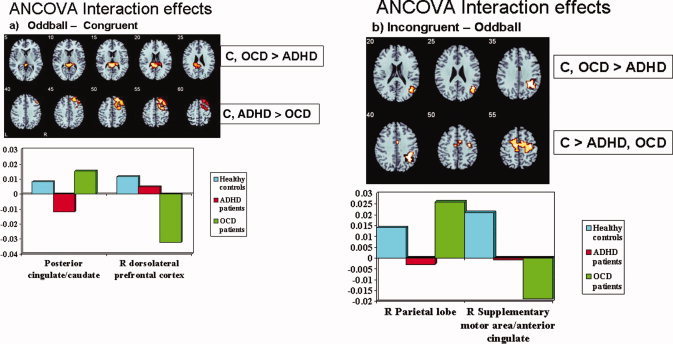
Results: During interference inhibition, both patient groups shared mesial frontal dysfunction compared to controls. Disorder-specific dysfunctions were observed in OCD patients in dorsolateral prefrontal cortex during the oddball condition and in ADHD patients in inferior parietal lobe during interference inhibition and in caudate and posterior cingulate during the simpler oddball condition. The decreased activation in caudate and cingulate in ADHD was furthermore negatively correlated with ADHD symptoms and positively with OCD behavioral traits.
Conclusions: The study shows that ADHD and OCD patients have shared but also disorder-specific brain dysfunctions during interference inhibition and attention allocation. Both disorders shared dysfunction in mesial frontal cortex. Disorder-specific dysfunctions, however, were observed in dorsolateral prefrontal cortex in OCD patients and in caudate, cingulate, and parietal brain regions in ADHD patients. The disorder-specific dissociation of striato-cingulate activation that was increased in OCD compared to ADHD patients, was furthermore inversely related to the symptomatology of the two disorders, and may potentially reflect differential dopamine modulation of striatal brain regions.
Copyright © 2010 Wiley-Liss, Inc.
Figures
References
-
- Achenbach T, Edelbrook CS ( 1983): Manual for the Child Behavior Checklist and Revised Child Behavior Profile. Vermont: University of Vermont.
-
- American Psychiatric Association ( 1994): Diagnostic and Statistical Manual of Mental Disorders. Washington: American Psychiatric Association.
-
- Barry RJ, Clarke AR, Johnstone SJ ( 2003): A review of electrophysiology in attention‐deficit/hyperactivity disorder: I. Qualitative and quantitative electroencephalography. Clinical Neurophysiology 114: 171–183. - PubMed
-
- Birleson P ( 1981): The validity of depressive disorder in childhood and the development of a self‐rating scale—A research report. J Child Psychol Psychiatry Allied Disciplines 22: 73–88. - PubMed
-
- Booth JR, Burman DD, Meyer JR, Lei Z, Trommer BL, Davenport ND, Li W, Parrish TB, Gitelman DR, Mesulam MM ( 2005): Larger deficits in brain networks for response inhibition than for visual selective attention in attention deficit hyperactivity disorder (ADHD). J Child Psychol Psychiatry 46: 94–111. - PubMed
Publication types
MeSH terms
Grants and funding
LinkOut - more resources
Full Text Sources
Medical
