Review
. 2011 Apr;132(4):453-65.
doi: 10.1111/j.1365-2567.2011.03410.x.

Control of epithelial cell function by interleukin-22-producing RORγt+ innate lymphoid cells

Affiliations
Review

Control of epithelial cell function by interleukin-22-producing RORγt+ innate lymphoid cells

Stephanie L Sanos et al. Immunology. 2011 Apr.

Abstract

It is rapidly emerging that the defence system of innate lymphocytes is more diverse than previously recognized. In addition to natural killer (NK) cells, lymphoid tissue inducer (LTi) cells, and natural helper cells have now been identified. LTi cells are developmentally dependent on the orphan transcription factor RORγt and instruct lymph node development during embryogenesis. More recently, it has become evident, that in addition to their role for lymph organ development, LTi cells are also potent producers of cytokines such as interleukin-22 (IL-22) and IL-17 in adult mice. In addition to LTi cells, another RORγt-dependent innate lymphocyte subset co-expressing RORγt and NK cell receptors (NKRs) has been identified. These NKR(+) RORγt(+) cells are also potent producers of IL-22 but it is unclear whether they are part of the NK cell or LTi cell lineage. This review will highlight recent progress in understanding development and function of innate IL-22-producing lymphocyte subsets.


Figures

Figure 1
Figure 1
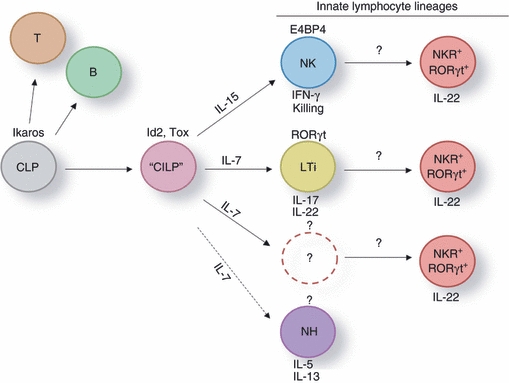
Models for the differentiation of interleukin-22 (IL-22)-producing natural killer cell receptor-positive (NKR+) retinoic acid orphan receptor (ROR) γt+ innate lymphoid cells (ILCs). All lymphocyte lineages develop from a committed common lymphoid progenitor (CLP)., All of the recognized innate lymphocyte lineages [natural killer (NK) cells, lymphoid tissue inducer (LTi) cells, natural helper (NH) cells] are developmentally dependent on the transcription factor Id2.,, These data suggest that the innate lymphocyte lineages may share an Id2-dependent common innate lymphoid progenitor (CILP). Further commitment to the distinct innate lymphocyte lineages requires regulated expression of lineage-specific transcription factors (E4BP4 for the NK cell lineage, RORγt for the LTi cell lineage).–,, A specific transcription factor determining the cell fate of NH cells is currently unknown, making it unclear whether NH cells represent a progenitor cell subset or a distinct innate lymphocyte lineage. Specific cytokines are required to further regulate differentiation and survival of the innate lymphocyte subsets. Interleukin-15 is required for NK cell lineage differentiation whereas IL-7 is required for LTi cells and NH cells.,,,,– Three models for the development of NKR+ RORγt+ ILCs have been proposed. NKR+ RORγt+ ILCs are either NK cells up-regulating RORγt or LTi-like cells that up-regulate NK cell receptors. NKR+ RORγt+ cells may also represent a distinct innate lymphocyte lineage derived from a progenitor distinct from the NK or LTi cell lineage.
Figure 2
Figure 2
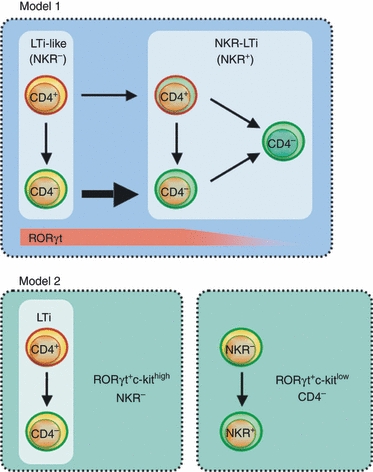
Lineage relationships between lymphoid tissue inducer (LTi) cells and natural killer cell receptor-positive (NKR+) retinoic acid orphan receptor (ROR) γt+ innate lymphoid cells (ILCs). Two different models for the development of NKR+ RORγt+ ILCs have been proposed., Model 1: LTi-like cells constitute an innate lymphocyte lineage defined by the expression of the orphan transcription factor RORγt. Genetic fate mapping for CD4 expression revealed that most NKR LTi-like cells are derived from a CD4+ progenitor. Both CD4+ and CD4 LTi-like cells up-regulate NKRs differentiating into CD4+ or CD4 RORγt+ NKR-LTi cells. Dependent on the organ microenvironment NKR-LTi cells lose RORγt expression differentiating into RORγt NKR-LTi cells that are functionally distinct from RORγt+ NKR-LTi cells. Model 2: The population of NKR RORγt+ ILCs contains two distinct innate lymphocyte lineages that can be discriminated by their levels of c-kit expression. The LTi cell lineage (CD4+ or CD4) is characterized by a c-kithigh phenotype whereas the CD4, committed precursor to CD4 NKR+ RORγt+ ILCs is c-kitlow.
Figure 3
Figure 3
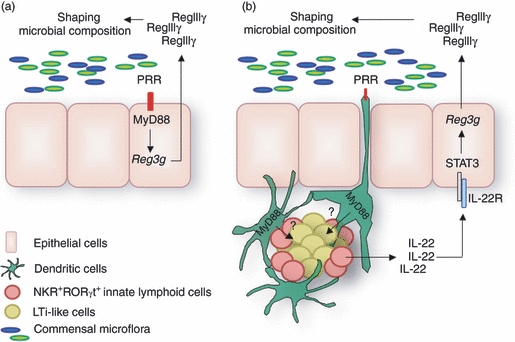
Models for interleukin-22 (IL-22) -instructed epithelial homeostasis. Lymphoid tissue inducer (LTi) -like cells and natural killer cell receptor (NKR) -LTi cells are resident within cryptopatches of the small intestine and constitutively produce IL-22 if commensal bacteria are present., The IL-22 receptor (IL-22R) is exclusively expressed by epithelial cells and IL-22 regulates the expression of Reg3 genes in intestinal epithelial cells.,, RegIII proteins have antimicrobial function and may be important regulators of the composition of the colonizing intestinal microbiota.,,, Two non-exclusive models for the regulation of Reg3 gene expression have been proposed. The ‘epithelial cell-autonomous model’ of Reg3 gene expression (a) predicts that epithelial cells themselves ‘sense’ the presence of bacteria in a MyD88-dependent manner resulting in the up-regulation of Reg3 gene expression. The ‘IL-22 model’ of Reg3 gene expression (b) emphasizes the role of IL-22-producing innate lymphocytes in instructing Reg3 expression by epithelial cells. In this model, the microflora regulates through an unknown pathway the functionality of LTi-like cells and retinoic acid orphan receptor (ROR) γt+ NKR-LTi cells. PRR, pattern-recognition receptors.

References

    1. Macpherson AJ, Harris NL. Interactions between commensal intestinal bacteria and the immune system. Nat Rev Immunol. 2004;4:478–85. - PubMed
    1. Artis D. Epithelial-cell recognition of commensal bacteria and maintenance of immune homeostasis in the gut. Nat Rev Immunol. 2008;8:411–20. - PubMed
    1. Niess JH, Brand S, Gu X, et al. CX3CR1-mediated dendritic cell access to the intestinal lumen and bacterial clearance. Science. 2005;307:254–8. - PubMed
    1. Rescigno M, Urbano M, Valzasina B, et al. Dendritic cells express tight junction proteins and penetrate gut epithelial monolayers to sample bacteria. Nat Immunol. 2001;2:361–7. - PubMed
    1. Littman DR, Rudensky AY. Th17 and regulatory T cells in mediating and restraining inflammation. Cell. 2010;140:845–58. - PubMed

Publication types

MeSH terms

Substances

LinkOut - more resources