A comprehensive non-clinical evaluation of the CNS penetration potential of antimuscarinic agents for the treatment of overactive bladder
- PMID: 21392072
- PMCID: PMC3162653
- DOI: 10.1111/j.1365-2125.2011.03961.x
A comprehensive non-clinical evaluation of the CNS penetration potential of antimuscarinic agents for the treatment of overactive bladder
Abstract
What is already known about this subject: This study provides antimuscarinic agents for overactive bladder (OAB) display variable association with side effects mediated by the central nervous system (CNS), which may be of particular concern in the elderly. Adverse effects on CNS functioning are related to muscarinic receptor subtype selectivity and the ability of the agent to cross the blood-brain barrier, where P-gp plays a role in limiting permeability.
What this study adds: This study provides a parallel investigation of CNS penetration of antimuscarinic OAB agents in vivo and assessment of physical properties and permeability in cell monolayers in vitro. It adds further understanding of the roles of passive transcellular permeability and P-gp in determining CNS penetration of antimuscarinic OAB agents. It also enables a comparison of CNS side-effect profiles of OAB agents with preclinical CNS penetration data.
Aims: To assess and compare the mechanisms of central nervous system (CNS) penetration of antimuscarinic overactive bladder (OAB) agents.
Methods: Physical properties were computed or compiled from the literature. Rats were administered 5-hydroxymethyl tolterodine (HMT), darifenacin, oxybutynin, solifenacin, tolterodine or trospium subcutaneously. At 1 h postdose, plasma, brain and cerebrospinal fluid (CSF) concentrations were determined using LC-MS/MS assays. Brain and plasma protein binding were determined in vitro. Permeability in the presence and absence of the efflux transporter P-glycoprotein (P-gp) was assessed in RRCK and MDCK-MDR1 transwell assays.
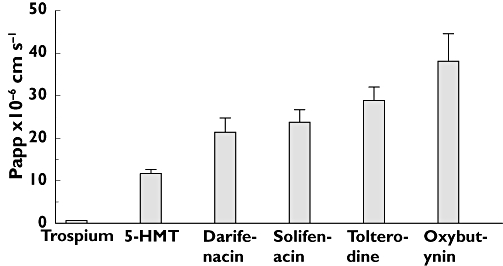
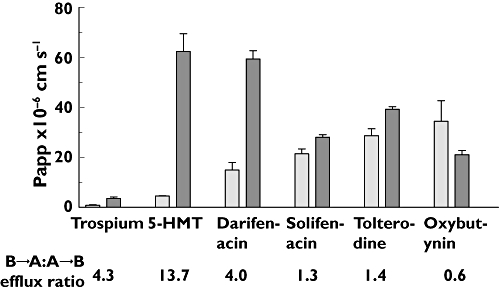
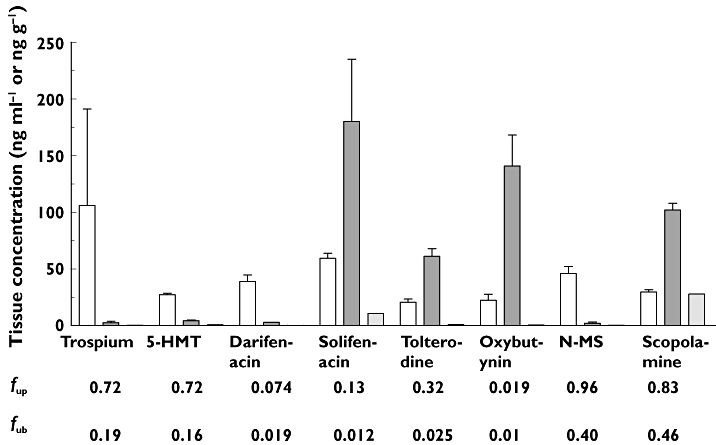
Results: Oxybutynin displayed extensive CNS penetration, with brain:plasma ratios (B:P), unbound brain:unbound plasma ratios (Kp,free) and CSF:free plasma ratios each >1. Tolterodine (B:P = 2.95, Kp,free = 0.23 and CSF:free plasma = 0.16) and solifenacin (B:P = 3.04, Kp,free = 0.28 and CSF:free plasma = 1.41) showed significant CNS penetration but with some restriction from CNS as indicated by Kp,free values significantly <1. 5-HMT, darifenacin and trospium displayed much lower B:P (0.03-0.16), Kp,free (0.01-0.04) and CSF:free plasma (0.004-0.06), consistent with poor CNS penetration. Permeability in RRCK cells was low for trospium (0.63 × 10(-6) cm s(-1) ), moderate for 5-HMT (11.7 × 10(-6) cm s(-1) ) and high for darifenacin, solifenacin, tolterodine and oxybutynin (21.5-38.2 × 10(-6) cm s(-1) ). In MDCK-MDR1 cells 5-HMT, darifenacin and trospium, were P-gp substrates, whereas oxybutynin, solifenacin and tolterodine were not P-gp substrates.
Conclusions: Brain penetration was low for antimuscarinics that are P-gp substrates (5-HMT, darifenacin and trospium), and significant for those that are not P-gp substrates (oxybutynin, solifenacin and tolterodine). CNS adverse events reported in randomized controlled clinical trials show general alignment with the preclinical data described in this study.
© 2011 Pfizer Inc.. British Journal of Clinical Pharmacology © 2011 The British Pharmacological Society.
Figures
 ); B→A (
 )
)
 ); brain (ng g−1) (
 ); CSF (ng ml−1) (
 )
)References
-
- Haylen BT, de Ridder D, Freeman RM, Swift SE, Berghmans B, Lee J, Monga A, Petri E, Rizk DE, Sand PK, Gabriel N, Schaer GN. An International Urogynecological Association (IUGA)/International Continence Society (ICS) joint report on the terminology for female pelvic floor dysfunction. Neurourol Urodyn. 2010;29:4–20. - PubMed
-
- Temml C, Haidinger G, Schmidbauer J, Schatzl G, Madersbacher S. Urinary incontinence in both sexes: prevalence rates and impact on quality of life and sexual life. Neurourol Urodyn. 2000;19:259–71. - PubMed
-
- Milsom I, Abrams P, Cardozo L, Roberts RG, Thüroff J, Wein AJ. How widespread are the symptoms of an overactive bladder and how are they managed? A population-based prevalence study. BJU Int. 2001;87:760–6. - PubMed
-
- Michel M, Chapple CR. Basic mechanisms of urgency: preclinical and clinical evidence. Eur Urol. 2009;56:298–308. - PubMed
-
- Mostwin JL. Pathophysiology: the varieties of bladder overactivity. Urology. 2002;5(Suppl. 1):22–7. - PubMed
MeSH terms
Substances
LinkOut - more resources
Full Text Sources
Other Literature Sources
Medical
Miscellaneous