


Distribution of causes of maternal mortality among different socio-demographic groups in Ghana; a descriptive study
- PMID: 21392387
- PMCID: PMC3063206
- DOI: 10.1186/1471-2458-11-159
Distribution of causes of maternal mortality among different socio-demographic groups in Ghana; a descriptive study
Abstract
Background: Ghana's maternal mortality ratio remains high despite efforts made to meet Millennium Development Goal 5. A number of studies have been conducted on maternal mortality in Ghana; however, little is known about how the causes of maternal mortality are distributed in different socio-demographic subgroups. Therefore the aim of this study was to assess and analyse the causes of maternal mortality according to socio-demographic factors in Ghana.
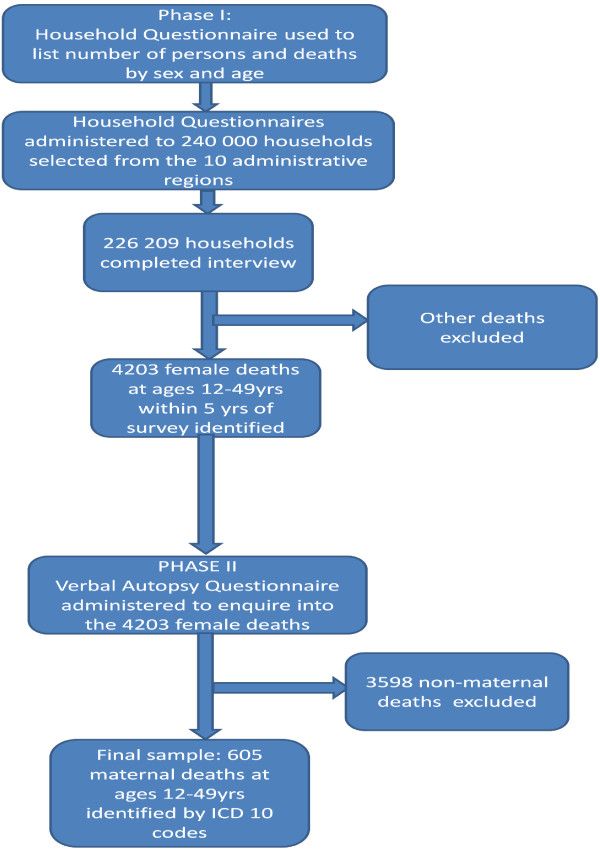
Methods: The causes of maternal deaths were assessed with respect to age, educational level, rural/urban residence status and marital status. Data from a five year retrospective survey was used. The data was obtained from Ghana Maternal Health Survey 2007 acquired from the database of Ghana Statistical Service. A total of 605 maternal deaths within the age group 12-49 years were analysed using frequency tables, cross-tabulations and logistic regression.
Results: Haemorrhage was the highest cause of maternal mortality (22.8%). Married women had a significantly higher risk of dying from haemorrhage, compared with single women (adjusted OR = 2.7, 95%CI = 1.2-5.7). On the contrary, married women showed a significantly reduced risk of dying from abortion compared to single women (adjusted OR = 0.2, 95%CI = 0.1-0.4). Women aged 35-39 years had a significantly higher risk of dying from haemorrhage (aOR 2.6, 95%CI = 1.4-4.9), whereas they were at a lower risk of dying from abortion (aOR 0.3, 95% CI = 0.1-0.7) compared to their younger counterparts. The risk of maternal death from infectious diseases decreased with increasing maternal age, whereas the risk of dying from miscellaneous causes increased with increasing age.
Conclusions: The study shows evidence of variations in the causes of maternal mortality among different socio-demographic subgroups in Ghana that should not be overlooked. It is therefore recommended that interventions aimed at combating the high maternal mortality in Ghana should be both cause-specific as well as target-specific.
Figures
References
-
- UN. General Assembly. Geneva: Human Rights Council; 2009. Preventable Maternal Mortality and Morbidity and Human Rights.
-
- WHO; UNICEF; UNFPA; The World Bank. Trends in maternal mortality 1990-2008: estimates developed by WHO, UNICEF, UNFPA and The World Bank. Geneva: World Health Organization; 2010.
-
- Hogan MC, Foreman KJ, Naghavi M, Ahn SY, Wang M, Makela SM, Lopez AD, Lozano R, Murray CJ. Maternal mortality for 181 countries, 1980--2008: a systematic analysis of progress towards Millennium Development Goal 5. The Lancet. 2010;375(9726):1609–1623. doi: 10.1016/S0140-6736(10)60518-1. - DOI - PubMed
-
- Thonneau PF, Matsudai T, Alihonou E, De Souza J, Faye O, Moreau JC, Djanhan Y, Welffens-Ekra C, Goyaux N. Distribution of causes of maternal mortality during delivery and post-partum: results of an African multicentre hospital-based study. European Journal of Obstetrics Gynecology and Reproductive Biology. 2004;114(2):150–154. doi: 10.1016/j.ejogrb.2003.12.004. - DOI - PubMed
MeSH terms
LinkOut - more resources
Full Text Sources
