. 2011 Mar 11:11:34.
doi: 10.1186/1471-2377-11-34.

Cortical swallowing processing in early subacute stroke

Affiliations

Cortical swallowing processing in early subacute stroke

Inga K Teismann et al. BMC Neurol. .

Abstract

Background: Dysphagia is a major complication in hemispheric as well as brainstem stroke patients causing aspiration pneumonia and increased mortality. Little is known about the recovery from dysphagia after stroke. The aim of the present study was to determine the different patterns of cortical swallowing processing in patients with hemispheric and brainstem stroke with and without dysphagia in the early subacute phase.

Methods: We measured brain activity by mean of whole-head MEG in 37 patients with different stroke localisation 8.2+/-4.8 days after stroke to study changes in cortical activation during self-paced swallowing. An age matched group of healthy subjects served as controls. Data were analyzed by means of synthetic aperture magnetometry and group analyses were performed using a permutation test.

Results: Our results demonstrate strong bilateral reduction of cortical swallowing activation in dysphagic patients with hemispheric stroke. In hemispheric stroke without dysphagia, bilateral activation was found. In the small group of patients with brainstem stroke we observed a reduction of cortical activation and a right hemispheric lateralization.

Conclusion: Bulbar central pattern generators coordinate the pharyngeal swallowing phase. The observed right hemispheric lateralization in brainstem stroke can therefore be interpreted as acute cortical compensation of subcortically caused dysphagia. The reduction of activation in brainstem stroke patients and dysphagic patients with cortical stroke could be explained in terms of diaschisis.


Figures
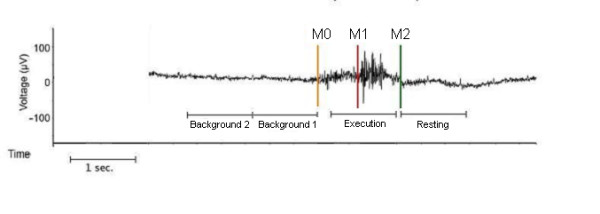
Figure 1
Figure 1
Definition of active and resting stage of swallowing-related muscle activity. The EMG recording of one swallowing act is shown (surface electrodes, recording from the submental muscles). For the analysis with SAM, the beginning (M1) and the end (M2) of larynx elevation were marked. The activation phase and the corresponding resting phase were defined. To estimate the maximal null distribution a third marker (M0) at the beginning of preparation activity was set and two background phases were defined (Methods).
Figure 2
Figure 2
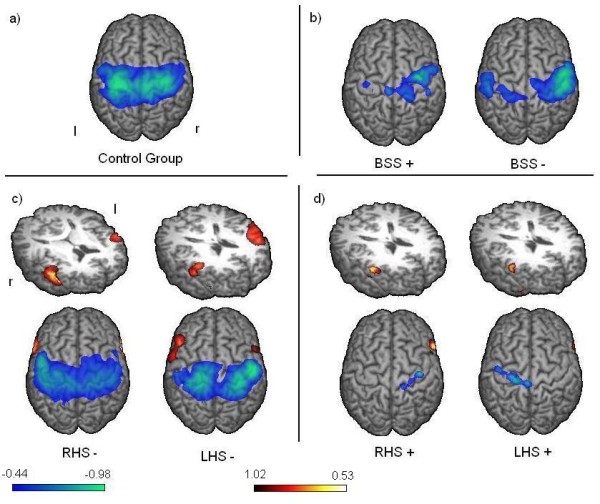
Event related desynchronization. Group results of changes in the beta-frequency-band during swallowing execution compared to the resting stage are shown. The color bar represents the t-value (yellow - red donates beta synchronization, green - blue the desynchronization). Significant activation in group analysis is shown (p < 0.05). a) In control subjects bilateral pericentral activation is seen. b) In both patient groups with brainstem stroke a right hemispheric lateralization of pericentral activation is observed. Stronger activation is seen in the non dysphagic group. c) In non dysphagic patients with hemispheric stroke pericentral activation is lateralized to the unaffected hemisphere. Additionally prefrontal synchronization with lateralization to the affected side is observable. d) In dysphagic hemispheric stroke patients very little pericentral activation of the affected hemisphere is found, while no contralesional activation is present. Prefrontal activation is only significant in the right hemisphere.

References

    1. Aszalos Z, Barsi P, Vitrai J, Nagy Z. Lateralization as a factor in the prognosis of middle cerebral artery territorial infarct. Eur Neurol. 2002;48(3):141–145. doi: 10.1159/000065515. - DOI - PubMed
    1. Horner J, Massey EW, Riski JE, Lathrop DL, Chase KN. Aspiration following stroke: clinical correlates and outcome. Neurology. 1988;38(9):1359–1362. - PubMed
    1. Walker AE, Robins M, Weinfeld FD. The National Survey of Stroke. Clinical findings. Stroke. 1981;12(2 Pt 2 Suppl 1):I13–44. - PubMed
    1. Young EC, Durant-Jones L. Developing a dysphagia program in an acute care hospital: a needs assessment. Dysphagia. 1990;5(3):159–165. doi: 10.1007/BF02412640. - DOI - PubMed
    1. Smithard DG, O'Neill PA, England RE, Park CL, Wyatt R, Martin DF, Morris J. The natural history of dysphagia following a stroke. Dysphagia. 1997;12(4):188–193. doi: 10.1007/PL00009535. - DOI - PubMed

Publication types