. 2011 Mar;17(3):387-94.
doi: 10.3201/eid1703.101290.

Serologic surveillance of anthrax in the Serengeti ecosystem, Tanzania, 1996-2009

Affiliations

Serologic surveillance of anthrax in the Serengeti ecosystem, Tanzania, 1996-2009

Tiziana Lembo et al. Emerg Infect Dis. 2011 Mar.

Abstract

Bacillus anthracis, the bacterium that causes anthrax, is responsible for varying death rates among animal species. Difficulties in case detection, hazardous or inaccessible carcasses, and misdiagnosis hinder surveillance. Using case reports and a new serologic assay that enables multispecies comparisons, we examined exposure to and illness caused by B. anthracis in different species in the Serengeti ecosystem in Tanzania during 1996-2009 and the utility of serosurveillance. High seroprevalence among carnivores suggested regular nonfatal exposure. Seropositive wildebeest and buffalo showed that infection was not invariably fatal among herbivores, whereas absence of seropositivity in zebras and frequent detection of fatal cases indicated high susceptibility. Exposure patterns in dogs reflected known patterns of endemicity and provided new information about anthrax in the ecosystem, which indicated the potential of dogs as indicator species. Serosurveillance is a valuable tool for monitoring and detecting anthrax and may shed light on mechanisms responsible for species-specific variability in exposure, susceptibility, and mortality rates.


Figures
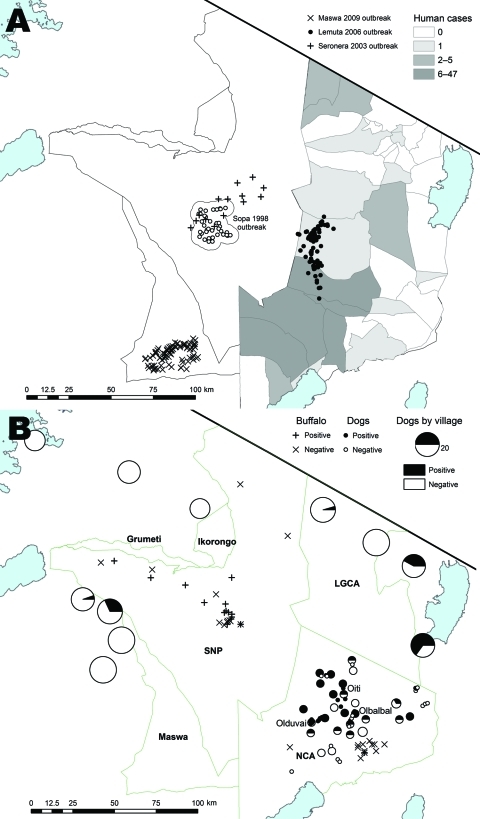
Figure 1
Figure 1
Anthrax cases and exposure to anthrax in the study area, Tanzania. Blue areas indicate lakes. A) Location of wildlife carcasses during anthrax outbreaks. Shaded areas indicate regions where human anthrax cases were reported during 1995–2008. Exact locations of carcasses obtained during the Sopa 1998 outbreak were not available; open circles indicate area where 549 probable cases and 67 suspected cases were detected. For the Seronera 2003 outbreak, locations of cases were randomized within a 10-km radius of the outbreak area because exact locations of carcasses were not available. B) Seroprevalence in domestic dog populations from sampled villages. Sample size is indicated by the radii of the pie charts. Green border indicates Serengeti ecosystem. LGCA, Loliondo Game Control Area; SNP, Serengeti National Park; NCA, Ngorongoro Conservation Area.
Figure 2
Figure 2
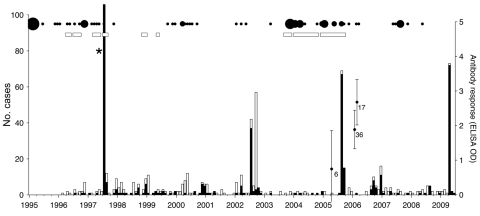
Anthrax case detection in wildlife, livestock, and human populations in the Serengeti ecosystem, Tanzania, 1996–2009. Probable (black bars) and suspected (white bars) wildlife cases (as defined in the Materials and Methods) are shown. Black circles indicate hospital records of anthrax scaled according to the number of cases, and rectangles indicate when cases in livestock were reported (quality of the data for livestock cases was too poor to quantify). Domestic dogs were sampled in villages near wildlife cases detected in 2006. Error bars indicate mean antibody responses and 95% confidence intervals at the time of sampling; sample sizes are indicated. *During the 1998 outbreak, 549 probable cases and 67 additional suspected cases were detected. OD, optical density.
Figure 3
Figure 3
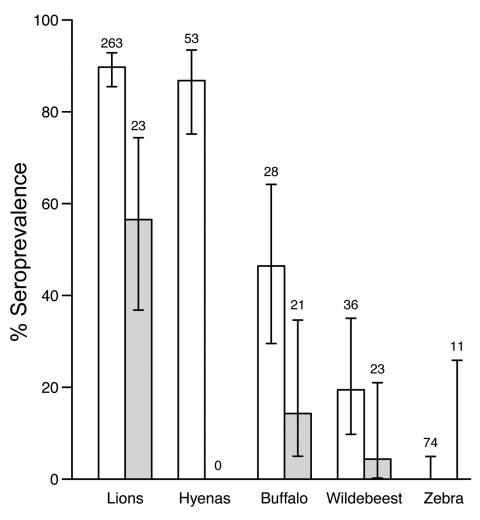
Seroprevalence of anthrax in sampled wildlife populations from Serengeti National Park (white bars) and Ngorongoro Crater (gray bars), Tanzania, 1996–2009. Error bars indicate 95% confidence intervals. Sample sizes used to calculate seroprevalence are indicated above the bars. Hyenas were not sampled in Ngorongoro Crater. Seropositive zebras were not detected; error bars indicate 95% confidence intervals based on a binomial distribution of the sample size and the seropositivity range that can be expected.
Figure 4
Figure 4
Anthrax seroprevalence patterns in carnivores, by age, Tanzania, 1996–2009. Lions (A) in Serengeti and domestic dogs (B) in agropastoralist regions where no outbreaks were detected (black line), in pastoralist regions where repeated outbreaks were detected (red line), and in an agropastoralist village where no outbreaks were reported but serologic surveys indicated previous exposure (blue line). Error bars indicate 95% confidence intervals for age seroprevalence in lions and dogs, but are juxtaposed for dogs to improve readability. Sample sizes used to calculate seroprevalences are indicated.

References

    1. Halliday JE, Meredith AL, Knobel DL, Shaw DJ, Bronsvoort BM, Cleaveland S. A framework for evaluating animals as sentinels for infectious disease surveillance. J R Soc Interface. 2007;4:973–84. 10.1098/rsif.2007.0237 - DOI - PMC - PubMed
    1. McCluskey BJ, Salman MD, Martinez GE, Serrano AO, Shaw JL, Herrerro MV. A 3-year pilot study of sentinel dairy herds for vesicular stomatitis in El Salvador. Prev Vet Med. 2003;58:199–210. 10.1016/S0167-5877(03)00054-0 - DOI - PubMed
    1. Eidson M, Schmit K, Hagiwara Y, Anand M, Backenson PB, Gotham I, et al. Dead crow density and West Nile virus monitoring, New York. Emerg Infect Dis. 2005;11:1370–5. - PMC - PubMed
    1. Clegg SB, Turnbull PC, Foggin CM, Lindeque PM. Massive outbreak of anthrax in wildlife in the Malilangwe Wildlife Reserve, Zimbabwe. Vet Rec. 2007;160:113–8. 10.1136/vr.160.4.113 - DOI - PubMed
    1. Prins HH, Weyerhaeuser FJ. Epidemics in populations of wild ruminants: anthrax and impala, rinderpest and buffalo in Lake Manyara National Park, Tanzania. Oikos. 1987;49:28–38. 10.2307/3565551 - DOI

Publication types

LinkOut - more resources