


Aging in the natural world: comparative data reveal similar mortality patterns across primates
- PMID: 21393544
- PMCID: PMC3396421
- DOI: 10.1126/science.1201571
Aging in the natural world: comparative data reveal similar mortality patterns across primates
Abstract
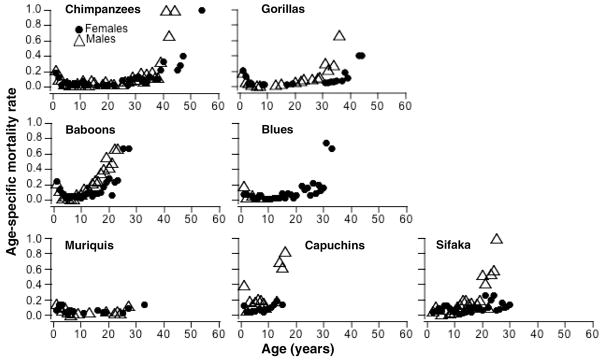
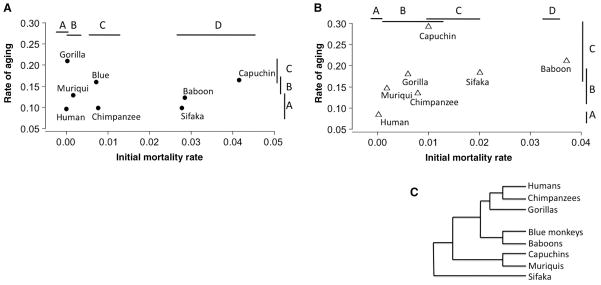
Human senescence patterns-late onset of mortality increase, slow mortality acceleration, and exceptional longevity-are often described as unique in the animal world. Using an individual-based data set from longitudinal studies of wild populations of seven primate species, we show that contrary to assumptions of human uniqueness, human senescence falls within the primate continuum of aging; the tendency for males to have shorter life spans and higher age-specific mortality than females throughout much of adulthood is a common feature in many, but not all, primates; and the aging profiles of primate species do not reflect phylogenetic position. These findings suggest that mortality patterns in primates are shaped by local selective forces rather than phylogenetic history.
Figures
References
-
- Finch CE, Pike MC, Witten M. Science. 1990;249:902. - PubMed
-
- Finch C. Longevity, Senescence and the Genome. Univ. of Chicago Press; Chicago: 1990.
-
- Sacher GA. In: Handbook of the Biology of Aging. Finch CE, Hayflick L, editors. Van Nostrand Reinhold; New York: 1977. pp. 582–638.
-
- Sanderson WC, Scherbov S. Science. 2010;329:1287. - PubMed
Publication types
MeSH terms
Grants and funding
LinkOut - more resources
Full Text Sources
Other Literature Sources
Medical
