. 2011 Mar;121(3):1191-8.
doi: 10.1172/JCI45294.

A mutation in the leptin receptor is associated with Entamoeba histolytica infection in children

Affiliations

A mutation in the leptin receptor is associated with Entamoeba histolytica infection in children

Priya Duggal et al. J Clin Invest. 2011 Mar.

Abstract

Malnutrition substantially increases susceptibility to Entamoeba histolytica in children. Leptin is a hormone produced by adipocytes that inhibits food intake, influences the immune system, and is suppressed in malnourished children. Therefore we hypothesized that diminished leptin function may increase susceptibility to E. histolytica infection. We prospectively observed a cohort of children, beginning at preschool age, for infection by the parasite E. histolytica every other day over 9 years and evaluated them for genetic variants in leptin (LEP) and the leptin receptor (LEPR). We found increased susceptibility to intestinal infection by this parasite associated with an amino acid substitution in the cytokine receptor homology domain 1 of LEPR. Children carrying the allele for arginine (223R) were nearly 4 times more likely to have an infection compared with those homozygous for the ancestral glutamine allele (223Q). An association of this allele with amebic liver abscess was also determined in an independent cohort of adult patients. In addition, mice carrying at least 1 copy of the R allele of Lepr were more susceptible to infection and exhibited greater levels of mucosal destruction and intestinal epithelial apoptosis after amebic infection. These findings suggest that leptin signaling is important in mucosal defense against amebiasis and that polymorphisms in the leptin receptor explain differences in susceptibility of children in the Bangladesh cohort to amebiasis.


Figures
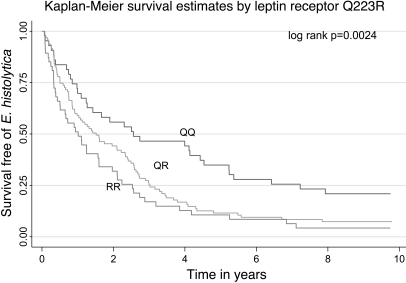
Figure 1
Figure 1. Kaplan-Meier analysis of time to E. histolytica infection for the RR, QR, and QQ variants.
Figure 2
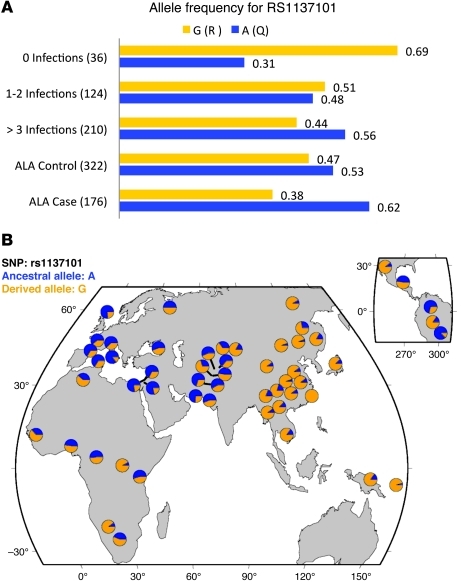
Figure 2. The allele frequencies for the rs1137101 allele.
The frequencies are presented for the Q and R alleles. The A nucleotide translates to the amino acid glutamine (Q); the G nucleotide translates to the amino acid arginine (R). International HapMap samples frequencies were 0.53 (Q) for the CEU population and 0.52 (Q) for the GHI. (A) The child cohort is represented by 0, 1–2, or more than 3 infections among all genotyped children in the cohort. The overall allele frequency for the child cohort is 0.52 and 0.49 (Q). Adult ALA patients are subdivided into cases and controls. Parentheses denote the number of alleles for each category. The allele frequencies of the HapMap populations reflect the population-based allele frequencies and are similar to children with 1–2 infections (38). Differences in the allele frequencies are most noted for those with 0 infections, or with more than 3 infections, and the ALA cases. (B) Geographic distribution of the rs1137101 alleles as generated by the Human Genome Diversity Project selection browser ( hgdp.uchicago.edu).
Figure 3
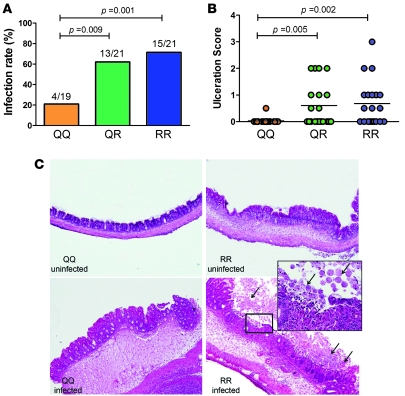
Figure 3. The 223R allele of the leptin receptor increases susceptibility to intestinal amebic infection and mucosal destruction in the murine model of intestinal amebiasis.
(A) Mice carrying 1 or 2 copies of the arginine allele at the 223 codon (QR or RR) were more susceptible to intestinal infection with E. histolytica than those homozygous for the glutamine (QQ) allele, as assessed by culture and parasite antigen detection (QQ versus QR P = 0.009, QQ versus RR; P = 0.001 by c2 test). (B) RR and QR mice exhibited more severe epithelial ulceration than the QQ mice by histological examination (QQ versus QR, P = 0.005; QQ versus RR, P = 0.002 by Mann-Whitney test; n = 19, 21, and 21 for QQ, QR and RR mice, respectively). (C) Representative cecal pathology of E. histolytica–challenged but uninfected at day 3 animals showed nearly normal-looking morphology or a mild submucosal edema (top left and right). While infected QQ mice mainly exhibited submucosal edema and epithelial hyperplasia (bottom left), the infected RR cecum displayed marked mucosal destruction/ulceration and inflammation. E. histolytica trophozoites are indicated by arrows (bottom right and insert). Original magnification, ×40; ×200 (inset).
Figure 4
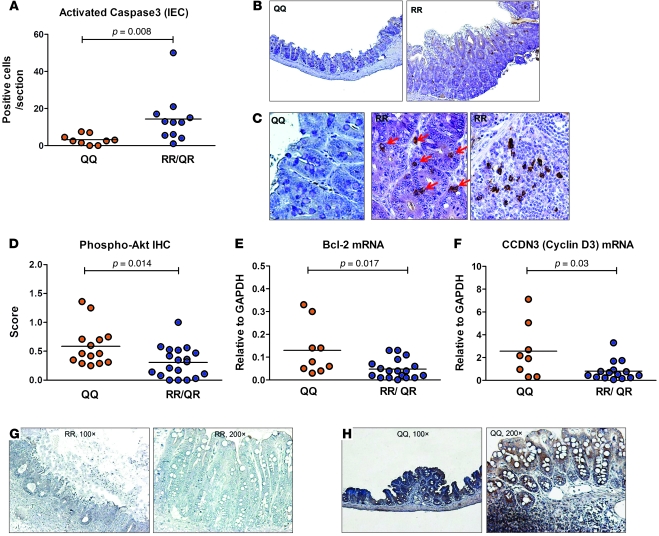
Figure 4. Increased caspase-3 activity and decreased expression of phosphorylated Akt and antiapoptotic genes in the ceca of RR and QR mice.
(A) Mice carrying 1 or 2 copies of the arginine allele (QR or RR, n = 9) had increased caspase-3 activity in IECs compared with the QQ mice (n = 11) by day 3 after infection. (B) Representative sections of the cecum showed increased levels of active caspase-3 in infected RR mice. Original magnification, ×100. (C) Higher magnification demonstrated undetectable active caspase-3 staining in QQ IECs (left), but cytoplasmic and perinuclear staining in RR IECs (middle, arrows) and infiltrating cells (right). Original magnification, ×400. (D) Compared with the RR or Q/R animals, QQ mice had significantly greater levels of Akt phosphorylation (n = 14 and 19 for QQ and RR/QR mice respectively) and (E and F) antiapoptotic gene expression including Bcl-2 (E, P = 0.017) and cyclin D3 (F, P = 0.03) in the cecum (n = 9 and 18 for QQ and RR/QR mice respectively). (G) Representative IHC staining for phospho-Akt showed minimal expression in the cecum of the 223R mouse. (H) Intense phospho-Akt expression was present throughout the crypts and villi, and also in the mononuclear cells in the QQ cecum (left and right).

References

    1. Black RE, et al. Maternal and child undernutrition: global and regional exposures and health consequences. Lancet. 2008;371(9608):243–260. doi: 10.1016/S0140-6736(07)61690-0. - DOI - PubMed
    1. Caulfield LE, Richard SA, Black RE. Undernutrition as an underlying cause of malaria morbidity and mortality in children less than five years old. Am J Trop Med Hyg. 2004;71(2 suppl):55–63. - PubMed
    1. Tilg H, Moschen AR. Adipocytokines: mediators linking adipose tissue, inflammation and immunity. Nat Rev Immunol. 2006;6(10):772–783. doi: 10.1038/nri1937. - DOI - PubMed
    1. Myers MG, Cowley MA, Münzberg H. Mechanisms of leptin action and leptin resistance. Annu Rev Physiol. 2008;70:537–556. doi: 10.1146/annurev.physiol.70.113006.100707. - DOI - PubMed
    1. Palacio A, Lopez M, Perez-Bravo F, Monkeberg F, Schlesinger L. Leptin levels are associated with immune response in malnourished infants. J Clin Endocrinol Metab. 2002;87(7):3040–3046. doi: 10.1210/jc.87.7.3040. - DOI - PubMed

Publication types