


Multi-criteria clinical decision support: A primer on the use of multiple criteria decision making methods to promote evidence-based, patient-centered healthcare
- PMID: 21394218
- PMCID: PMC3049911
- DOI: 10.2165/11539470-000000000-00000
Multi-criteria clinical decision support: A primer on the use of multiple criteria decision making methods to promote evidence-based, patient-centered healthcare
Abstract
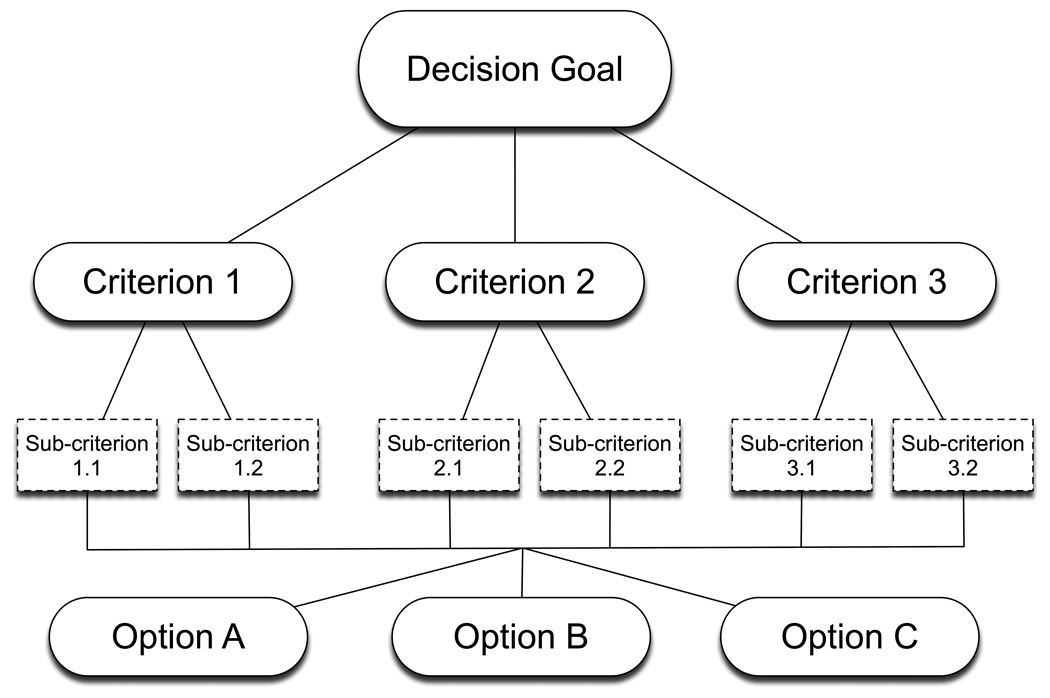
Current models of healthcare quality recommend that patient management decisions be evidence-based and patient-centered. Evidence-based decisions require a thorough understanding of current information regarding the natural history of disease and the anticipated outcomes of different management options. Patient-centered decisions incorporate patient preferences, values, and unique personal circumstances into the decision making process and actively involve both patients along with health care providers as much as possible. Fundamentally, therefore, evidence-based, patient-centered decisions are multi-dimensional and typically involve multiple decision makers.Advances in the decision sciences have led to the development of a number of multiple criteria decision making methods. These multi-criteria methods are designed to help people make better choices when faced with complex decisions involving several dimensions. They are especially helpful when there is a need to combine "hard data" with subjective preferences, to make trade-offs between desired outcomes, and to involve multiple decision makers. Evidence-based, patient-centered clinical decision making has all of these characteristics. This close match suggests that clinical decision support systems based on multi-criteria decision making techniques have the potential to enable patients and providers to carry out the tasks required to implement evidence-based, patient-centered care effectively and efficiently in clinical settings.The goal of this paper is to give readers a general introduction to the range of multi-criteria methods available and show how they could be used to support clinical decision-making. Methods discussed include the balance sheet, the even swap method, ordinal ranking methods, direct weighting methods, multi-attribute decision analysis, and the analytic hierarchy process (AHP).
Figures


References
-
- Committee on quality of health care in America IoM. Crossing the Quality Chasm: A New Health System for the 21st Century. Washington, D.C.: National Academy Press; 2001.
-
- National Healthcare Quality Report. 2008. [2010 August 11]; Available from: http://www.ahrq.gov/qual/nhqr08/Key.htm.
-
- Bodenheimer T, Wagner EH, Grumbach K. Improving Primary Care for Patients With Chronic Illness: The Chronic Care Model, Part 2. JAMA. 2002;288(15):1909–1914. - PubMed
-
- O'Connor AM, Wennberg JE, Legare F, Llewellyn-Thomas HA, Moulton BW, Sepucha KR, et al. Toward The 'Tipping Point': Decision Aids And Informed Patient Choice. Health Aff. 2007;26(3):716–725. - PubMed
Grants and funding
LinkOut - more resources
Full Text Sources
Other Literature Sources