


The implications of propensity score variable selection strategies in pharmacoepidemiology: an empirical illustration
- PMID: 21394812
- PMCID: PMC3123427
- DOI: 10.1002/pds.2098
The implications of propensity score variable selection strategies in pharmacoepidemiology: an empirical illustration
Abstract
Purpose: To examine the effect of variable selection strategies on the performance of propensity score (PS) methods in a study of statin initiation, mortality, and hip fracture assuming a true mortality reduction of < 15% and no effect on hip fracture.
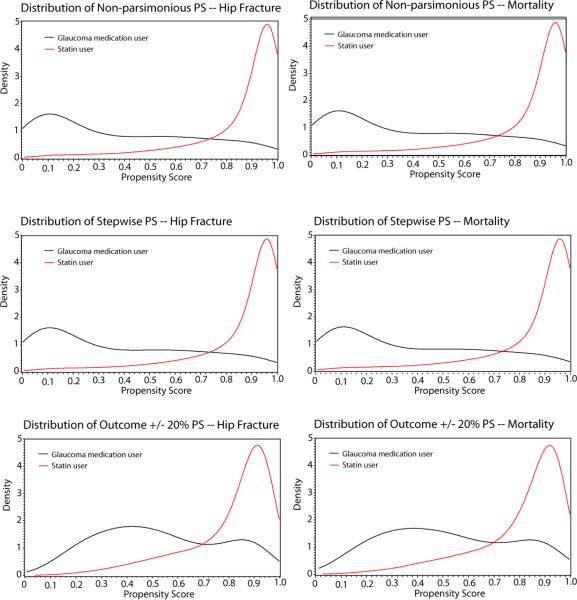
Methods: We compared seniors initiating statins with seniors initiating glaucoma medications. Out of 202 covariates with a prevalence > 5%, PS variable selection strategies included none, a priori, factors predicting exposure, and factors predicting outcome. We estimated hazard ratios (HRs) for statin initiation on mortality and hip fracture from Cox models controlling for various PSs.
Results: During 1 year follow-up, 2693 of 55,610 study subjects died and 496 suffered a hip fracture. The crude HR for statin initiators was 0.64 for mortality and 0.46 for hip fracture. Adjusting for the non-parsimonious PS yielded effect estimates of 0.83 (95%CI:0.75-0.93) and 0.72 (95%CI:0.56-0.93). Including in the PS only covariates associated with a greater than 20% increase or reduction in outcome rates yielded effect estimates of 0.84 (95%CI:0.75-0.94) and 0.76 (95%CI:0.61-0.95), which were closest to the effects predicted from randomized trials.
Conclusion: Due to the difficulty of pre-specifying all potential confounders of an exposure-outcome association, data-driven approaches to PS variable selection may be useful. Selecting covariates strongly associated with exposure but unrelated to outcome should be avoided, because this may increase bias. Selecting variables for PS based on their association with the outcome may help to reduce such bias.
Copyright © 2011 John Wiley & Sons, Ltd.
Figures
References
-
- Rosenbaum P, Rubin D. The central role of the propensity score in observational studies for causal effects. Biometrika. 1983;70:41–55.
-
- Shah BR, Laupacis A, Hux JE, Austin PC. Propensity score methods gave similar results to traditional regression modeling in observational studies: a systematic review. J Clin Epidemiol. 2005;58(6):550–9. - PubMed
-
- Stürmer T, Joshi M, Glynn RJ, Avorn J, Rothman KJ, Schneeweiss S. A review of the application of propensity score methods yielded increasing use, advantages in specific settings, but not substantially different estimates compared with conventional multivariable methods. J Clin Epidemiol. 2006;59:437–47. - PMC - PubMed
-
- D'Agostino RB., Jr. Propensity score methods for bias reduction in the comparison of a treatment to a non-randomized control group. Stat Med. 1998 Oct 15;17(19):2265–81. - PubMed
-
- Stürmer T, Schneeweiss S, Brookhart MA, Rothman KJ, Avorn J, Glynn RJ. Analytic strategies to adjust confounding using exposure propensity scores and disease risk scores: nonsteroidal antiinflammatory drugs and short-term mortality in the elderly. Am J Epidemiol. 2005 May 1;161(9):891–8. - PMC - PubMed
Publication types
MeSH terms
Substances
Grants and funding
LinkOut - more resources
Full Text Sources
Medical
