. 2011 Mar 11:12:27.
doi: 10.1186/1471-2202-12-27.

Interocular induction of illusory size perception

Affiliations

Interocular induction of illusory size perception

Chen Song et al. BMC Neurosci. .

Abstract

Background: The perceived size of objects not only depends on their physical size but also on the surroundings in which they appear. For example, an object surrounded by small items looks larger than a physically identical object surrounded by big items (Ebbinghaus illusion), and a physically identical but distant object looks larger than an object that appears closer in space (Ponzo illusion). Activity in human primary visual cortex (V1) reflects the perceived rather than the physical size of objects, indicating an involvement of V1 in illusory size perception. Here we investigate the role of eye-specific signals in two common size illusions in order to provide further information about the mechanisms underlying illusory size perception.

Results: We devised stimuli so that an object and its spatial context associated with illusory size perception could be presented together to one eye or separately to two eyes. We found that the Ponzo illusion had an equivalent magnitude whether the objects and contexts were presented to the same or different eyes, indicating that it may be largely mediated by binocular neurons. In contrast, the Ebbinghaus illusion became much weaker when objects and their contexts were presented to different eyes, indicating important contributions to the illusion from monocular neurons early in the visual pathway.

Conclusions: Our findings show that two well-known size illusions - the Ponzo illusion and the Ebbinghaus illusion - are mediated by different neuronal populations, and suggest that the underlying neural mechanisms associated with illusory size perception differ and can be dependent on monocular channels in the early visual pathway.


Figures
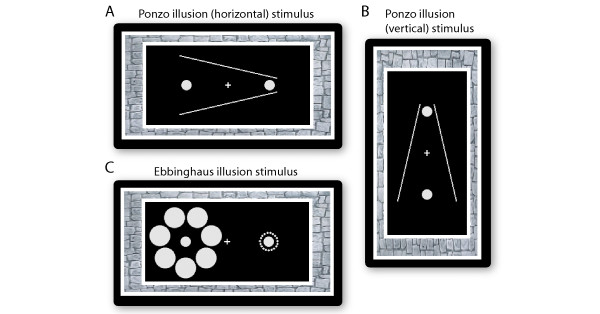
Figure 1
Figure 1
Ponzo illusion stimulus and Ebbinghuas illusion stimulus. In the Ponzo illusion (A, B), the two converging lines provided the depth impression that the two physically identical objects were located at different distances from the observer, and the distant object looks larger than the object that appears closer in space. In the Ebbinghaus illusion (C), the object surrounded by small items looks larger than a physically identical object surrounded by big items.
Figure 2
Figure 2
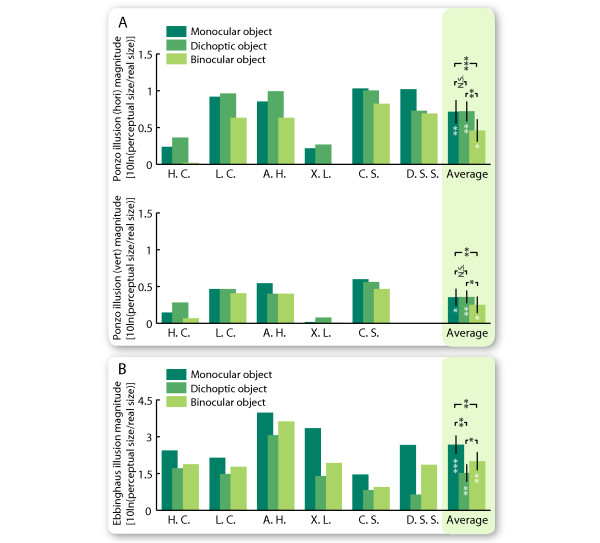
Different interocular transfer patterns in the two illusions. Both the Ponzo and the Ebbinghaus illusion persisted in all three presentation conditions. In the Ponzo illusion (A), the illusion magnitude is the same under monocular and dichoptic presentation, and lowest under binocular presentation. In the Ebbinghaus illusion (B), the illusion magnitude is highest under monocular presentation and lowest under dichoptic presentation. Error bars represent SEM (N = 6 or 5). * p < 0.05, ** p < 0.01, *** p < 0.001.
Figure 3
Figure 3
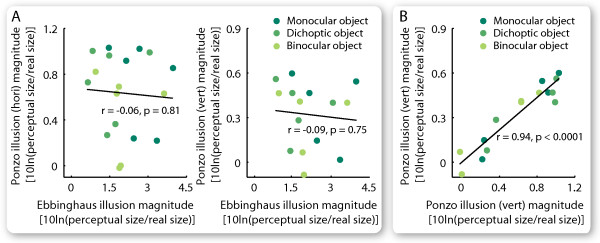
Correlation in the illusion magnitude. Each point represents the magnitudes of two illusions for one participant in one of the three conditions (monocular, dichoptic, binocular). Comparing the Ponzo illusion and the Ebbinghaus illusion (A), the illusion magnitudes were not correlated in strength for each separate condition (N = 6 or 5) or for all three conditions considered together (N = 18 or 15). Comparing the Ponzo illusion in the horizontal and the vertical design (B), the illusion magnitudes were correlated in strength for each separate condition (N = 5) and for all three conditions considered together (N = 15).
Figure 4
Figure 4
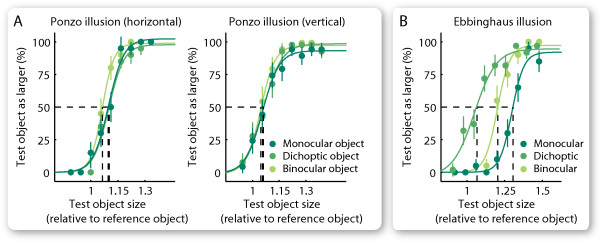
Measurement of the illusion magnitude. The size of one object (the reference object) was kept constant and the size of the other object (the test object) was varied. The percentage of the test object being judged as larger was plotted against the relative size of the test object (illustrative data from the Ponzo illusion in (A) and the Ebbinghaus illusion in (B)). The data were fitted with a logistic function, and the illusion magnitude was quantified according to the threshold point at which the test object was judged as larger for half of the trials (dashed lines). Error bars represent SEM (N = 20).

References

    1. Fisher GH. Detection of visual stimuli located within angles. Nature. 1967;215:553–554. doi: 10.1038/215553a0. - DOI - PubMed
    1. Massaro DW, Anderson NH. Judgmental model of the Ebbinghaus illusion. Journal of Experimental Psychology. 1971;89:147–151. doi: 10.1037/h0031158. - DOI - PubMed
    1. Franz VH, Scharnowski F, Gegenfurtner KR. Illusion Effects on Grasping Are Temporally Constant Not Dynamic. Journal of Experimental Psychology: Human Perception and Performance. 2005;31:1359–1378. doi: 10.1037/0096-1523.31.6.1359. - DOI - PubMed
    1. Murray SO, Boyaci H, Kersten D. The representation of perceived angular size in human primary visual cortex. Nature Neuroscience. 2006;9:429–434. doi: 10.1038/nn1641. - DOI - PubMed
    1. Fang F, Boyaci H, Kersten D, Murray SO. Attention-Dependent Representation of a Size Illusion in Human V1. Current Biology. 2008;18:1707–1712. doi: 10.1016/j.cub.2008.09.025. - DOI - PMC - PubMed

Publication types

LinkOut - more resources